
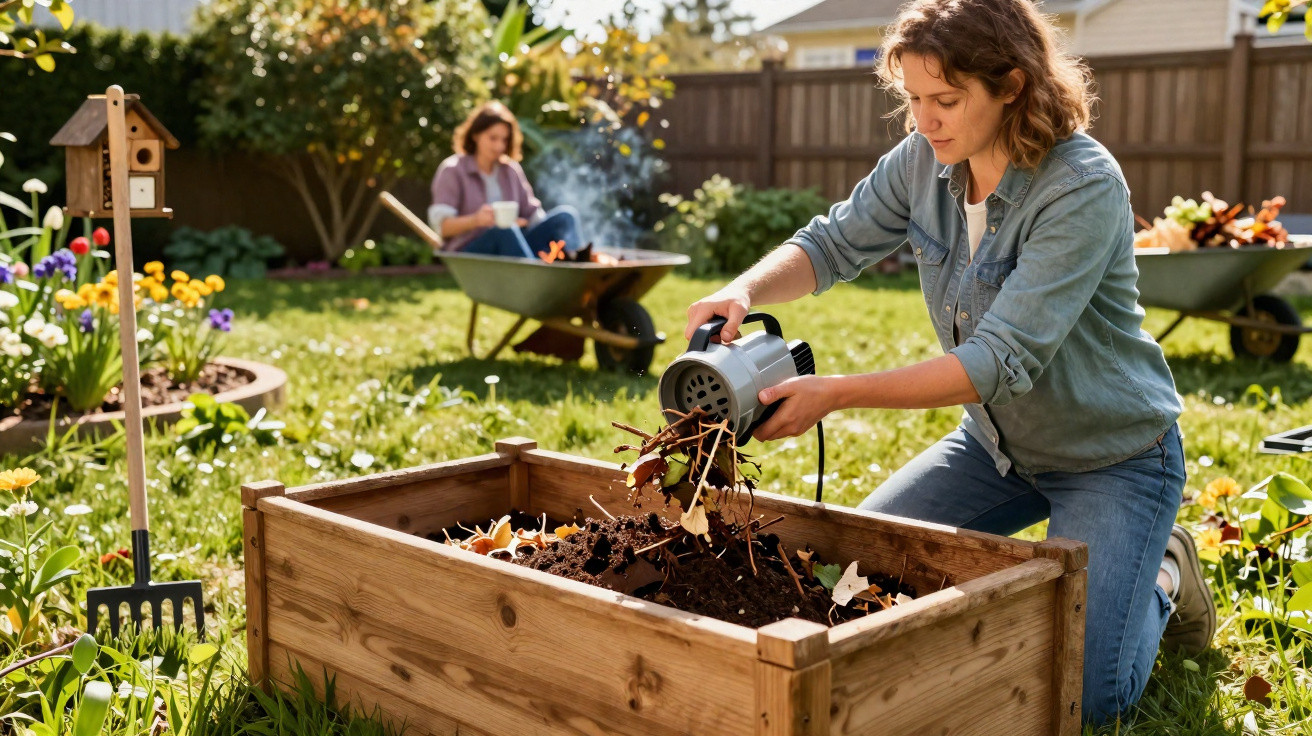
For years, smouldering piles of leaves and branches have been a familiar spring ritual in many private gardens. However, this tradition is undergoing a major change. More and more German states and local authorities are restricting the controlled burning of prunings and leaf litter – in some cases gradually, in others through a complete ban from a specified date. Anyone who simply lights a fire regardless now risks fines, upset neighbours and considerable trouble.
Cut-off date of 31 March: why garden fires are ending in many places
The legal position is more straightforward than many people realise: under the Circular Economy Act, burning garden waste is generally prohibited throughout Germany. The fact that smoke can still be seen in many areas does not mean it is permitted; rather, the states, districts and councils operate time-limited exemptions.
In numerous municipalities, the exemption ends as early as 31 March – after that, a de facto ban on garden fires applies.
Typical permissions cover a period from autumn to early spring, during which leaves, brushwood and other plant material may be burned subject to strict conditions. This allowance often runs until 31 March, although it continues until around mid-April in some areas. Once it ends, burning must stop until the following autumn – or permanently, depending on the local by-law.
These cut-off dates are intended to protect the environment and public health:
- As warmer weather begins, people spend more time outdoors, meaning smoke becomes a nuisance more quickly.
- Every individual fire considerably increases levels of particulate matter and pollutants.
- Animals living in the soil and dead plant matter start to become active, and fire destroys their habitat.
Anyone who disregards local rules risks more than a fine: they may also trigger complaints from neighbours. Many public order offices now take a far firmer approach than they did a few years ago.
Mecklenburg-Vorpommern: a complete ban from 2029
Mecklenburg-Vorpommern illustrates the direction of travel. Environment Minister Till Backhaus has announced that the burning of garden waste will be prohibited entirely from 1 January 2029. From that point, private garden fires involving leaves, branches and green waste will no longer be allowed in any form.
This change follows an alignment with federal waste legislation and a desire to provide better protection for air quality and the climate. Material once viewed as harmless “organic material” is now treated by modern waste law as a valuable resource. Green waste can be turned into high-quality compost and even energy – in a bin or at a composting facility rather than in a fire.
Garden waste is no longer considered rubbish, but a raw material – it should return to the cycle, not go up in smoke.
Other German states are also progressively tightening their rules. In some places, older exemptions are being removed altogether; elsewhere, limits on quantities, permitted periods and distances make holding a garden fire scarcely worthwhile.
Why garden fires are more problematic than many people think
The idea of a “natural” fire in the garden remains deeply rooted. After all, only leaves, twigs and plant cuttings appear to be burned. Yet the damage is not immediately visible: it comes in the form of fine particles and gases that enter both lungs and the atmosphere.
Impact on air quality and health
Burning damp leaves and green waste produces substantial amounts of particulate matter and smoke. People who are particularly vulnerable – including children, people with asthma and older people – may experience irritated airways, coughing and headaches. In closely built-up residential areas, one garden fire can blanket an entire street in smoke.
There is another issue: many piles contain more than supposedly “clean” garden waste. Painted wood, treated materials and plastic remnants repeatedly end up on the fire. This releases additional pollutants that are significantly more toxic than smoke from a campfire fuelled by dry, untreated wood.
The loss of valuable nutrients
Anything put on the fire is lost to the soil. Leaves, grass cuttings and small branches contain nutrients that composting can convert back into fertile soil. Burning leaves only ash behind – and, in normal domestic garden quantities, this is of little use as fertiliser.
This is precisely where the modern circular economy comes in: organic materials should be returned as fully as possible to the nutrient cycle. Burning everything prevents that process.
What garden owners should do now
Even if it has “always been done that way” for years, relying on old habits has become risky. Every municipality can set its own detailed rules. A quick check before lighting the first pile is therefore essential.
Checking the legal position without unpleasant surprises
- Check the town or municipal website, using search terms such as “garden waste”, “burning” or “low-emission disposal”.
- If in doubt, contact the public order office or environmental department directly.
- Pay attention to permitted dates: many by-laws specifically state 31 March or a similar cut-off date.
- Observe requirements relating to times of day, distances from neighbouring properties and permitted quantities.
Ignoring these points can lead to fines in the hundreds or even thousands, depending on the area. In extreme cases, the fire brigade or police may also attend if neighbours report a fire.
Legal alternatives: making good use of garden waste
Rather than burning the remains, there are several practical and trouble-free ways to dispose of them responsibly. In many cases, these options are even more convenient and cheaper over time because they reduce the need for fertiliser.
| Option | Benefit | Particularly suitable for |
|---|---|---|
| Home composting | Produces free fertiliser for the garden | Leaves, grass cuttings, small twigs, kitchen waste |
| Food and garden waste bin | Convenient disposal provided by the local authority | Household-scale quantities, soft material |
| Recycling centre / green-waste collection point | Accepts large volumes and coarse material | Thick branches, large amounts of leaves, prunings |
| Municipal composting facility | Finished compost can often be bought back | Mixed garden waste from larger gardens |
Composting – more than a heap in the corner
Anyone with sufficient space should consider making their own compost. A simple wooden or metal frame is often enough. The important thing is to use a balanced mix:
- Soft green material, such as grass cuttings, provides nitrogen.
- Dry brown material, including leaves or shredded twigs, supplies carbon.
- Turning the compost occasionally introduces air and speeds up the decomposition process.
After a few months, this produces loose, dark compost that benefits flowerbeds, lawns and potted plants. Many amateur gardeners find that they subsequently need to buy considerably less fertiliser.
Greater peace in the neighbourhood: avoiding disputes with neighbours
Garden fires are not only an environmental and legal issue; they are also frequently a source of social tension. Smoke rarely travels straight upwards alone: it drifts into bedrooms, across patios and into children’s rooms. In densely built-up areas, this can quickly lead to arguments.
Choosing not to burn garden waste eases tensions in the neighbourhood. Particularly in terraced-house estates and densely populated villages, many councils report that complaint numbers have fallen noticeably since garden fires were heavily restricted or banned.
Common misconceptions about garden fires
Several myths persist around this subject. Authorities encounter three of them particularly often:
- “It is only a few leaves, so it is not prohibited.” Most by-laws do not distinguish by quantity. A ban remains a ban, whether the pile is small or large.
- “I have done this for 20 years, so I am allowed to.” Long-standing habits have no legal force of their own. As soon as the by-law changes, the new rule applies, regardless of how long someone has “always done it this way”.
- “If I light it once it is dark, nobody will notice.” Smoke is especially noticeable in the evening. Many neighbours react more sensitively when fumes suddenly enter their bedroom through an open window.
Why giving up garden fires pays off in the long run
Although some people see the new rules as unnecessary interference, those who adapt to the changes often benefit themselves in the end. A well-planned combination of composting, a food and garden waste bin and occasional trips to the recycling centre requires some organisation – but the garden’s nutrients return to the soil rather than disappearing up the chimney.
The risk of uncontrolled fires is also reduced. In dry, windy conditions, a single flying spark can endanger hedges, sheds or neighbouring properties. Insurers repeatedly point out that grossly negligent behaviour – which may include an unauthorised fire – can put insurance cover at risk if damage occurs.
So anyone considering quickly lighting a pile should think not only about the calendar, but above all about the local by-law. The trend is clearly moving in one direction: garden waste belongs in the cycle, not in the flames.

Comments
No comments yet. Be the first to comment!
Leave a Comment