
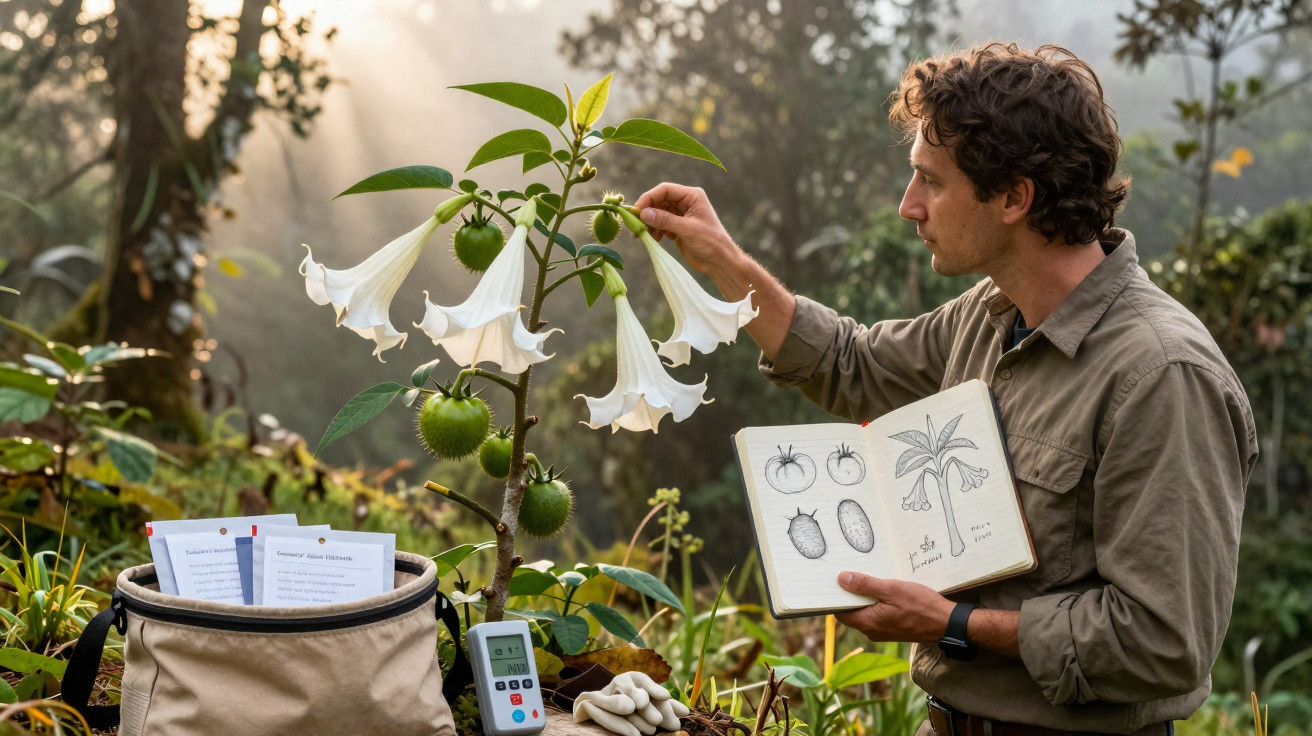
Scientists have recognised a rare Andean forest tree related to tomatoes and potatoes as belonging to a plant group that had never previously been named.
The finding reshapes one section of the nightshade family and connects the tree with plant chemicals that have medicinal effects.
Evidence from collections
The evidence for the tree’s newly defined scientific identity came from both pressed herbarium specimens and recently gathered forest samples.
After assessing that material, Gina P. Sierra of the National University of Colombia assigned the tree to a lineage of nightshades of its own.
For over 20 years, specimens had been recorded in Colombia and Peru, yet its position among its nearest relatives had remained unresolved.
Without that placement, its distinctive physical form was more difficult to interpret, prompting the more detailed comparison that followed.
The new tree genus Daturodendron
Researchers gave the new genus, a formal classification above the species level, the name Daturodendron, meaning a tree-like relative of Datura.
In contrast with many well-known nightshades, the plant is a woody, single-trunked tree that can grow to 20 metres in humid woodland.
Its flowers face upwards, whereas the flowers of many related angel’s trumpets droop downwards, a structural contrast that indicates a separate evolutionary past.
The tree also differs from several better-known relatives because its fruit remains woody and does not open.
Habitat and survival
Verified populations occur in cloud forests-humid mountain woods frequently shrouded in mist-in Colombia and northern Peru.
The tree is found at elevations of about 1,340 to 2,100 metres, where damp slopes shelter numerous plants from heat and dry conditions.
Despite field expeditions between 2022 and 2025, scientists know of only a few isolated populations across the two countries.
This limited distribution makes each known location significant, particularly as scattered trees may disappear before they can be properly studied or protected.
Deeper family relationships
The tree forms part of a small branch within the nightshade family, the plant family that also contains tomatoes and potatoes.
By including Daturodendron absconditum, researchers revised the membership of that branch and clarified its evolutionary history.
“Together, these results support the recognition of Daturodendron as a distinct genus within Datureae,” wrote Sierra and coauthors.
This finding is important because a newly identified genus may expose ancestral characteristics that later relatives retained, altered or lost.
Why chemical defences matter
The leaves of Daturodendron absconditum contain tropane alkaloids, natural defensive chemicals that plants use to disrupt animals’ nervous systems.
Scientists identified several nerve-active chemicals used in medicine, as well as a related compound that produces similar effects.
These substances probably protect the tree from feeding insects and other herbivores by interfering with their nervous systems.
Their discovery also places the new tree within the long human history of useful, hazardous and potent nightshade chemistry.
Genes revealed the history
Genetic data placed Daturodendron absconditum as the sister group to every other member of Datureae, rather than as a later-diverging branch.
Researchers compared 292 genes across 45 nightshade species, providing strong support for this crucial relationship.
A wider chemical survey examined 105 species as well, showing how tropane alkaloids are distributed throughout the broader plant family.
The results indicate that this chemical defence system may be ancient within Datureae, though certain relatives still require direct testing.
Medicine and caution
These chemicals draw interest because clinicians use comparable compounds to treat nausea, travel sickness and muscle spasms.
A separate genomic investigation showed that several nightshade lineages lost elements of this chemical pathway through time.
That pattern of loss and retention makes the new tree valuable for tracking the genes that preserved the pathway’s function.
Nevertheless, potential pharmacological value does not mean that the plant is safe to handle informally or collect from wild forests.
Rarity brings risk
At present, the species is classified as Data Deficient, a conservation category limited by insufficient evidence, because scientists do not yet know enough about it.
The IUCN Red List provides the worldwide framework for assessing extinction risk using population size, distribution and threats.
Researchers caution that the tree could eventually meet the criteria for Vulnerable or Endangered, both higher-risk categories, as urban expansion and roads approach some Colombian locations.
Effective conservation planning will require improved mapping, repeated field surveys and protection for the forest fragments in which the tree grows.
What Daturodendron teaches us
More than 20 years elapsed between the first known specimen collection in 2004 and the publication of its formal scientific name.
The lengthy delay demonstrates that plant discovery relies on collaboration across six countries, field research, local access and specialists capable of recognising unusual features.
The tree was neither tiny nor concealed beneath the ground, but its scientific identity nevertheless remained unsettled for a generation.
Cases like this show researchers that biodiversity can still go unnoticed, even in areas linked to roads, cities and protected places.
Further surveys in Ecuador and other Andean forests may establish whether the genus occupies the apparent gap between Colombia and Peru.
The discovery provides botanists with a clearer picture of nightshade evolution, yet the tree’s future relies on safeguarding rare forests before their evidence is lost.





Comments
No comments yet. Be the first to comment!
Leave a Comment