
In April, one often overlooked task determines the entire summer display.
Many amateur gardeners care for their oleander attentively, water it regularly and place the container in the sunniest spot available. Even so, buds fail to appear while the foliage grows luxuriantly. The cause is rarely the location; more often, it is a missed spring job that directly determines the summer flowering.
Oleander without flowers in April: a green shrub but no buds
Anyone growing oleander in a pot on the balcony will recognise the sight: rich, glossy leaves, long shoots and a container plant that looks impressive - yet there is no sign of flowers. These observations are especially common in April. The plants appear healthy, but nothing seems to happen where flowering is concerned.
Typical warning signs include:
- long shoots with little branching
- a dark, dense centre of the plant that receives hardly any light
- slow-growing, soft new growth rather than strong, compact shoots
- plenty of leaf growth but no, or almost no, flower buds
At this point, the oleander directs almost all its energy into foliage. For summer, that means lots of green but no cloud of blooms. This is exactly where the crucial April trick comes in.
“Whether your oleander becomes a wall of flowers in summer or simply keeps growing green is decided in spring - not in July.”
Why the container can become a problem
Oleander originates from the Mediterranean and naturally flowers in summer. In the UK, it is usually kept in a large pot: on a city balcony, beside the house and often in full sun. On paper, these are ideal conditions - regular watering, fresh compost now and then, and a sheltered position.
The catch is that a container-grown plant cannot produce unlimited new shoots. Its basic framework becomes woody, while the old structure continues to grow and consumes most of the available energy. Anyone who simply lets the plant grow is effectively feeding only “old wood”.
The result is a plant that looks vigorous but flowers increasingly poorly, until it eventually produces almost nothing but leaves. In April, this pattern can be interrupted with one clear measure.
The key spring moment: pruning oleander in April
Oleander mainly forms its flowers on the young shoots produced in the same season. If spring pruning is skipped, this young, well-supplied wood is missing. Instead, all the plant’s energy goes into old, sluggish branches that produce leaves only.
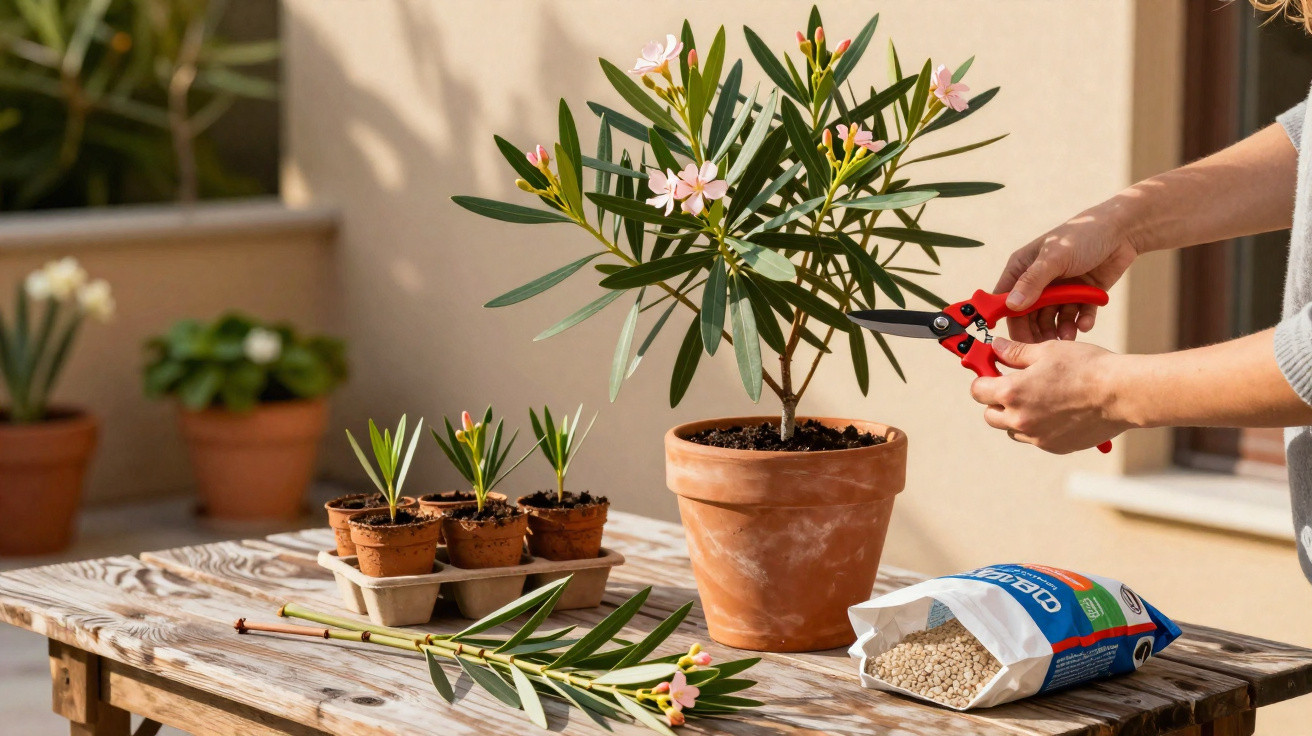
Once night-time temperatures are consistently around 10°C or above, it is time to prune the oleander. Professionals advise cutting back roughly one third of the shoot length. This may sound drastic, but for container-grown oleander it acts as a rejuvenating treatment.
“Every carefully placed cut redirects energy away from old wood and towards fresh, flower-ready shoots - that is the real secret of summer flowering.”
Step-by-step guide to April pruning
If you are unsure how hard to prune, follow this straightforward order:
- Prepare the tools
Use sharp, clean secateurs and wipe the blades with alcohol. This helps limit fungal diseases and bacteria. - Remove dead and obstructive wood
Cut away dead, brown branches completely. Also remove shoots that cross one another or grow awkwardly inwards, as they block light and air. - Shorten the main shoots
Prune the remaining healthy shoots by around one third. Make the cut just above an outward-facing bud. This creates a more open crown and allows more light into the centre. - Provide a nutrient boost
After pruning, use a fertiliser containing a clearly significant proportion of potassium. Potassium strengthens the plant and encourages flower formation.
It is important to watch the calendar: pruning too early while frost remains a risk can damage fresh shoots, while pruning too late leaves the plant with less time to develop new buds.
When oleander still refuses to flower after pruning
Sometimes every recommendation has been followed, yet the pot still seems stubborn. One common reason is that the shrub has never been thoroughly rejuvenated over many years. Its leading shoots then become heavily woody, and the internal transport channels function only to a limited extent.
In these cases, the oleander needs more than a single trim. If, after several seasons with few flowers, you consistently cut back around one third of the old structure, this often triggers noticeable new growth. Patience is worthwhile: many plants initially respond to such treatment with abundant foliage before really taking off in the following summer.
A practical everyday example
A typical situation is a south-facing balcony with a large, mature oleander in a terracotta pot. For two summers, it produces only occasional flowers despite being watered and fertilised. After a substantial April prune - including the removal of several very old, bare shoots - the plant suddenly produces dense, compact growth. New buds appear in the lower areas that were previously shaded, and in the following year the plant once again produces an unbroken front of blooms.
Bonus benefit: use prunings for free young plants
April pruning brings another welcome advantage: many of the cut young shoots are ideal as cuttings. Rather than throwing them away, you can use them to raise new plants.
Here is a simple method:
- Choose fresh, still slightly green shoot tips around 10–15 centimetres long.
- Remove the lower leaves so that no foliage sits in the water or compost.
- Place the cuttings in a glass of water, optionally with a piece of charcoal to help keep the water clear for longer.
- Once white roots develop, pot them into small containers filled with loose, free-draining compost.
During rooting, keep the young plants somewhere bright but out of fierce midday sun. Regular watering and a light application of fertiliser will help them establish quickly.
Common mistakes that further slow flowering
Anyone aiming to encourage their oleander to flower should also keep several other factors in mind:
| Mistake | Effect |
|---|---|
| Pot too small | Roots become restricted, nutrient supply suffers and flowering remains weak. |
| Permanently wet compost | Root rot becomes a risk, the plant weakens and flower production declines sharply. |
| Weak or unsuitable fertiliser | Lots of leafy growth, but few or no flower buds. |
| Partially shaded position | Too little light means the plant forms flowers only reluctantly. |
Despite its toughness, oleander is one of those plants that reacts quickly to insufficient light and poor nutrition by becoming “offended” - often with a complete break from flowering. Those who address every factor at the same time have the best chance of a true display of colour.
What terms such as “old wood” and “potassium” mean
The frequently used term “old wood” refers to the heavily woody, older shoots, which are usually several years old. They may still carry leaves, but they form far fewer new side shoots capable of flowering. When this wood is selectively reduced, young, juicy shoots with a strong willingness to flower can develop again.
Potassium, usually marked with the letter “K” on fertiliser, plays a central role for balcony plants. It strengthens plant tissue, promotes a stable water balance and supports the formation of flowers and fruit. For potted oleander, it is therefore worth choosing a fertiliser that provides not only nitrogen for leaf growth, but also sufficient potassium.
More flowers, less frustration: combining oleander care correctly
Once you understand how strongly spring pruning influences flowering, it is easy to combine it with other measures. A light prune in April, a sunny location, structured fertiliser applications and an appropriate amount of water are often enough to turn a tired container plant into a real highlight on a balcony or terrace.
Many gardeners now deliberately use oleander as the star of the summer display, combining it in the same pot with lower companion plants such as trailing thyme or small ornamental grasses. In this arrangement, an open prune becomes even more important - only when light reaches the centre of the plant will the desired floral fireworks appear instead of a dense but flower-poor curtain of leaves.




Comments
No comments yet. Be the first to comment!
Leave a Comment