
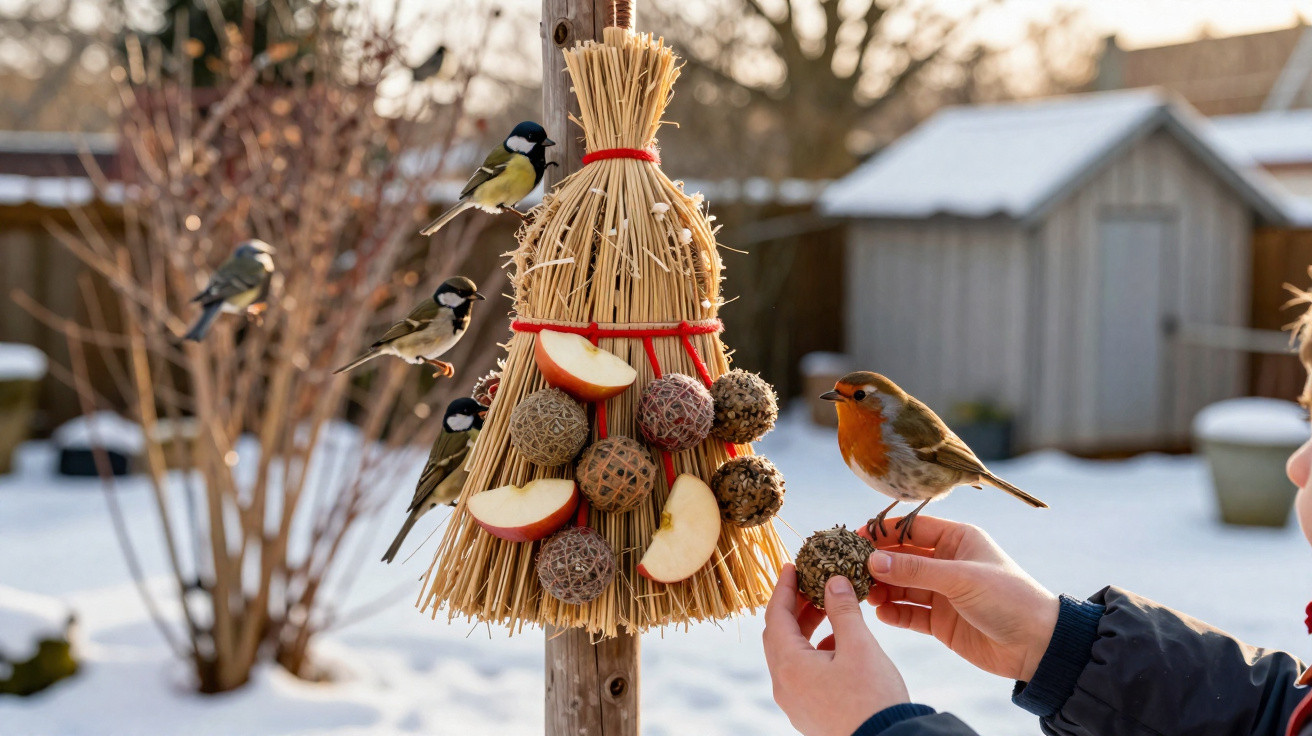
During harsh winters, tits, robins and sparrows are quite literally competing for every seed. Many people immediately think of pricey feeding stations from the garden centre. Yet the ideal aid is often already lying unused in the shed, garage or cellar: an old broom. With only a few simple adjustments, it can become a secure perch, feeder and shelter all in one.
Why winter is so difficult for garden birds
When temperatures fall below freezing, birds use huge amounts of energy simply to maintain their body heat. To survive icy nights, they need to eat for almost the entire day. At the same time, many natural food sources disappear:
- Snow covers seeds, leftover plant material and insects on the ground.
- Frozen soil puts worms and larvae beyond reach.
- Shrubs are stripped bare, while berry supplies quickly run low.
- Strong winds draw heat from birds and make every search for food harder.
Increasing cold therefore means greater energy needs, less food and a higher risk of starving or freezing. This is exactly where the unassuming household item can help.
An old broom can provide birds with a feeding spot, resting place and shelter at the same time – without costing an extra penny.
From cleaning tool to lifesaver: the broom as a bird station
A broom has everything small wild birds need in winter: a dense bundle of stems or bristles, a sturdy handle and flexible ways to use it in the garden. From a bird’s point of view, it resembles a small shrub on a stem – but one that is safer and easier to access.
Its bristles offer a firm place to perch, small gaps in which to hide and enough surface area to secure food. The handle keeps this miniature oasis raised above the ground. That makes it harder for cats and many other predators to reach the birds, while the food does not sit directly in cold, wet snow.
How to turn an old broom into winter support
You will usually need only items that are already at home to repurpose the broom. It should be clean and dry, ideally made from natural bristles or tough plastic with no sharp edges.
Step 1: Choose the right place in the garden
Place or hang the broom somewhere birds will feel secure:
- close to shrubs or a hedge, allowing them to reach cover quickly if danger appears
- at least 1.5 metres above ground level to keep cats at a distance
- away from the patio door, so they do not feel disturbed
- visible from a window if you would like to watch the activity
You can lean the broom upright against a wall, push it into the ground or hang it upside down from a tree. The essential point is that it is firmly secured and does not sway in the wind.
Step 2: Attach food to the broom
To ensure your feathered visitors genuinely benefit, add suitable food to the broom deliberately. Good options include:
- fat balls or energy balls without plastic netting
- unsalted sunflower seeds
- porridge oats mixed with a little vegetable fat
- apple pieces or unsulphured raisins
- specialist winter bird food from retailers
Use twine, wire or ordinary string to fasten portions of food to the bristles. The spaces within the broom head are also suitable for wedging in seeds or small pieces of fat. Birds then have to work, peck and pull for their meal – much as they would in nature, but with a far greater reward.
| Food type | Suitable bird species | Note |
|---|---|---|
| Sunflower seeds | Tits, finches, sparrows | Keep them as natural as possible and unsalted |
| Apples | Blackbirds, thrushes, robins | Cut into wedges, then skewer or tie them on |
| Porridge oats with fat | Tits, nuthatches, sparrows | Do not scatter directly on the ground |
| Raisins (unsulphured) | Robins, blackbirds | Offer sparingly and provide fresh ones each day |
Step 3: Make the broom into a small hiding place
Food matters, but so does protection. Small cavities form between the bristles, where birds can at least briefly shelter from gusts of wind. If you are more practical, you can take the idea a little further:
- fit a small wooden board on top of the handle as a roof against rain and snow
- attach a miniature birdhouse to the handle
- weave in thin twigs to give the broom a bushier appearance
This creates a kind of artificial shrub, which is particularly useful when the garden looks bare and exposed in winter.
Why a broom can work better than a conventional feeding station
Many bird feeders are positioned too low or are too exposed. As well as attracting birds, this can draw rats, mice and stray cats. A broom has several advantages:
- Food hangs or is wedged up high, making it difficult for rodents to reach.
- Birds have a clear all-round view and can spot danger early.
- The many bristles provide multiple perches, resulting in less squabbling over food.
- Its position is flexible: the broom can quickly be moved if a location proves unsuitable.
The old broom becomes a mobile winter station – wherever birds need it most.
Especially in built-up residential areas with few hedges and natural corners, this straightforward solution fills a gap. It adds structure to an otherwise bare garden and gives animals a dependable place to refuel with energy each day.
When the broom brings neighbours and family together
Anyone who sets up an improvised feeding station like this soon notices that it becomes a talking point. Children eagerly watch which species arrive, count the tits and secretly give the robins names. Older people enjoy the movement in a winter garden that might otherwise be rather quiet.
Shared outdoor spaces and courtyards can also work well in blocks of flats. A broom fixed to the building wall or hung in a courtyard tree can encourage several households to take part: one supplies food, another adds fresh apple pieces, while someone else clears away old leftovers.
What else to consider when feeding birds
As helpful as a broom can be, a few basic rules offer birds additional protection:
- Check food every day and remove mouldy items and leftovers.
- Use only food specifically suitable for birds.
- Do not offer salty foods or large quantities of bread.
- Clean the area beneath the broom regularly to help prevent disease.
If you have a garden, you can increase the benefit by creating more variety throughout the year: native shrubs, wild corners with seed heads and piles of leaves for insects. The broom then becomes a winter extra that eases the shortage between November and March.
More ideas for giving garden items a second chance
The old broom is only a starting point. Many objects otherwise destined for bulky waste can be repurposed usefully:
- broken rakes as climbing supports for beans or peas
- damaged wooden handles as stakes for tomatoes or herbaceous plants
- old metal buckets as water stations in summer
Thinking this way does more than save money: it creates extra structure, hiding places and nesting opportunities for animals. It also gives children a practical way to learn that helping animals and treating possessions carefully go hand in hand.
For many people, the idea may initially seem almost too simple. Yet that is precisely its strength: no specialist knowledge, no expensive materials, just an old broom, some food and the willingness to make everyday life a little easier for small winter visitors.
Comments
No comments yet. Be the first to comment!
Leave a Comment