
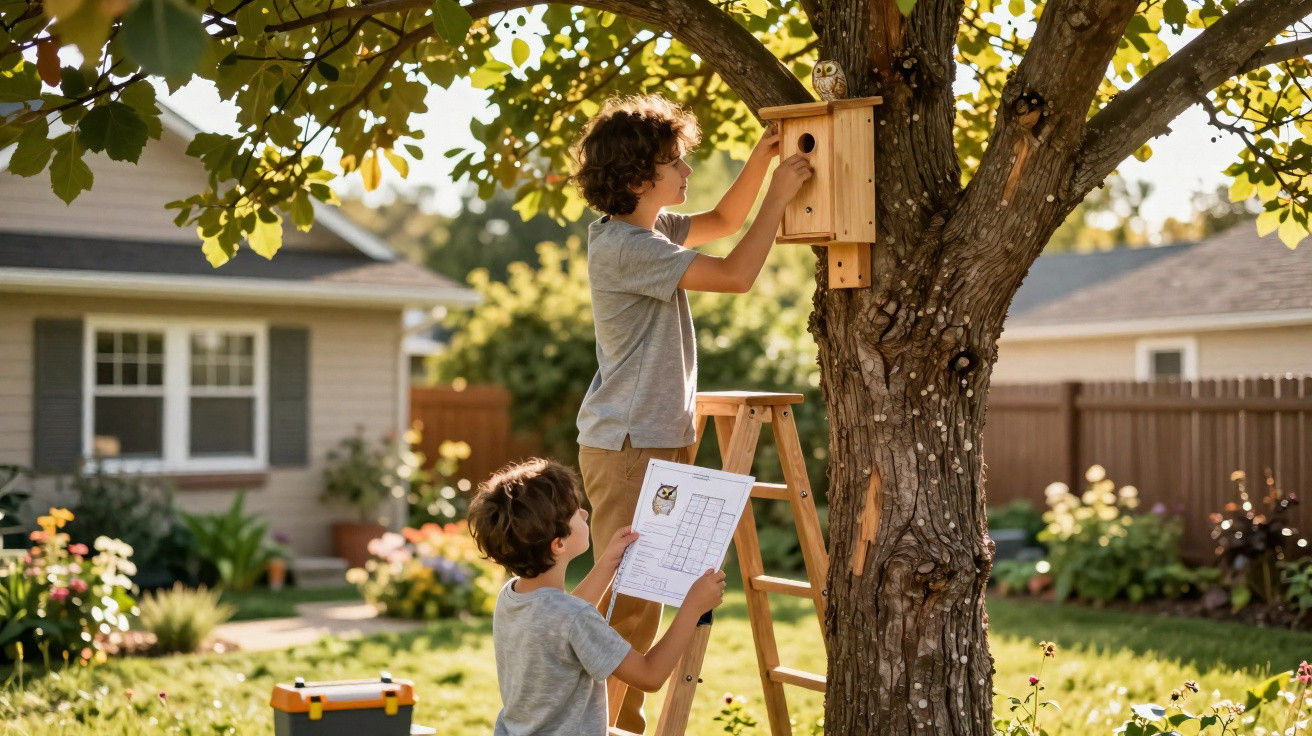
A simple step in the garden can make the difference between a happy life and a breeding disaster for owls.
Owls can seem as though they belong in a fairy-tale film: round-headed, wide-eyed and silent-winged. Yet many species are quietly struggling to survive because suitable nesting sites are becoming scarce. Anyone with a house, a yard or even a larger balcony can help at precisely this point – with one item that takes little effort but can make an enormous difference to these birds.
Why owls urgently need our help
In the past, owls could find natural cavities almost everywhere: in old fruit trees, decaying beech trees, barns, church towers and open roof spaces. Many of these features are now disappearing. Old trees are felled for safety reasons, roofs are tightly insulated, barns are renovated and façades are sealed.
A pair of owls can breed successfully in a suitable box for years – without such a site, breeding often does not happen at all.
At the same time, people benefit greatly from owls. They eat large numbers of mice and rats, reducing the pressure on fields, gardens and even stables. A tawny owl, for example, consumes several hundred small mammals each year. Where owls hunt regularly, considerably less rodent poison is usually needed.
The difficulty is that, if no safe breeding location is available during the mating season, pairs may forgo laying eggs or lose their clutch to predators such as martens or crows. This is where conservationists intervene, using a solution that any private individual can provide.
The garden game-changer: a suitable owl nest box
The most effective way to protect these nocturnal hunters is with a purpose-built nest box. A standard small-bird box is unsuitable for owls; they require far more space and a different design.
Several species in Central Europe readily use artificial nesting aids, including:
- Tawny owl – relatively common in parks, villages and woodland
- Barn owl – a typical “barn dweller”, highly dependent on the availability of suitable buildings
- Little owl – favours traditional orchards and pollarded willows, and is in sharp decline
- Long-eared owl – rather secretive and sometimes uses old crow nests
All of these species benefit from suitable boxes placed around homes or along woodland edges. The birds simply need to locate them in good time for the breeding season – which makes timing particularly important.
Breeding season: when it matters
For many owl species, the crucial period begins from late March and continues well into April. Males call distinctively at night and females respond. Pairs form or reinforce their bond. Soon afterwards, the female looks for a secure place in which to lay two to four eggs.
If an appropriate box is already in place, a pair will often use it straight away. If nothing suitable is nearby, they may move their breeding attempt to unsafe crevices or skip it entirely in poor years.
How to build a suitable owl nest box
Anyone with a little practical skill can make an owl box themselves. It does not need to be perfect, but several details are essential.
Key dimensions and choice of materials
- Material: untreated, weather-resistant timber, such as spruce or larch, at least 18–20 mm thick
- Internal space: depending on the species, roughly 30–40 cm wide and deep, and 40–50 cm high
- Entrance opening: neither too small nor too large – approximately 12–15 cm in diameter, or an equivalent slot
- Protection from predators: avoid an oversized opening so that martens and cats cannot easily get inside
- Roof: it should slope slightly forwards and extend well beyond the box, preventing water from entering
The ideal box provides sufficient room for adult birds and young, stays dry inside and reliably protects against predators at the same time.
If desired, place a layer of dry wood shavings or straw on the floor. Owls do not construct conventional nests in the way songbirds do; instead, they make use of the available material and the surface beneath them.
Mistakes many well-meaning helpers make
Several common pitfalls arise time and again:
- Painted or stained timber: the smell can deter owls, while harmful substances may release fumes inside the box.
- An interior that is too smooth: young birds can slip when climbing without rough surfaces. Untreated boards or roughly textured walls are helpful.
- No access panel for cleaning: at least one side or the roof should open so the box can be cleaned after the season.
- Exposed metal fittings inside: nails and screws must not protrude, as they could cause injuries.
The right location: height, orientation and surroundings
The installation site matters at least as much as the box itself. Owls are sensitive to disturbance, but they also need a clear flight path.
| Aspect | Recommendation |
|---|---|
| Height | 4–8 metres above ground level, depending on the building or tree |
| Orientation | Avoid facing west where possible, to reduce exposure to heavy rain and wind |
| Surroundings | A quiet setting with hunting grounds nearby, such as meadow, field or parkland |
| Access | A clear approach, with no dense branches immediately in front of the opening |
A large tree with a sturdy trunk is ideal, as is a gable wall on a barn, garage or house. If you live in rented accommodation, ask the landlord whether it can be fitted to a side wall. Local conservation groups may also be able to assist with installation.
Not a DIY enthusiast? How to find ready-made boxes
Not everyone wants to start sawing and drilling. If that applies to you, look in well-stocked pet shops or specialist online retailers. Many suppliers now offer owl boxes specifically designed with suitable dimensions and durable construction.
When buying one, check for the following:
- Solid timber rather than thin chipboard
- Information stating which species the box is intended for
- Secure hanging hardware or fixing points
- A side that can be opened for cleaning
In some areas, conservation organisations also provide or loan boxes. A quick call to a local group may be worthwhile, as their specialists will also know the preferred sites of native owl species.
How to tell whether the box has been accepted
Owls are generally elusive, but a few signs can reveal that a pair has moved in:
- Dark droppings beneath the entrance
- Remains of pellets – regurgitated balls of fur and bones – on the ground
- Calls at dusk close to the box
- Quiet squeaking from young birds in late spring or early summer
If you notice these signs, keep your distance. Repeated ladder checks cause stress to the birds and may even lead them to abandon the breeding attempt. An occasional look from afar with binoculars is entirely sufficient.
Light, poisons and noise: other threats facing owls
Nesting sites are only one part of the picture. Even a perfect box is of little use if the surrounding area becomes hostile to birds.
Three factors are particularly harmful:
- Light pollution: permanently illuminated yards, LED floodlights and advertising boards confuse nocturnal hunters and deter their prey.
- Poison bait for mice and rats: owls eat poisoned rodents and often die painfully as a result, without anyone recognising the connection.
- Constant noise: loud music, engines or building work close to a nesting site can endanger a clutch.
Anyone putting up a box should also pay attention to light, noise and poison in the surrounding area – otherwise even the finest nesting site will be of little help.
Even minor changes can have a major effect: motion sensors instead of permanent lighting, mechanical traps instead of poison, and quiet zones during the breeding season.
How to involve children and neighbours
Owl conservation is an excellent way to engage children and neighbours with nature. A box built together can quickly become a project for an entire household or street. Children can keep a “breeding diary”, record calls or make drawings.
Those who want to explore the subject further can use binoculars together to watch foraging at dusk, without shining lights at the birds. This creates direct encounters with nature right outside the door – with no television documentary required.
A useful technical term in this context is “pellet”. This is the name given to the small balls of hair and bones that owls regurgitate after digestion. They can be carefully taken apart, often revealing tiny mouse skulls and bones inside. It is hands-on biology learning right in the garden.
Anyone with a tree, a gable or a larger yard therefore holds a key in their hands in the truest sense: a sturdy nest box, installed in the right place and kept reasonably free from disturbance, can provide a safe nursery for generations of owls – turning an ordinary property into a quiet refuge for the secretive huntress of the night.
Comments
No comments yet. Be the first to comment!
Leave a Comment