
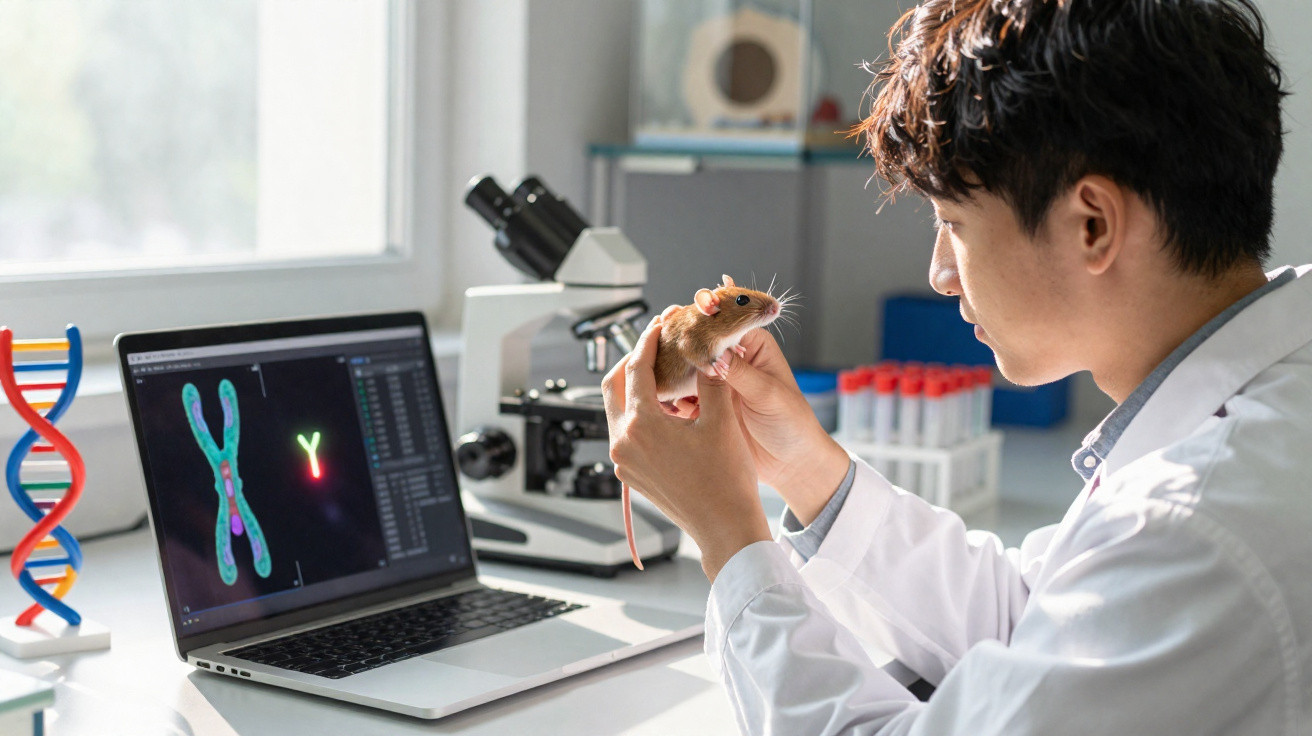
Researchers who investigate the Y chromosome have long expected its history to be one of decline. In every mammal examined, the Y has lost genes over millions of years without acquiring new ones.
This one-way pattern has been the field’s standard view. But a team working with deer mice identified a gene that appeared to defy it.
The gene reached the Y, replicated itself and created something new on a chromosome scientists had regarded as an evolutionary dead end.
The Y chromosome and gene loss
Chromosomes normally occur in matching pairs, exchanging sections of DNA in a process that helps correct copying mistakes before they become permanent.
The Y lacks a true partner with which to exchange DNA, allowing damage to accumulate as its genes gradually erode, one by one.
Nevertheless, the chromosome remains vital. Its surviving genes are involved in producing sperm, making the Y indispensable to male fertility.
It was this history of gradual gene loss that a team led by Ivan F. Mier set out to investigate in deer mice.
The study took place in the genetics laboratory of Dr. Jacob Mueller at the University of Michigan Medical School.
The problem of backup genes
Sperm production creates a challenge for the sex chromosomes. At an intermediate stage, cells almost completely shut down the X and Y, silencing their genes precisely when some of them are required.
Females have two X chromosomes, meaning one can compensate for the other. Males possess only one X, leaving no replacement available.
Evolution has relied on a solution: moving copies of important X-linked genes to chromosomes that remain active.
These copied genes provide backups. One study identified a duplicated gene that mammals truly require for sperm production, replacing an X gene that is switched off.
“It’s like having your own clone around who can jump in when you’ve gone on vacation,” said Mier.
How Phf8y reached the Y chromosome
In deer mice, the researchers tracked a gene that had followed an unusual path. It started as an ordinary X chromosome gene called Phf8.
It first generated a copy on an autosome, a chromosome that is not involved in determining sex. A further copy then reached the Y.
That single Y-linked copy then did something unexpected. It repeatedly duplicated, producing a small group of nearly identical genes that the researchers called Phf8y.
Genes commonly move from the X to autosomes, and biologists have documented many of these backup copies. Yet no gene had previously been observed completing the entire route to the Y. Not once.
“To our knowledge, it is the first example ever,” said Mier. The direction of that movement surprised the team.
The Y is known as a chromosome that loses genes rather than acquiring new gene families. Seeing it gain Phf8y and replicate it appeared to reverse the usual process of decay.
Using the DNA copying machinery
Genes need molecular machinery to move between chromosomes, and the deer mouse genome contained the necessary tools.
The DNA of nearly all animals contains scattered sequences known as jumping genes, which copy and insert themselves elsewhere in the genome. They account for roughly half of human DNA.
Phf8y seems to have used this very mechanism. Instead of following the typical route, the gene apparently commandeered mobile genetic machinery to create an additional copy and place it on the Y.
Usually, these sequences remain inactive and controlled so that they cannot rearrange the genome. Occasionally, however, one escapes that restraint.
One such rare event seems to have given the Y an entirely new gene family.
A possible competitive advantage
Although the team can clearly observe Phf8y becoming active in developing sperm, exactly what it does inside the cell remains unknown.
Beyond that observation, the explanation is an informed hypothesis. Their leading idea concerns the way DNA is packaged.
As sperm mature, their DNA is unwound and tightly packed into a head much smaller than that of an ordinary cell. Phf8y may assist with this compression.
That function would fit with the gene’s location. Sex chromosomes contain an unusually high number of genes active only during sperm formation, a pattern mapped by one analysis of mouse germ cells.
House mice offer clues about why such a gene might remain, as competing X and Y genes influence whether offspring are male or female.
If Phf8y alters how Y-bearing sperm are formed, it may give those sperm a modest advantage.
What the Phf8y discovery changes
Before this research, the Y chromosome’s narrative seemed to move in only one direction: loss.
Phf8y demonstrates that movement can also go the other way, with a gene completing its transfer to the Y and multiplying once there. The supposed dead-end chromosome can create.
The finding reshapes biologists’ understanding of Y chromosome evolution. The ways in which new genes arrive on the Y affect how populations maintain an even sex ratio, close to half male and half female.
In separate research, scientists switched off mouse Y genes individually and found that sperm production faltered.
For researchers, this result offers a tangible way to approach a longstanding question: why the sexes remain approximately balanced from one generation to the next.
A chromosome once dismissed as a place of inevitable decay is quietly acquiring new components. That gives the field a firm basis for further work.






Comments
No comments yet. Be the first to comment!
Leave a Comment