
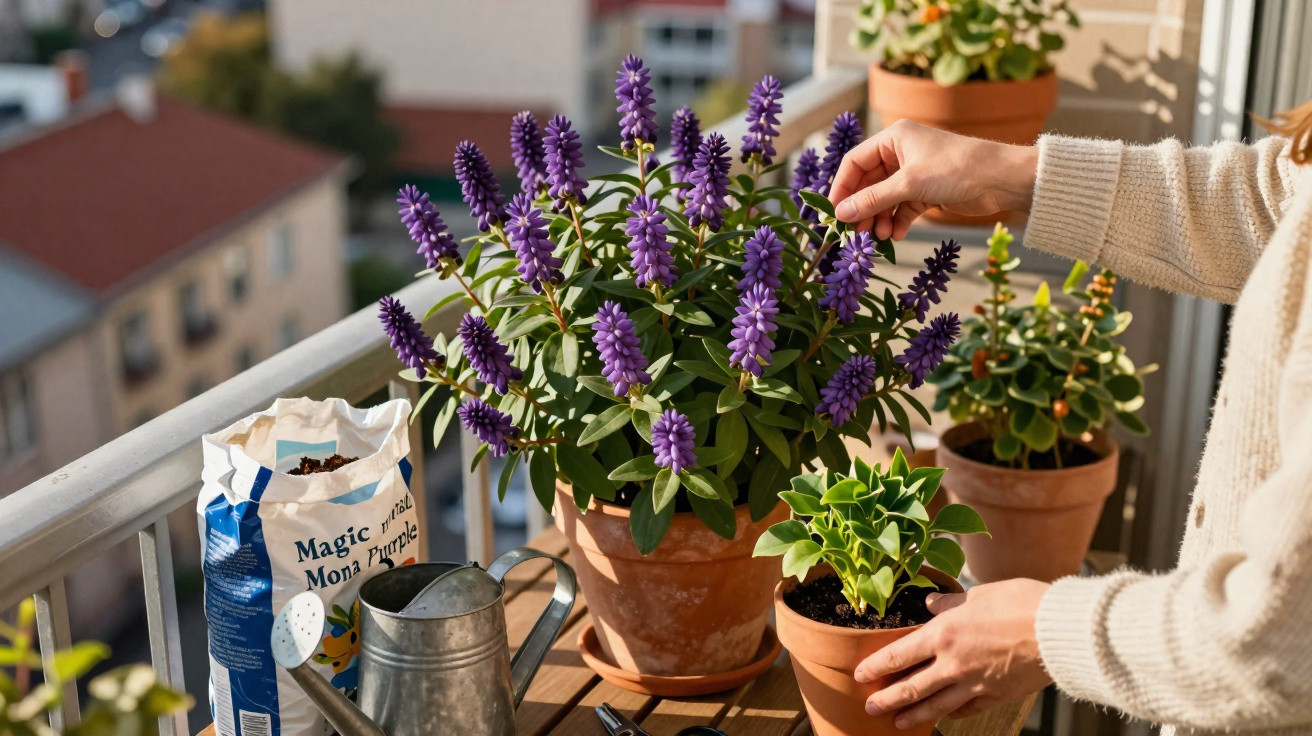
A little-known violet perennial truly comes into its own at this time of year.
Anyone who plants their balcony containers with the usual petunias, geraniums or fuchsias will know the issue: by late summer, their display is over and pots can quickly look dull. Yet garden centres stock an otherwise unassuming plant that becomes the quiet star of the season – flowering precisely when most others have already faded.
The little-known Plectranthus ‘Magic Mona Purple’
The plant at the centre of this story is Plectranthus ‘Magic Mona Purple’, which is also frequently sold as ‘Mona Lavender’. Botanically, it belongs to the extensive sage family, originates in South Africa and has been further developed by breeders specifically for containers and hanging baskets.
It grows into an upright, well-branched shrub, reaching roughly 60 to 70 centimetres in height and about the same spread. One plant will therefore comfortably fill a large pot or hanging basket without becoming overcrowded.
Its two-tone foliage is particularly striking: dark green on top and intensely violet underneath. This gives it a refined, ornamental appearance even when it is not in flower, rather like a houseplant from a design catalogue.
“What makes it special is this: while other balcony plants grow tired in autumn, Plectranthus ‘Magic Mona Purple’ is only then beginning its grand display of long violet flower spikes.”
Autumn flowering rather than a summer spectacle
The perennial’s greatest advantage is its flowering season. Although many summer plants put on an enormous display in June and July, they then begin to fade. Plectranthus concentrates its efforts on late summer and autumn, producing numerous long, delicate flower spikes in a rich violet shade.
Each flower is somewhat reminiscent of sage or lavender, which is unsurprising given their relationship. The perennial is regarded as a valuable nectar source, and bees and other pollinators readily visit it as other food sources become scarcer.
In very mild, frost-free areas, it behaves as a genuinely perennial plant. In colder locations, it is not strictly hardy, but it performs extremely well in a container and can be overwintered somewhere frost-free. This allows many amateur gardeners to enjoy its potential for several years.
Plectranthus ‘Magic Mona Purple’: a shade star for balconies and patios
Plectranthus ‘Magic Mona Purple’ enjoys bright conditions but does not cope with relentless midday sun. A partially shaded position is ideal: somewhere it receives sunshine in the morning or evening while remaining somewhat sheltered during the day.
- East-facing balcony: Morning sun followed by bright, less intense light – almost perfect.
- North-facing balcony: A surprisingly good option, provided it is sufficiently bright.
- Beneath a canopy: Protected from harsh sunlight and heavy rain.
- Under lightly shaded trees: A filtering leafy canopy creates pleasantly gentle light.
This species is especially useful on urban balconies where other plants struggle because of excessive shade. It brings colour to spots where often only foliage plants survive.
Choosing the right pot and compost
As this perennial is grown in a container, the choice of pot has a major impact on its health and growth. Effective drainage holes are essential to prevent waterlogging. Plectranthus likes fresh compost, but it does not like having wet roots.
Planting step by step
- Choose a sufficiently large pot or sturdy hanging basket with drainage holes.
- Add a drainage layer of expanded clay or coarse gravel.
- Mix good-quality multipurpose compost with a little compost and a free-draining material, such as broken expanded clay or coarse sand.
- Position the plant, fill in compost around it and firm it gently.
- Water thoroughly so the roots make contact with the compost, but do not allow the plant to stand in water.
With this foundation, the perennial establishes quickly and soon forms a dense, compact shrub. Its neat, full way of filling space is particularly noticeable in hanging baskets.
Watering, feeding and pruning: care suitable for beginners
In everyday care, Plectranthus is pleasingly straightforward. Keep the compost evenly slightly moist, without leaving it constantly wet. Pushing a finger one to two centimetres into the compost will quickly reveal whether watering is needed.
During the spring and summer growing and flowering period, feed it regularly. A liquid fertiliser for flowering plants added to the watering can every two weeks is usually sufficient. This keeps the plant vigorous, its foliage dense and its flowering abundant.
A light trim maintains its shape and encourages branching. Pinching out the shoot tips in spring produces even more compact, bushier growth. Once the main flowering period has passed, individual shoots can be cut back again to keep the plant tidy.
“A few simple tasks each year are enough to turn an unassuming pot into an impressive, long-flowering autumn display.”
Overwintering frost-free to keep the perennial for years
Since Plectranthus ‘Magic Mona Purple’ cannot tolerate frost, overwintering is crucial. Bring the pot indoors as soon as the first nights approach zero degrees.
A bright place in the house or conservatory is ideal, for example:
- directly beside a window on the stairwell
- a bright hallway
- a not overly warm south-facing window in the living room
The cooler the room – around 10 to 15 degrees – the less water the plant requires. Moderate watering is enough at this point, and the surface of the root ball may dry out slightly between waterings. Do not feed it during its winter rest.
In spring, once there is no longer any risk of frost, the perennial can go outside again. Initially, place it in a sheltered, partially shaded spot so it can adjust to wind and sunshine. After one to two weeks, it is ready once more for a hanging basket or large balcony pot.
Easy propagation: growing new plants from cuttings
Anyone taken with this violet autumn perennial can propagate it without difficulty. It is very easy to raise from tip cuttings. In spring or late summer, cut younger shoots that have not yet become woody.
Remove the lower leaves, then place the shoot tip in a glass of water or directly into moist seed compost. Roots often form in water after just a few days. The cuttings can then be transferred to small pots, kept somewhere bright and watered moderately.
This gradually creates a whole group of identical plants – ideal for planting several window boxes, hanging baskets or shaded garden corners in the same colour scheme.
Which plants complement the violet perennial?
With its dark leaves and violet flowers, Plectranthus has an elegant, slightly mysterious look. It creates eye-catching contrasts when combined with other shade-loving plants. Suitable companions include:
- white or cream begonias for pronounced light-and-dark contrasts
- hosta varieties with variegated leaves
- ornamental grasses in pots, which add lightness
- evergreen ivy varieties as a backdrop
Those who prefer a single-species display can also plant a larger pot solely with this one variety. Its dense growth then makes the container resemble one compact cushion of flowers set against colour-coordinated foliage.
Why it is worth looking beyond the classics
Many amateur gardeners automatically choose the same summer-flowering plants every year. Plectranthus ‘Magic Mona Purple’ demonstrates just how much potential lies in less familiar species. Particularly in an era of hot summers, a plant that does not want to stand in glaring midday sunshine but instead excels in shaded positions becomes highly appealing.
Low-maintenance care, suitability for pots and hanging baskets, decorative foliage, and flowering when other plants have long since given up: this combination makes the perennial a genuine insider tip for anyone wishing to enjoy their balcony planting for longer.
So, anyone who does not want empty window boxes in September but would rather celebrate autumn with a rush of violet colour will find an unexpectedly dependable companion in this ornamental South African perennial.




Comments
No comments yet. Be the first to comment!
Leave a Comment