
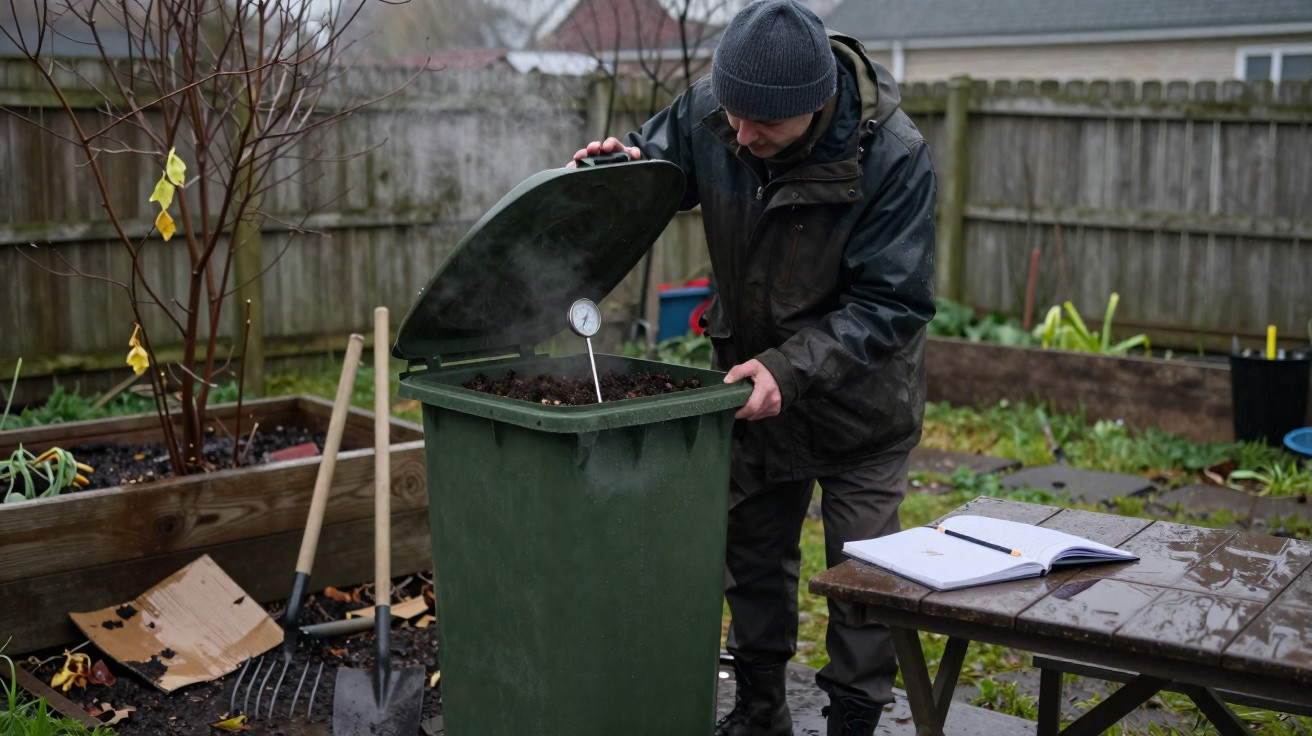
On a grey December morning, when the garden seems less like a living space and more like a forgotten, damp room, I saw my compost heap giving off a gentle plume of steam into the cold air.
Every other bed was motionless and partly frozen, yet the mound of vegetable peelings and shredded cardboard seemed full of activity. For weeks it had felt warm beneath my hand, one of those understated victories that gardeners alone tend to appreciate. Then the rain arrived: driving sheets of it sweeping across the lawn, saturating everything and rattling on the compost-bin lid like drumming fingers.
By the following day, the heat had vanished. My compost thermometer, which had been reassuringly in the “hot” zone, had nosedived. The heap was dense, claggy and seemingly resentful in its corner. It bothered me more than it ought to have done. How could a proper December downpour apparently drain the life from a compost heap that had been happily cooking only the day before?
The morning the compost ‘died’
This modest garden study began with virtually no preparation. I had only a cheap online compost thermometer and a notebook already marked with soil and tea stains. Since late autumn, I had recorded the temperature in my main compost heap, following its rise as fallen leaves, kitchen waste and spent plant stems decomposed. The readings were gratifying: 45°C, then 52°C, before approaching 60°C on a few unexpectedly mild afternoons. The heap appeared to have settled into a rhythm.
Then early December brought its familiar, penetrating wetness. There were no spectacular storms, only continual soaking rain that found its way into every surface. On the evening before the rain, I pushed the thermometer into the pile and felt its usual agreeable warmth on my fingers. The next morning, I did the same, anticipating that familiar sense of satisfaction. Instead, the dial had fallen by more than 15 degrees. The heap was cold, sodden and strangely devoid of life, as though the party had finished overnight without informing its host.
We have all experienced the moment when something we believed we understood suddenly behaves in an unfamiliar way, leaving us a little betrayed. Composting is meant to be straightforward: brown material, green material, air and time. But there it was, sulking after one spell of rain. So I continued taking readings. Several days of gentle drizzle caused only a modest decline followed by rapid recovery. A heavy December downpour, however, made the temperature collapse every time. It was not in my head: the heap was trying to say something.
What the bacteria were quietly trying to tell us about a compost heap
At the centre of any steaming compost heap is a microscopic community of bacteria and fungi. These organisms do the hard work, converting old cabbage leaves and coffee grounds into crumbly, dark compost with a gently sweet, earthy scent. Given sufficient air, food and moisture, they work intensely. Their activity produces heat, sometimes in unexpectedly large quantities. Even when the air around it is bitterly cold, a hot heap can readily remain within the 50–65°C range.
Rain alters their environment in ways that are not immediately visible. December rain is not like a brief summer shower that soon evaporates from warm ground. It is cold, persistent and invasive. As it enters the compost, it fills the small air spaces on which the microbes rely. Rather than breathing freely, they are left struggling in a dense, waterlogged pile. Some become less active, others die back, and heat production falls sharply.
There is a basic point of physics, too, which is easily overlooked amid the appeal of “natural gardening”. Water removes heat. Cold rain filtering through a heap behaves like an enormous cooling mechanism, pulling heat from the material and taking it away. It’s like someone has opened all the windows in a cosy kitchen and left them wide while the kettle is still trying to boil. The bacteria remain present, but they are working against a cold force they never chose.
The insulation myth: why a ‘big heap’ isn’t always enough
When size helps – and when it doesn’t
Garden wisdom often says that a larger compost heap will remain hot. There is some truth in it: a substantial pile retains heat more effectively than a thin, half-hearted one. My study heap was reasonably large, at roughly a cubic metre, and in dry weather it performed exactly as the guides suggested. After it had become active, it remained warm for days, sometimes sending little threads of steam into the cold air like a contented dragon.
But even this substantial, well-stocked heap lost momentum after heavy December rain. Its outer layer absorbed the water, became saturated and could no longer insulate the centre effectively. The wet, compressed leaves and grass cuttings began to behave more like a sodden blanket than winter clothing. Heat produced at the centre leaked into the cold, saturated exterior, where rain-chilled air rapidly carried it away.
This is where everyday garden conditions collide with the tidy diagrams found in composting manuals. In theory, a large pile ought to soften the impact of changing weather. On an actual UK December day, with wind cutting across the garden and rain finding every gap, the heap becomes part of a much larger and colder system. The bacteria are still working and the principle of insulation remains sound, but waterlogging combined with heat loss is more powerful than we may wish to acknowledge.
The quiet role of structure
I also could not overlook the importance of structure. In my small garden experiment, the heaps that retained their warmth for longest were not simply large; they were bouncy. They contained twigs, shredded cardboard, ripped egg boxes and dry stems. When I inserted the thermometer, I felt a soft resistance rather than hitting a solid, sticky barrier. Air could weave through these heaps more readily, even after rainfall.
The more thoroughly I chopped and crushed the contents, the quicker the pile warmed up - but the sooner it slumped into a compact, wet mass that lost heat at the first substantial downpour. It seemed rather like modern life: productive and intense, but not especially robust. The heap that worked best was neither the tidiest nor the most carefully assembled. It had an untidy blend in which an occasional woody stalk preserved tiny permanent air channels through the centre.
December is different: cold, short days and a tired garden
Another factor makes the temperature fall after December rain seem especially severe: the entire garden is already operating in a low-energy state. In late autumn, an occasional spell of sunshine can still raise air temperatures and assist a soaked heap in recovering. By December, daylight is brief, sunshine is weak, and night charges in at about four o’clock and shuts the door behind it. After rain has cooled the compost, little outside the heap is available to help it warm again.
The materials being added to the compost have changed as well. The nitrogen-rich summer grass clippings, which provide easy energy for bacteria, have disappeared long ago. What goes in now - dead leaves, old stems, cardboard and peelings from slow winter meals - remains entirely suitable for composting. It simply supports a less vigorous fire. When rain chills the heap, the microbes lack the rich, high-energy feast they had in July to fuel a swift recovery.
Honestly, few people turn a compost heap every few days once winter arrives. You tell yourself that you will. You picture yourself outside in a woolly hat, energetically forking through steaming layers of decomposing material like an environmentally minded television presenter. In practice, it is dark after work, the lawn is slippery, and wrestling with a weighty compost fork is far less inviting than remaining indoors with a hot drink. Left unturned, the heap stays wet longer, and its temperature decline turns into a prolonged low point.
The small study that changed how I use rain
Watching the pattern repeat
Over three winters, the results in my modest garden study repeated often enough to become impossible to dismiss. During dry, cold periods, compost temperature declined a little but commonly rose again if the heap was still active. Brief, light showers created a slight wobble before temperatures recovered within a day or two. Extended December rain that thoroughly saturated the pile made the thermometer reading sink and remain low for days, occasionally for more than a week.
Whenever I turned the heap afterwards, it felt weightier and almost bad-tempered. There was less of the reassuring warm-earth smell, and, when I had allowed it to sit for too long, more of a flat, swampy odour. The fork cut through lumps that squelched rather than crumbled. Saturated patches at the centre told the story themselves: insufficient air, excessive water and a microbial party made to proceed in slow motion.
What astonished me most was the speed with which the heap could recover with a little help. One purposeful turning session after rain - raising and aerating the contents, then bringing the sodden outer material into the middle - frequently restored 5–10 degrees within a few days. If I added a small amount of fresh “green” material, such as coffee grounds or kitchen scraps, at the same time, it recovered faster still. The microbes had not died; they were simply waiting for conditions to swing back in their favour.
Learning to work with the weather, not against it
The study led me to a quietly radical idea: perhaps rain itself was not the problem. Perhaps the real issue was expecting compost to perform identically throughout the year, whatever the weather overhead. When I began to regard December rain as a reset rather than a catastrophe, my relationship with that moody winter heap changed entirely.
These days, I treat heavy rainfall as a sort of diary prompt. The day after a genuine December soaking, I set aside 15 minutes outdoors. I lift the lid, accept the first rush of cold, wet air and turn the upper half of the pile, separating any clumps. I may add a loose covering of cardboard or straw to prevent the next rainfall from striking straight through. It is not a textbook-perfect method, but it feels like speaking with the heap rather than battling it.
What this reveals about our gardens – and ourselves
There is a straightforward physics explanation: cold water cools hot material, waterlogged heaps lose air and microbes become less active. But beyond the figures and thermometer readings, this small garden study showed something more human. We are drawn to the idea of control - follow the compost instructions and receive the expected compost outcome. Then relentless December drizzle arrives and reminds us that living systems respond to weather, season and the weariness of short days.
At first, the sharp temperature drops after December rain seemed like failure. I felt as if I had made an error, or as though the heap had somehow lost its magic. In time, they came to seem more like a heartbeat. The heap heats up, rain cools it, the bacteria pause, regroup and start again. My role is not to keep it hot at any price. It is to recognise when conditions have changed and choose whether to encourage recovery or allow it to rest.
In that peaceful, steaming garden corner, beneath the rain-darkened lid and wet cardboard, life continues reorganising itself unseen. The thermometer needle may dip after a December downpour, but the process does not truly end. Once you have observed a “dead” heap gradually warm itself again after nothing more than a turn with the fork and a short dry spell, winter rain no longer seems quite so unfriendly. It becomes part of the process.
Compost temperature drops because rain takes away heat, fills air pockets and slows the tiny workers on which we depend. But the same pattern offers a broader lesson: gardens do not owe us uninterrupted performance. They pulse, rest and gather pace again. On the next cold December morning, when your own heap slumps after overnight rain, you may feel a small flash of recognition. The microbes are tired, and so are we. Given some air and a pause in the weather, both will quietly become warm again.


Comments
No comments yet. Be the first to comment!
Leave a Comment