
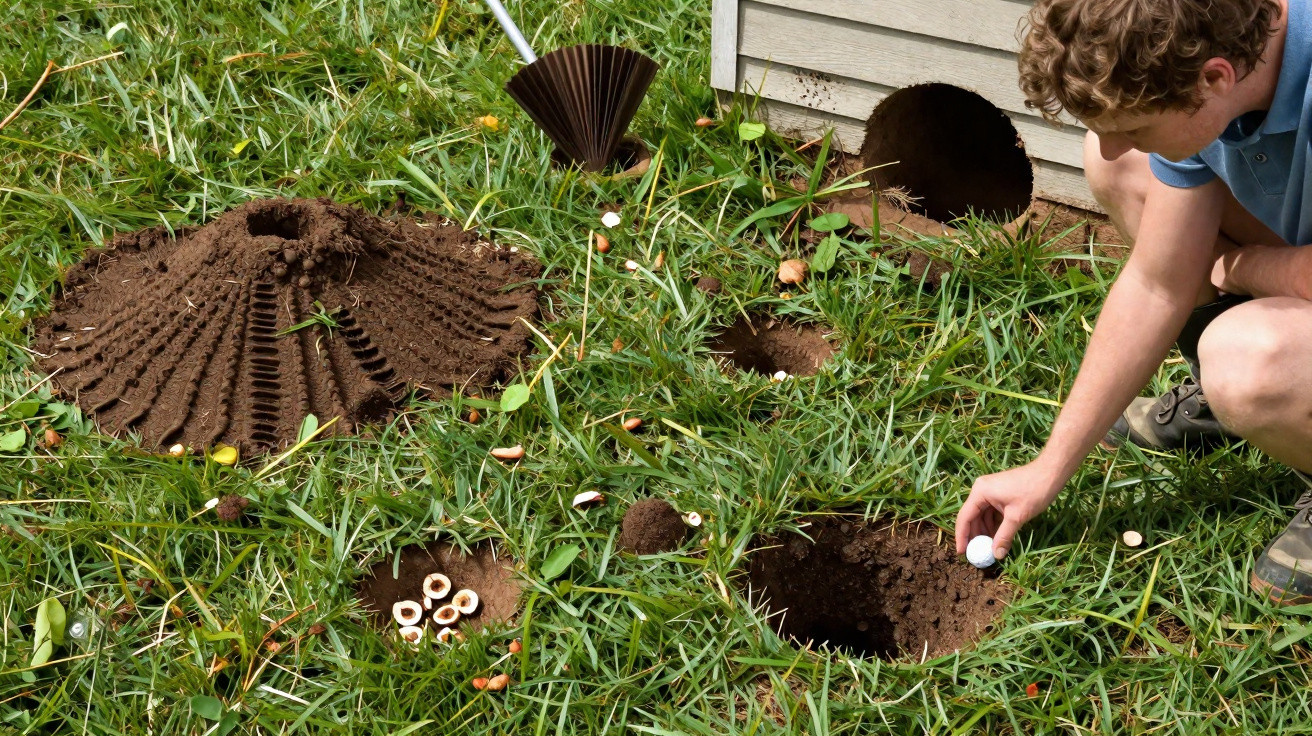
Read your lawn before attempting any repairs.
Your lawn records the animals that visited overnight. The dimensions, form and timing of each hole can identify a different culprit. Interpreting these signs quickly helps you halt the damage and apply the correct solution straight away.
Why hole shape, size and timing matter
A hole in the middle of a lawn provides different evidence from one beside a fence. A cone-shaped mound has one meaning, while a neat circular entrance has another. Damage appearing overnight indicates one category of visitor; digging during the day suggests a different one.
Move in closer and look for footprints, cut stems, droppings or discarded food. Every sign reduces the number of likely animals. Raised lines can indicate underground tunnels. Fans of displaced soil suggest a large burrowing animal. A section of turf peeled back like a mat points to a powerful digger using claws and strength.
“Match the evidence before you act. The wrong fix can feed the problem or push it closer to your house.”
- Measure the entrance: record its width at ground level and whether fresh soil is present.
- Assess the setting: is it in open grass, beside a shed, beneath shrubs or along an edge?
- Identify patterns: one crater, a row of small holes, raised tunnels or lifted turf.
- Record the timing: damage at dawn, in daylight, at dusk or overnight.
- Search for additional evidence: gnawing, seeds, shells, claw marks or droppings.
Common animals that dig holes in lawns and their signs
Moles: tidy volcano mounds and raised tunnels
Moles search underground for insects and earthworms. As they excavate, they force soil into rounded, volcano-style mounds with a plug in the centre. You may also notice elevated tunnels winding over the lawn surface. Mounds are 10–25 cm across and several centimetres tall. Damage can occur in any month when the soil is moist. Although moles aid aeration, they can rapidly spoil an immaculate lawn.
Voles: subtle entrances and surface runways
Voles create small round openings measuring 2–5 cm wide. They generally leave little excavated soil behind. Check for shallow paths flattened through the grass, plus slanted gnaw marks on low stems or bark. Their activity is greatest in cooler seasons. Numerous small holes grouped in borders or around stone edging can indicate a colony.
Raccoons: lifted turf and scattered grass
Raccoons pull back turf as if rolling up a carpet while searching for grubs. By morning, orderly lawn areas may have become a patchwork of overturned sod. Their claw marks are often visible in soft ground. Raided bins and knocked-over feeders strengthen the evidence. Damage may spread widely after damp evenings, when grubs rise nearer the surface.
Skunks: neat, golf-ball-sized cones
Skunks make small conical holes while hunting beetle larvae and other invertebrates. These divots measure 3–8 cm wide. The holes are scattered across the grass rather than joined by runs. The problem often increases while skunks are feeding their young. A pungent smell or a confirmed spraying incident can identify the visitor.
Groundhogs: large burrows with fans of earth
Groundhog, also called woodchuck, dens have sizeable round entrances measuring 15–30 cm wide, accompanied by a low fan of dug-out soil. Look along fencing, near sheds and at sunny margins. Additional exits may be concealed beneath vegetation. If ignored, their tunnels can weaken slabs and footings.
Squirrels: shallow caches and nut shells
During autumn and winter, squirrels bury and retrieve nuts. They leave shallow openings 2–5 cm across, with loose soil around them. Nearby, you may spot nut shells, seed husks or fruit stones. Holes are commonly concentrated close to trees, stumps and shrub borders. The effect is mainly cosmetic, though it can be extensive in years with heavy seed production.
Rats: smooth holes close to cover
Rats favour sheltered locations. They make entrances 5–10 cm wide along foundations, below sheds, and inside compost heaps or woodpiles. Frequent use gives their holes a smooth edge. Look for greasy rub marks on walls, pellet-shaped droppings and chewed containers. Their presence presents significant health hazards to people and pets.
Armadillos: numerous conical scoops overnight
In warmer regions, armadillos cover lawns with conical holes 5–12 cm wide as they search for insects. Dozens of shallow pits can appear in a single night. Their routes often follow edges and mulched borders. They are mainly active from dusk until before dawn.
Digging birds: seasonal scratches and divots
Wild turkeys, crows and even robins rake through leaf litter and turf to find grubs and worms. Expect scratched areas and small divots instead of distinct holes. Their activity changes with food availability during spring and autumn.
| Animal | Appearance of hole | Main clue | Usual time |
|---|---|---|---|
| Mole | Volcano mound, raised tunnels | Central plug in mound | Any time, most active in moist periods |
| Vole | 2–5 cm round entrance, little soil | Surface runways, angled gnaw marks | Cool seasons, day or night |
| Raccoon | Lifted turf, scattered clumps | Claw marks, raided bins | Night |
| Skunk | Small conical divots | Many neat holes, musky smell | Night |
| Groundhog | 15–30 cm burrow, fan of soil | Near sheds or fences | Day and twilight |
| Rat | 5–10 cm smooth-edged hole | Grease marks, pellets | Mostly night |
| Armadillo | Numerous shallow conical pits | Sudden batch of fresh holes overnight | Night |
| Birds | Scattered scratches, small divots | Feathers, tracks, seasonal activity | Day |
When evidence conflicts or cannot be seen
Some animals do not usually excavate their own dens. Foxes, coyotes and snakes may occupy abandoned burrows, obscuring tracks and confusing the timeline. Wind and sprinklers can also soften footprints and hole edges. If you cannot make a reliable identification within a few days, use a straightforward test. At dusk, spread flour or builder’s sand in a 60 cm circle around the entrance. Inspect it for tracks at sunrise.
“Still stuck after 48–72 hours? Set a trail camera or call licensed wildlife control before the colony grows.”
Act promptly to protect people, pets and property
Tunnels can destabilise soil below patios and play equipment. Weak patches are often discovered first by ankles and lawnmower wheels. Burrows close to foundations may redirect water and undermine concrete slabs. Rats can spread disease and lead to indoor infestations. Skunks may spray pets and can carry rabies. The longer the problem remains, the bigger the tunnel network becomes and the harder it is to resolve.
Targeted solutions that work
- Eliminate attractants: secure rubbish, feed pets indoors, choose bird feeders with trays and collect fallen fruit.
- Reduce the food supply: control lawn grubs at the larval stage, using options such as beneficial nematodes or milky spore in the appropriate season.
- Prevent entry: fit hardware cloth 12–30 cm deep around sheds and decking, creating an L-shaped underground apron that extends outwards.
- Safeguard beds: cover the base of new raised beds with 6–12 mm mesh to prevent burrowers entering from underneath.
- Fill holes only once they are empty: place crumpled paper in an entrance, then check after 48 hours for disturbance before backfilling.
- Select traps or deterrents suited to the species and local regulations. Live trapping often requires permits, and relocation is prohibited in many places.
- Contact professionals for rats, groundhogs close to buildings, or repeated damage and any safety concern.
“Repellents and gadgets give mixed results. Integrated steps-food control, exclusion and timing-change the math for good.”
Extra tips to save time and money
Maintain a basic lawn diary. Record dates, weather conditions, new holes and the measures taken. Even two weeks of notes can reveal patterns quickly. This can guide you towards the most effective period for grub control or trapping, if required.
Make a quick size comparison whenever you discover a hole. A golf ball measures 4.3 cm across. A tennis ball is approximately 6.7 cm wide. A fizzy drink can is roughly 6.5 cm across. Compare the opening with a familiar object to obtain a consistent measurement without using a tape measure.
Consider neighbours and pets as well. Poison bait can cause secondary poisoning in owls, hawks and cats. Opt for approaches that reduce unintended harm. For this reason, exclusion and habitat changes are often preferable to chemicals.
The season also provides useful context. Autumn brings squirrel nut caches and raccoon grub raids. Spring often reveals fresh vole runways after snowmelt. A brief increase may end when food sources change, whereas a continual stream of new holes suggests a resident burrowing animal that requires action.






Comments
No comments yet. Be the first to comment!
Leave a Comment