
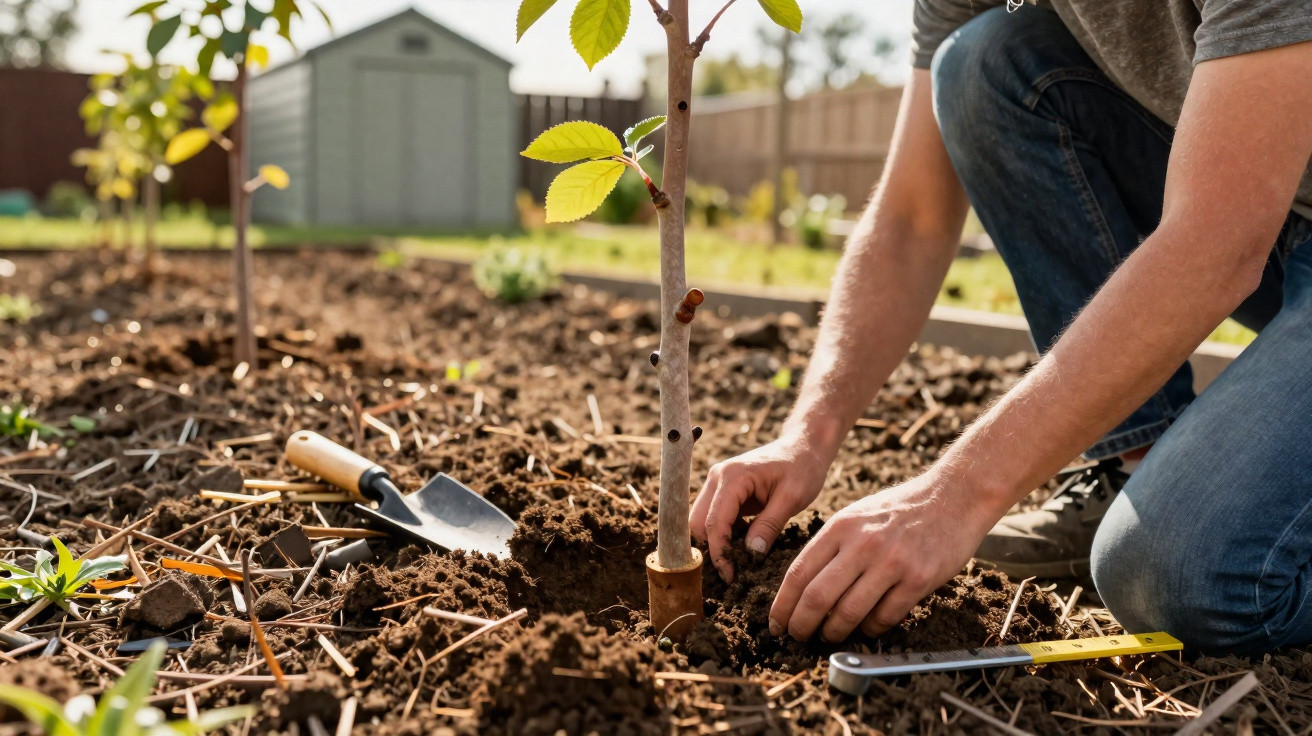
Spring has arrived, garden centres are busy, and before long an apple, cherry or peach tree ends up in the boot. At home, a generous planting hole is dug, the tree is put in place ‘well protected’ – and that is precisely where the trouble starts. A tiny area around the trunk determines whether the fruit tree will later be covered in blossom or struggle for years.
The most common planting trap: planted too deeply and slowly suffocated
Why planting ‘extra deep’ is a misconception
Many people assume that the deeper a tree sits in the soil, the more secure it will be and the better it will withstand wind and weather. So the base of the tree is covered liberally with soil and pressed down firmly. It sounds sensible, but for fruit trees it is fatal in most cases.
A thick layer of soil around the lower trunk acts like a heavy scarf over the nose and mouth. It deprives the tree of air at its most vulnerable point. This area needs oxygen exchange, dryness and light. Instead, it is exposed to waterlogging, rot and fungal disease.
A fruit tree rarely dies dramatically – it suffers quietly for years when the base of its trunk disappears beneath the soil.
Damp soil and bark: a dangerous combination
Trunk bark is designed to live in the open air, not in permanently wet soil. While roots can cope with lasting moisture, bark cannot. Moisture accumulates around the trunk, particularly in clay soils or after heavy rainfall.
The hidden consequences include:
- Fungi establish themselves and attack the wood and bark.
- The bark starts to rot and may peel away in places.
- The channels that carry water and nutrients become damaged.
- The crown receives too little nourishment and remains weak.
From the outside, it often merely appears that the tree is ‘somehow failing to get going’. The real cause is below ground – buried at the wrong point.
The critical area: the root collar and graft union
How to identify the sensitive sections of the trunk
Nearly all fruit trees bought from a nursery are grafted. This means that a desirable variety, such as a particular apple or sweet cherry, has been joined to a hardy rootstock. That join can be seen on the trunk.
There are two important areas:
- Root collar (root flare): the transition between root and trunk, usually where the roots extend outwards from the sides.
- Graft union: a small swelling, bend or scar slightly above the root collar.
This subtle thickening on the trunk is crucial. It marks the point where the chosen variety was grafted onto the rootstock. Many people overlook it or mistake it for a cosmetic flaw, yet it is the centrepiece of the future fruit tree.
Why the graft union must never be below ground
If the graft union is covered with soil, the grafted variety may try to produce roots of its own. Specialists refer to this as the variety becoming ‘self-rooted’. It may sound intriguing, but it creates a problem for the tree.
This is what follows:
- The advantages of the rootstock – growth control, resilience and early fruiting – are lost.
- The tree directs energy into emergency roots rather than blossom and shoots.
- Flowering is significantly delayed or may not happen at all.
- The tree may grow considerably taller or more vigorously than intended.
In a sense, the graft union is the fruit tree’s lung: it must be able to breathe freely, or the harvest will remain poor.
How to plant correctly in March: depth, technique and checks
The right height: clearly above soil level
The basic rule for fruit trees is: the graft union belongs 5 to 10 centimetres above the eventual soil level. The root collar should be covered only very lightly at most; ideally, it should remain visible. The trunk itself must never be beneath the soil.
How to put this into practice:
- Dig the planting hole wide enough for the roots to fit comfortably.
- Form a small, firm mound of soil in the centre of the hole.
- Place the tree on this mound and arrange the roots loosely downwards.
- Position it so that the graft union sits clearly above ground level.
- Only then backfill around the sides with soil and tread it in lightly.
If you are unsure, lay a stake or spade across the planting hole while planting. This makes it easy to see the eventual soil level and check that the trunk has not slipped too low.
Preventing the soil from sinking later
Freshly loosened soil contains plenty of air. Rain and watering cause it to settle noticeably during the first few weeks. What looked perfect at planting time may be too deep only a few weeks later.
Straightforward measures can prevent this:
- Press the soil mound in the planting hole down firmly rather than simply piling it up loosely.
- As you backfill, tread the soil in gently in layers, not just on the surface.
- Check the tree after the first watering and, if necessary, remove some soil if the trunk is sitting too deeply.
- Create the watering basin at a distance from the trunk, rather than directly against the wood.
Spending a few extra minutes checking the planting height saves years of frustration with stunted trees later on.
Warning signs: how a ‘livingly buried’ tree calls for help
When the fruit tree simply does not get going in spring
A tree planted too deeply often shows signs of distress only after several months. In spring especially, certain symptoms become noticeable:
- Short, thin shoots with little vigour.
- Sparse or yellowing foliage despite normal watering.
- Flower buds that dry out and fail to open properly.
- An overall sense of ‘standstill’ while other trees in the garden burst into growth.
Many people suspect a nutrient deficiency, incorrect pruning or pests. Yet the cause is often closer to the trunk: too much soil in the wrong place.
Rescue work: expose the trunk without damaging the roots
If you suspect that a tree is sitting too low, it is possible to act afterwards. This can be done carefully and without much effort:
- Gently scrape away the soil around the trunk using your hands or a small hand trowel.
- Keep uncovering the area until the root collar and graft union are visible and exposed to the air.
- Take care not to injure the bark or sever fine roots.
- Recreate the watering basin slightly further away from the trunk.
Young trees in particular often reward this rescue work with noticeably more shoots and their first proper blossom as early as the following spring.
A reminder list for a thriving fruit garden
Checklist beside the planting hole
Anyone planting several trees in March or April can use this simple checklist:
- The graft union is clearly visible and at least a hand’s breadth above the soil.
- No compacted, damp soil is pressed against the trunk.
- The watering basin forms a ring rather than running along the bark.
- The trunk is upright, not leaning because of incorrectly settled soil.
- A stake supports the tree, rather than soil piled around its trunk.
Ticking off these points lays the foundation for robust, long-lived trees that manage without a chemical arsenal while still cropping reliably.
Why fruit trees are particularly sensitive to planting depth
In an ornamental garden, some shrubs will tolerate being planted slightly too deeply. Fruit trees are far more sensitive because their entire system is geared around the graft. The combination of rootstock and variety determines ultimate height, stability, susceptibility to disease and the start of cropping.
Planting too deeply disrupts this finely balanced system. The tree has to reorganise itself, produce emergency roots and simultaneously battle trunk rot – leaving it with too little energy for abundant blossom and fruit.
This is why, especially in home gardens where many people prefer to avoid chemical treatments, it is worth inspecting the trunk closely. An exposed root collar and a clearly visible graft union are among the simplest yet most effective measures for a healthy, productive fruit garden.



Comments
No comments yet. Be the first to comment!
Leave a Comment