
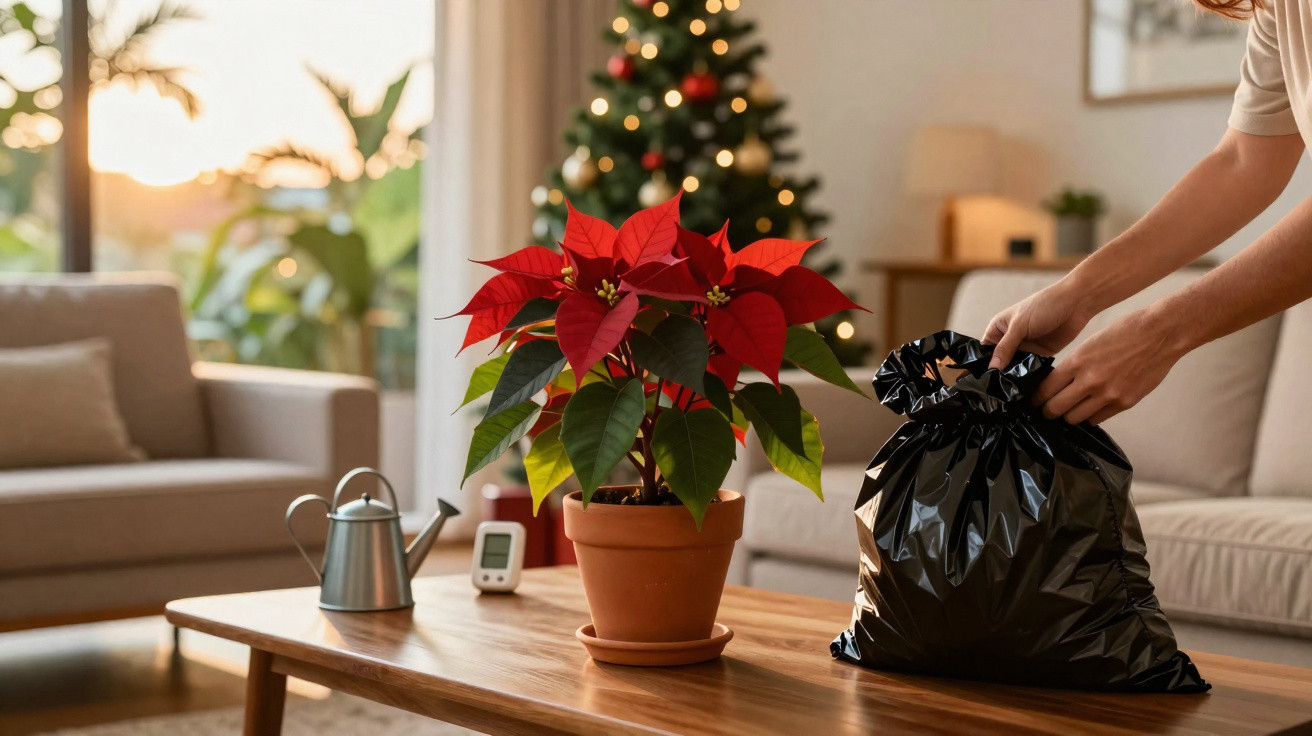
Every December, poinsettias light up living rooms, only to wilt as soon as the festive decorations are packed away.
However, many people misunderstand what this plant actually requires.
Although the Christmas star may appear robust, it acts more like a demanding long-haul traveller than a hardy houseplant. Warm rooms, artificial light and central heating exhaust it, while the key to helping it survive may be sitting beneath the kitchen sink: an ordinary black bin bag.
Why your poinsettia crashes after Christmas
Poinsettias look immaculate when they reach the shops, which leads many buyers to treat them as straightforward seasonal decorations. In reality, they are not. Their prospects are largely determined by the choice you make at the garden centre.
Growers liken choosing a poinsettia to buying fresh fish: start by checking the essentials. Its stems should be firm rather than soft or rubbery, while the leaves should be intact, with no signs of damage or bruising. When a plant looks fragile from the outset, it is unlikely to last beyond New Year in a British home.
An often-overlooked feature lies in the middle of the plant. The tiny cream or yellow beads between the red bracts are its actual flowers. Their appearance can indicate the plant's condition. Very small, shrivelled buds may point to weak growth, whereas large, fully opened buds can show that the plant is already beyond its best.
A healthy poinsettia at purchase gives you the only realistic chance to keep it going until the next Christmas season.
The real shock often begins once the plant gets home. Poinsettias originate in Mexico, where they receive bright, consistent light, warmth without stale air, and cooler nights. Modern houses and flats frequently offer the reverse: dry heat from radiators, inconsistent light, window draughts and continual shifts in temperature.
When a poinsettia droops, people commonly attempt to save it by watering more or placing it nearer a heat source. Together, these actions can quietly destroy it, causing root rot while dehydrating the leaves. The foliage falls, the bracts lose their colour, and the “Christmas star” is reduced to a bare stem in a plastic pot.
The surprising role of darkness: a photoperiod plant on your coffee table
Poinsettias belong to a category known as photoperiodic plants. They use the duration of darkness to determine when to produce coloured bracts and flowers. In their native environment, shorter days and long, uninterrupted nights tell the plant that winter has arrived.
Light from daylight bulbs, a hall light left on, television glow or even streetlights passing through thin curtains can interfere with this natural timing. The plant then receives mixed signals: winter seems never to arrive properly, so its red display may finish too soon or fail to return the following year.
Total darkness for long stretches, not more fertiliser or fancy compost, persuades a poinsettia to keep its festive red display.
This is why the humble black bin bag has become an unlikely feature of December 2025 poinsettia care trends.
The black bag method: 12 to 14 hours of real night
Nurseries specialising in Christmas poinsettias commonly follow a precise pattern: roughly twelve hours of bright light followed by twelve hours of complete darkness. At home, you can recreate this schedule using basic household items.
Daily routine from October to December
From early autumn, as daylight hours begin to shorten, the plant responds well to a regular routine. An opaque black rubbish bag or a completely dark cupboard can provide the darkness it lacks.
- Choose a consistent 12 to 14-hour period of darkness each day.
- In late afternoon or early evening, carefully place a black bin bag over the plant without squashing the bracts.
- Block as much light as possible, or put the whole pot into a shut cupboard or wardrobe.
- Remove the bag the following morning and place the plant somewhere bright, away from intense direct sunshine and heaters.
- Continue for several weeks, ideally from late September or early October until late November.
This straightforward daily routine recreates the extended winter nights found in the plant's original habitat. As the days pass, hormones within the stems change, allowing the coloured bracts to deepen and retain their colour for longer.
| Time of year | Dark period per night | Main goal |
|---|---|---|
| October – November | 13–14 hours | Trigger colouring and strong bract formation |
| Early December | 12–13 hours | Maintain colour and prevent early fading |
| After Christmas | Natural nights only | Let the plant rest and focus on general health |
Think of the bin bag as a blackout curtain tailored for one plant: it delivers night on demand, even in a bright flat.
Why the bag alone will not save a thirsty or cooked poinsettia
Managing darkness will only succeed when the plant's basic needs are also met. Two common problems account for many losses: waterlogged roots and excessively hot air.
Watering: treat it more like a cactus than a fern
Poinsettias do not tolerate constantly wet roots. A pot left standing in a saucer of water deprives the roots of air and encourages fungal rot. As a result, stems become soft, leaves turn yellow and the plant fails from the base upwards.
Using your fingers rather than following a fixed watering timetable is much safer:
- Press your fingertip into the surface of the compost.
- If it remains a little damp, wait another day or two.
- When it feels dry and light, water slowly once until moisture runs from the drainage holes.
- Allow all surplus water to drain away, and never leave standing water in the saucer.
Some gardeners prefer occasional immersion. If the compost has become completely dry, place the pot in a bucket of lukewarm water for around fifteen minutes, then allow it to drain thoroughly. This restores moisture to the rootball without leaving it saturated and sludge-like.
A gentle organic liquid fertiliser during the growing period, generally spring and early summer, may encourage fresh growth. Small, infrequent applications are better suited to its shallow roots than heavy feeding, which can scorch them.
Temperature and location: warm days, cooler nights
Most UK homes can offer the temperatures a poinsettia needs, although its exact position is important. It grows best at approximately 18–21 °C during the day, with a modest fall overnight. Direct heat from radiators or warm-air vents dries the foliage and puts stress on the stems.
A steady position on a windowsill, away from draughty gaps and without contact with cold glass, is usually ideal. Small day-to-day temperature changes cause no problem, but abrupt extremes do. If a room feels airless to you, the plant is likely to find it uncomfortable too.
Move the poinsettia away from radiators, fireplaces and front doors that slam open to winter air; calm corners mean longer-lasting colour.
How to carry a poinsettia from one Christmas to the next
Once its coloured bracts fade and leaves begin to fall, most people dispose of the plant. A different approach can turn that forlorn pot into the following year's festive centrepiece, saving both money and waste.
After flowering, trim every stem back to about 6 cm. Though this seems severe, it directs the plant's energy towards its roots. Move it into a slightly larger pot filled with fresh, free-draining compost, then keep it somewhere bright and frost-free with only light watering.
As temperatures rise in spring, fresh green shoots will usually emerge from the cut-back stems. During summer, care for it as an ordinary houseplant, providing light, moderate watering and a small amount of fertiliser. When early autumn comes around again, restart the black bag method to prompt new colour for December 2025.
Risks, small mistakes and how to avoid losing the plant
A bin bag can raise a few concerns. Moisture is the principal risk. Enclosing a very wet plant in a warm bag with no airflow may encourage mould and leaf loss. Ensure the foliage is dry before covering it, and do not water immediately before its dark period.
A bag pulled tightly over the bracts can also damage and stress the plant. Select one larger than the poinsettia, or use a lightweight wire frame to hold the plastic clear if the plant has become tall. Limited airflow in the room, especially alongside excessive warmth, may encourage pests such as whitefly; inspecting the undersides of leaves each week can reveal problems early.
Beyond Christmas décor: turning a festive plant into a long-term project
Maintaining a poinsettia until the next festive season changes the way you regard it. Rather than a disposable decoration, it becomes a gradual gardening project on the windowsill. Observing its light-and-dark pattern also offers children a practical way to learn about plant rhythms and seasonal signals.
The same photoperiod principle affects many other popular plants, including chrysanthemums and some houseplants cultivated for winter flowers. Once you have learned the black bag method for poinsettias, comparable techniques involving cardboard boxes or blackout fabric can be adapted to control flowering times in other species, turning your home from a passive display into a small, active growing laboratory.

Comments
No comments yet. Be the first to comment!
Leave a Comment