
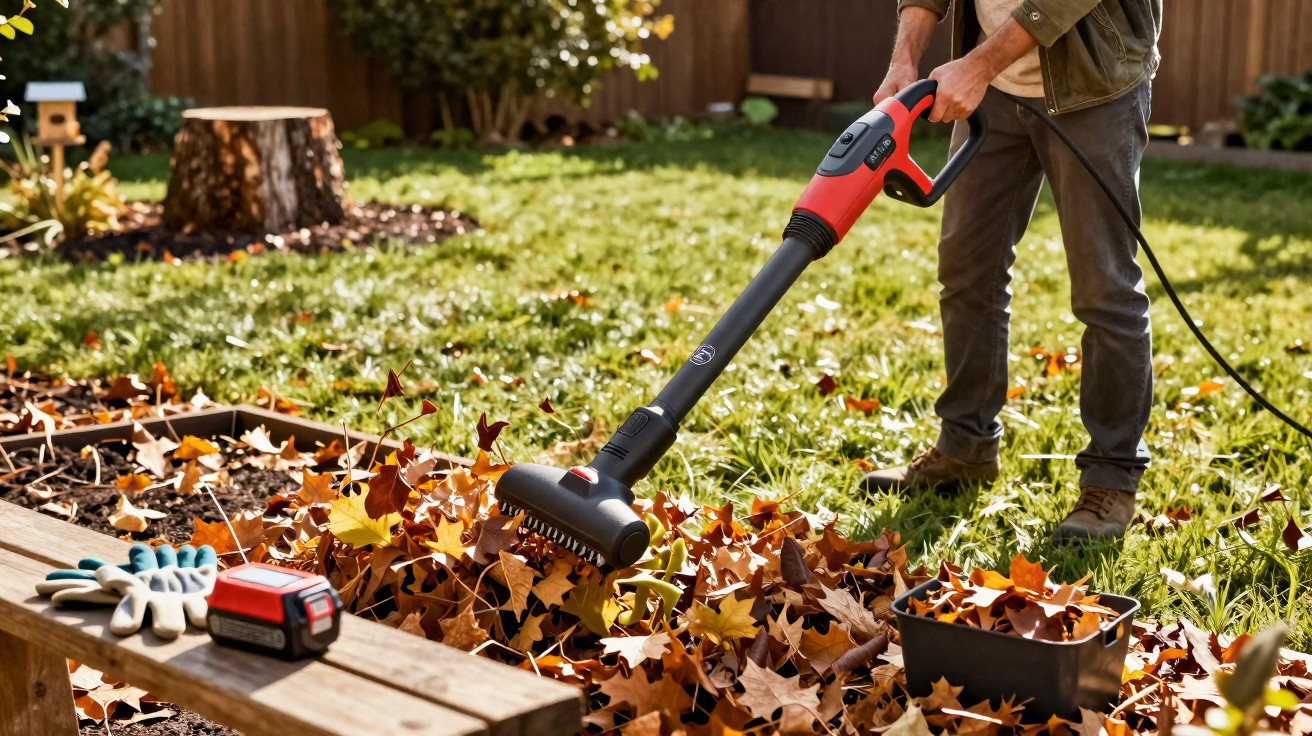
A crisp autumn weekend, a blanket of leaves and a rake propped against the shed: all quietly signalling aching muscles by Monday.
For plenty of householders, the image is instantly recognisable. The garden may look picture-perfect, but only after hours spent stooping, lifting and filling bags. A newer generation of cordless leaf tools is designed to change that pattern, making leaf clearance a fast and almost effortless job.
A leaf-strewn lawn without back-breaking work
Autumn foliage is attractive for a day or two, but it soon clings to damp grass, cuts off light and creates slippery surfaces on patios and walkways. Traditionally, dealing with it means a rake, a pile of refuse sacks and an aching lower back.
Leaf blowers altered the process by gathering debris into manageable heaps. Petrol-powered versions then brought bulky ear defenders, along with noise, fumes and maintenance demands. Corded electric blowers reduced noise and operating costs, yet still left users pulling a lead behind them. In a tight suburban garden, that is another hazard underfoot.
Cordless blower-vacuum-shredders promise the same cleaning power, without petrol fumes or a cable snaking through the flowerbeds.
This is the role of a machine such as the Mountfield MVS 20 Li: a battery-powered blower, vacuum and shredder combined in a single tool. It is supplied as a complete package, with batteries and charger included, so there is no need to search for a matching battery platform or purchase additional items separately.
How a blower-vacuum-shredder works in practice
The principle is straightforward: use the blower to gather leaves into a heap, change mode, then vacuum and shred them. In reality, this all-in-one approach changes the way garden waste is handled.
From scattered debris to compost-ready mulch
When used as a blower, the Mountfield MVS 20 Li directs a stream of air over the ground, steering leaves, small twigs and lightweight debris into rows or piles. It is useful on lawns, gravel driveways, decking and around a pool, where a rake could catch or cause scratches.
In vacuum mode, the same nozzle draws in the debris and pulls it through a blade set. The blades cut the leaves into far smaller fragments, which then drop into a fabric collection bag worn at the user's side.
By shredding leaves, volume is cut by roughly ten to one, turning a bulging pile into a dense, compost-friendly mulch.
This shredded material is particularly useful in two ways:
- Mulch around plants to retain moisture and reduce weeds.
- Feed a compost heap with fine matter that decomposes more quickly than intact leaves.
Rather than packing waste bins with bulky bags full of air, you can retain most of this organic material in the garden and use it to nourish the soil already there.
Inside the Mountfield MVS 20 Li kit
At the heart of the Mountfield MVS 20 Li is a brushless electric motor rated at approximately 600 W. Compared with older brushed designs, brushless motors generally operate efficiently and have fewer parts subject to wear. The tool is powered by two 20 V 4 Ah lithium batteries from the STIGA ePower range.
Both batteries and a dual charger come in the box, which is not always standard for tools in this class. Many manufacturers supply “bare” tools, assuming that buyers already have compatible batteries from another product.
| Feature | Mountfield MVS 20 Li |
|---|---|
| Power source | 2 x 20 V 4 Ah lithium batteries |
| Motor type | Brushless, approx. 600 W |
| Functions | Blower, vacuum, shredder |
| Air speed | Up to 55 m/s |
| Collection bag | 45 litres |
| Shredding ratio | Around 10:1 |
| Weight | Just under 5 kg with batteries |
| Runtime | Approx. 23 minutes blowing, 18 minutes vacuum/shred |
| Sound level | About 102 dB(A) |
Ergonomically, the end of the tube is fitted with small wheels. During vacuuming, the nozzle can be rolled across the ground instead of being held fully away from the body. A cushioned shoulder strap and soft-grip handle distribute the weight between the arm and torso.
The variable-speed trigger allows the output to be increased or reduced as needed. This is valuable on gravel, bark or decorative stones, where too much power could scatter material across the path.
Which gardens suit this cordless Mountfield?
The MVS 20 Li is intended for the type of outdoor space found at many suburban homes: larger than a tiny balcony, but nowhere near the scale of a park. Picture a small or medium-sized lawn, a few trees, one or two hedges, paved sections and perhaps a trampoline or an above-ground pool to work around.
Cordless freedom shines in gardens full of obstacles, where a trailing cable would constantly snag on furniture, toys and shrubs.
Its 45-litre bag and roughly 20 minutes of useful runtime make it better suited to frequent light clearing than to removing a full year's fallen leaves in a single ambitious session. Many people are likely to use it in brief spells, clearing the patio on a Sunday morning or quickly tidying the driveway before visitors arrive.
For larger, densely wooded grounds, especially those exceeding roughly 1,500 square metres, experts still commonly recommend powerful corded machines or petrol blowers. They can shift substantial volumes of debris in one session, although they bring more noise, more weight and, in the case of petrol, emissions.
Cordless, corded or petrol: understanding the trade-offs
Anyone considering a blower-vac has three main choices: corded electric, cordless battery and petrol. Each option comes with benefits and compromises.
Power, autonomy and comfort
- Corded electric: Delivers strong airflow and extended running times, usually for a lower initial price. However, an extension lead can snag on obstacles and restrict the working distance.
- Petrol: Offers substantial raw power and freedom from mains sockets and battery charging, making it suitable for large properties. Its disadvantages are noise, exhaust emissions, maintenance and weight.
- Cordless battery: Eliminates cables and petrol odours, while often providing simple push-button starting. Running time is limited by battery capacity, and output is generally designed for domestic rather than professional-scale work.
The Mountfield MVS 20 Li firmly belongs in the third group. At around 102 dB(A), hearing protection remains necessary, although its sound can seem less aggressive than that of certain petrol machines. Electric blowers commonly sit in a price range of around €100 to €350, while many lower-priced models exclude batteries, increasing their true cost once these are added.
What shredded leaves can do for your garden
A less obvious benefit of a shredder-vac comes after the leaves have entered the bag. Chopped material performs very differently to whole leaves and twigs.
Applied beneath shrubs or among perennials, this fine mulch:
- Creates a light covering that reduces water evaporation.
- Can limit some weed growth by reducing light at ground level.
- Slowly breaks down, contributing organic matter to the soil.
In a compost heap, smaller fragments provide microbes with greater surface area. This can accelerate decomposition and produce more consistent compost. It also prevents large, dry layers of leaves from forming a barrier within the heap.
Safety, noise and practical advice for everyday use
Although the tool reduces physical effort, it must still be used carefully. Extended exposure to 102 dB(A) without ear defenders may damage hearing over time. Safety glasses protect the eyes from grit and twigs thrown up by the airflow, while gloves improve grip and safeguard fingers when emptying the bag.
Using a lower blower setting on hard surfaces improves control and produces less dust. A higher setting is more effective for moving wet or compacted leaves from lawns, but caution is needed near loose stones. The wheels on the tube are intended to let the front roll along the ground, helping to prevent unnecessary strain on the shoulders.
Short, planned sessions make better use of the battery. One evening might be devoted solely to the terrace and paths, with the lawn tackled another day. This staggered method fits the tool's 20-minute sweet spot and helps avoid the temptation to continue once fatigue sets in.
Jargon check: what the specifications mean
Some specification-sheet numbers are more relevant to daily use than others. Air speed, which is around 55 m/s here, shows how forcefully the blower can shift leaves. Greater speed is useful for damp or stuck debris, especially in corners and confined areas.
The stated shredding ratio of roughly 10:1 means that ten bags of loose leaves are reduced to approximately one bag of shredded material. This is useful where council green-waste collections are limited or composting space is restricted.
Battery capacity, measured in ampere-hours (Ah), provides an indication of running time. Two 4 Ah batteries at 20 V offer a sensible balance: enough power to make a noticeable difference to the mess without making the machine excessively heavy.
For households balancing jobs, children and unpredictable weather, these details add up to something very practical: the possibility of returning indoors after half an hour outside to a neat lawn, a clearer conscience and a back still prepared for Monday morning.





Comments
No comments yet. Be the first to comment!
Leave a Comment