
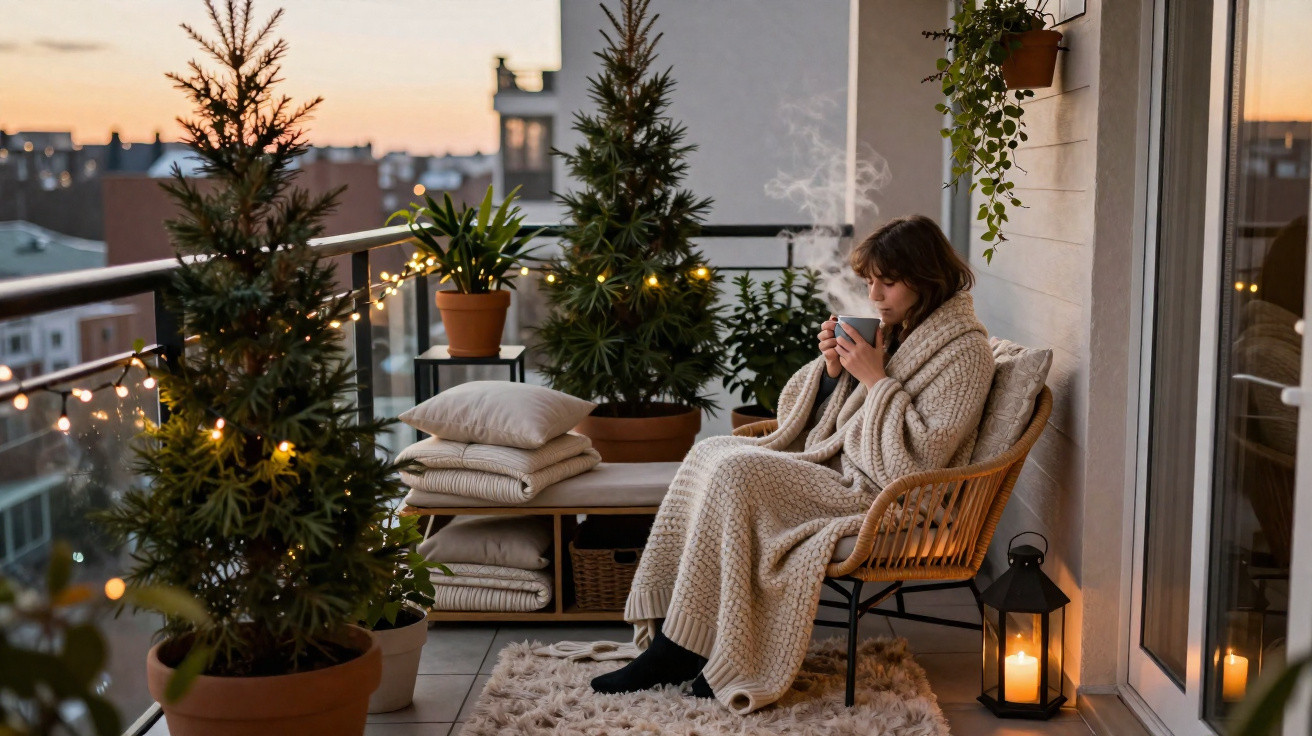
When temperatures fall, many people abandon their small outdoor space. Yet a few carefully selected additions can make it usable for far longer.
A balcony does not have to be large to feel like a genuine extra room. The issue is often that it has been arranged solely for fair weather: a lightweight chair, a couple of pots and, sometimes, an oversized table. As soon as the wind picks up or darkness arrives earlier, it can suddenly feel uninviting. With the right furniture, lighting, materials and draught protection, however, it can remain pleasant well into the season.
Choose seating that makes you want to linger
Comfort starts with the furniture. In a limited area, it is best not to crowd the balcony with too many pieces. A slim bench against a wall, two compact armchairs or a storage bench is often enough to create a relaxing corner.
Folding furniture is particularly useful when the balcony also needs to accommodate drying laundry or storing a few belongings. A drop-leaf table attached to the railing keeps the floor clear while still providing somewhere for coffee or a light meal outdoors.
“A pleasant balcony in winter is not the one with the most objects: it is the one where you can sit down without moving three pieces of furniture.”
In terms of materials, aluminium copes well with damp conditions and needs very little maintenance. Timber such as acacia or teak brings a warmer look, provided it is treated with a suitable protective product. Synthetic rattan is another lightweight choice that stands up well to showers.
Add textiles, but remember to protect them
A thick cushion, throw and outdoor rug can instantly transform how a balcony feels. They reduce contact with cold surfaces and make seating more inviting. During cooler spells, dense fabrics such as heavyweight cotton, wool or certain treated velvets make a noticeable difference.
- Removable cushion covers make washing easier after winter.
- Keeping a throw in a dry storage box prevents damp smells.
- A polypropylene rug withstands rain better than an indoor rug.
- Waterproof covers shield armchairs between uses.
Textiles should still be brought indoors during heavy rain or prolonged damp weather. Fabric that remains wet continuously will eventually go mouldy, even if it is marketed for outdoor use. A storage box therefore becomes one of the balcony’s most useful pieces of equipment.
Use plants as a living screen
Plants create privacy, soften the visual effect of concrete and make the space feel more sheltered. Evergreen varieties retain their foliage throughout the colder months. Ivy can cover a trellis, while Japanese spindle copes reasonably well with life in a container. Some non-invasive bamboos can also create a green screen, as long as they are planted in a sufficiently heavy, stable container.
Match pots to weight and wind exposure
On an upper floor, wind can easily topple lightweight containers. Sturdy planters placed on the floor, or securely fixed to the inside of the balustrade, are the safer option. Hanging pots require particular care: unsuitable fixings can endanger neighbours and passers-by.
In winter, roots suffer more quickly in pots than they do in open ground. Raising containers slightly, preventing standing water and wrapping pots in insulating protection can help plants withstand frosty spells.
Install soft lighting as daylight fades
Lighting extends the use of a balcony beyond 5 pm as days grow shorter. LED fairy lights, a rechargeable lamp or several solar lanterns are enough to create a welcoming atmosphere without the need for complicated wiring.
A colour temperature between 2,700 and 3,000 kelvins produces a warm effect similar to that of a traditional lamp. Very white light, by contrast, can look cold and feel less relaxing.
“For reading or dining outside, several small low-level light sources are often more comfortable than a single overly powerful light.”
LED candles are a sensible choice in a narrow space. They avoid open flames near curtains, cushions or dry plants. If real candles are used, they should be placed in a stable lantern and never left unattended.
Save space with discreet storage
Clutter can quickly make a balcony seem smaller than it is. A bench with built-in storage provides space for throws, covers and accessories. Wall shelves can hold a few plants or tealight holders without obstructing the walkway. Baskets are also useful for quickly putting cushions away just before a shower.
- Measure the circulation area before buying a storage box or bench.
- Keep at least one clear route to the patio door.
- Position heavy items against the structural wall, never along the edge of the balustrade.
- Do not overload wall fixings with excessively heavy planters.
This approach also makes the area easy to rearrange. A folding table can be used at the weekend, then put away when you simply want to sit with a throw and a book.
Block the wind without fully enclosing the space
Wind often drives people indoors more readily than cold temperatures do. A slatted wooden screen, a cane panel or an outdoor curtain can reduce draughts while allowing enough air to circulate. An awning can also provide shade in summer and limit direct exposure to light rain.
Before fitting anything, it is sensible to check the building’s leasehold or block regulations. Some buildings impose rules on awning colours, reed screening or equipment fixed to façades and railings. If you rent your home, the landlord’s permission may also be required for items installed permanently.
Perceived warmth also depends on the floor
The floor has a major impact on comfort. Interlocking tiles, an outdoor rug or wooden decking tiles can prevent the unpleasant sensation of icy paving underfoot. Decking tiles must allow water to drain away so that moisture is not trapped against the existing surface.
Lastly, a hot-water bottle, insulating blanket or rechargeable heated cushion may be enough for a quiet evening for two. Powerful heaters are rarely suitable for a narrow balcony: they use a great deal of energy, can disturb neighbours and require strict compliance with safety guidance. With wind protection, comfortable seating and well-positioned lighting, a few degrees less no longer necessarily means leaving this space empty.




Comments
No comments yet. Be the first to comment!
Leave a Comment