
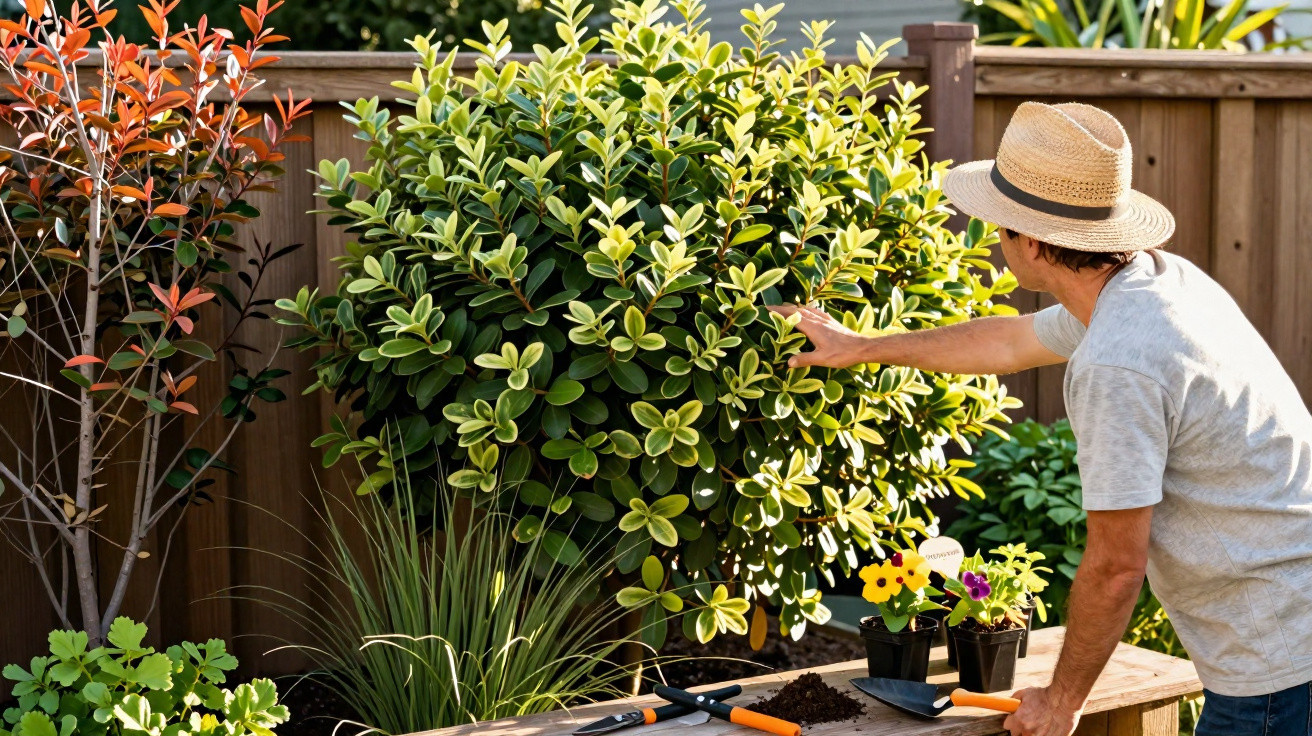
Many amateur gardeners are frustrated: the once-popular standard hedge is suddenly causing nothing but trouble – while another shrub is moving into the spotlight.
Damp springs, mild winters and leaves that are constantly under the weather: a plant once regarded as a dependable hedge choice is now producing gaps and brown patches in many gardens. As a result, more and more experts are advising a change – away from the sensitive classic and towards a hardy evergreen that is considered the new favourite for privacy hedges in 2026.
The former hedge star is losing strength
For years, Photinia – often sold as red robin in garden centres – was something of a favourite. It grows quickly, adds colour to borders with its reddish new growth and is relatively easy to clip into shape. For many homeowners, it was the default answer to the question: “How can I completely hide the neighbours within two or three years?”
That reputation is now beginning to crumble. Mild winters encourage fungal diseases, while wet springs take their toll on the foliage. Common consequences include:
- brown or black spots on the leaves
- heavy leaf drop as early as spring
- thin, see-through hedges with bare areas
- considerably more maintenance through pruning and plant protection
Anyone affected will know the pattern: they turn to sprays, prune more severely, clear up fallen leaves and hope for improvement – only to experience the opposite all too often. The hedge becomes thinner year after year, maintenance increases and privacy is reduced.
Many garden professionals now say plainly: anyone planting anew should think twice about choosing the sensitive red robin again.
The new favourite: Pittosporum as a hardy hedge alternative
Filling this gap is a shrub that was long regarded more as an insider tip: Pittosporum. In nurseries, it is usually listed under names such as pittosporum, Pittosporum tenuifolium or Pittosporum tobira. It is highly suitable for evergreen hedges – and perfectly matches the current mood.
Why Pittosporum is in such demand in 2026
Pittosporum has several qualities that make it a leading trend candidate:
- Strong resilience: It has far fewer problems with leaf diseases than red robin.
- Evergreen and dense: Its foliage stays on the shrub throughout the year, so it continues to provide privacy in winter.
- Tolerant of heat and drought: Summers are becoming longer and drier in many areas, and Pittosporum copes well once established.
- Keeps its shape: It can be pruned but does not require constant trimming.
- Versatile appearance: Depending on the variety, foliage may be green, almost black or variegated, creating looks from formally structured to naturally relaxed.
This shrub is especially appealing for people in full-time work: plant it once, water it well during the first two years, then give it only one or two trims a year – and that is it. No more continual battle with spots, spraying and drastic pruning.
Position, care and practical use: how Pittosporum works in real gardens
Pittosporum thrives in sunny to partially shaded positions. In particularly cold regions with harsh winters, variety selection needs more careful consideration, as some types are more frost-hardy than others. It grows without difficulty in many mild parts of Germany, Austria and Switzerland.
The key day-to-day points are:
- Soil: Loose and free-draining, with no waterlogging. Improve heavy soils with sand and compost.
- Plant spacing: Usually 60–80 centimetres between plants, depending on their eventual height.
- Watering: Water regularly during the first two summers; afterwards, mainly during periods of extreme drought.
- Pruning: In many cases, one shaping trim after the main flush of growth in June is enough.
- Feeding: One application of organic fertiliser or compost in spring is sufficient.
Anyone who does not want their hedge to become a full-time project will find Pittosporum a reliable partner – low-maintenance, yet far from visually boring.
Rethinking hedges: mixed planting instead of monoculture
Alongside Pittosporum as the trend shrub, a second approach is gaining ground: moving away from uniform single-species hedges and towards mixed hedges. Gardeners and landscape designers have promoted this idea for some time, but in 2026 it is increasingly reaching private terraced-house gardens.
The principle is simple: mixing several species spreads the risk. If one variety is lost to disease or frost damage, the rest remains stable. At the same time, insects and birds benefit from differing flowering periods, berries and growth habits.
Popular companions for Pittosporum
Typical companion plants in modern hedges include:
- Elaeagnus (oleaster): Very hardy, tolerant of wind and drought, and often with silvery foliage.
- Cornus sanguinea (common dogwood): Bright red stems in winter add structure during the bare months.
- Privet: A classic that tolerates pruning, forms a dense screen and copes with many locations.
- Osmanthus: Evergreen with fragrant flowers, offering an interesting replacement for box in certain settings.
- Native wild shrubs: Such as hornbeam, Juneberry or viburnum, which provide food and nesting places.
The result is not a sterile green wall but a living hedge that changes over the course of the year. Colourful new growth, flowers, berries and varied leaf shapes create interest without compromising privacy.
How attitudes to gardening are changing
Moving away from Photinia as an all-purpose solution is more than a short-lived fashion. Behind it lies a shift in the outlook of many amateur gardeners. They accept that climatic conditions are changing and are increasingly choosing plants that will perform over the long term.
Rather than pursuing rapid results with sensitive species, the question now increasingly becomes: will this planting still hold up in ten years, or will I have to start again from scratch? Hardiness, low maintenance and ecological value now count for more than a brief wow factor.
Plants that cope better with disease and extreme weather will become genuine “building blocks of security” in the garden in 2026 – Pittosporum is a typical example.
Practical advice for anyone changing their hedge
Anyone unhappy with an existing red robin hedge does not need to pull everything out at once. A gradual redesign is easier on both nerves and budget.
- Replace weak or severely diseased plants first.
- Fill gaps deliberately with Pittosporum and two or three other species.
- Always improve the soil when replanting, then water thoroughly.
- Leave older shrubs that are still healthy in place where possible – they can also be incorporated into a mixed hedge.
For terraced-house plots in particular, it is worth looking at the neighbouring side: it may be possible to agree a coordinated planting scheme, allowing both parties to benefit from a coherent overall appearance and better privacy.
What many people do not realise: risks, limits and useful combinations
Hardy though Pittosporum is, it is not completely invulnerable. Sensitive varieties can suffer dieback in exceptionally cold winters, especially in exposed places without protection from wind. In harsher regions, a sheltered site, such as in front of a wall, is advisable. Alternatively, choose especially frost-hardy varieties or use Pittosporum only as part of a mixed hedge rather than as the sole main plant.
Another consideration is that severely clipped hedges deprive many species of their natural shape. Pittosporum tolerates this, but often looks better when kept slightly cloud-like rather than cut with razor-sharp precision. Combined with somewhat wilder species such as dogwood or oleaster, it creates a look that feels less like a “drawing board” and more like a “garden for feeling at home”.
It becomes especially interesting when the new hedge is supplemented with ground-covering perennials or grasses. Underplanting with lavender, cranesbill or low sedges softens the hard edge between hedge and lawn while also shading the soil and reducing drying out. In this way, a simple boundary with the neighbouring property becomes a designed space that has something to offer throughout the year.



Comments
No comments yet. Be the first to comment!
Leave a Comment