
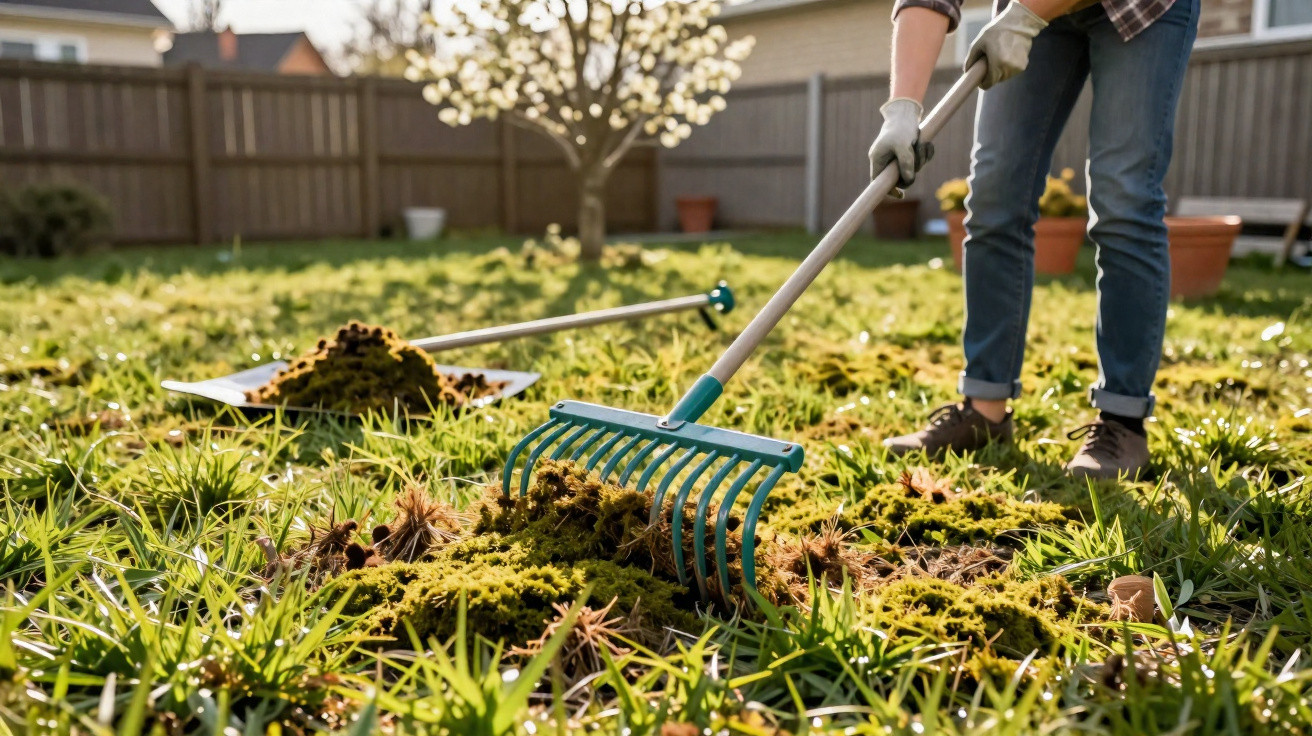
Two straightforward tools can change that.
In spring, looking out of the window often reveals a patchy carpet of moss cushions rather than a lush green lawn. Many people then reach for harsh chemicals or expensive machinery. Yet a clear approach using two basic tools, good timing and a few considered steps is enough to make the lawn vigorous, hard-wearing and attractive again.
Why moss spreads so quickly through a lawn
Moss is not a conventional weed; instead, it fills gaps wherever the grass has become weak. It thrives in shade, persistently damp ground, compacted soil and lawns cut extremely short – precisely the conditions found in many gardens after a wet winter.
Following the colder months, the soil is often:
- compacted by rain and foot traffic;
- short of nutrients and depleted;
- partly waterlogged because water cannot drain away properly;
- still cool while the sun has little strength.
Grass responds with poor growth. Moss takes advantage of the gaps, forming a dense cushion from spores that continues to spread. Simply pulling it away at the surface or ‘scraping’ it off with the mower does not tackle the underlying cause – and within a few weeks, it returns.
Moss is a symptom: it indicates that the soil and lawn are weakened. Understanding this makes it easier to plan a smarter response.
Timing matters: why patience is important in spring
Many amateur gardeners start enthusiastically in early March, then wonder why the lawn seems worse afterwards. The reason is simple: grass needs a degree of warmth to regrow after maintenance work.
It is worth beginning treatment only once temperatures are consistently mild and the lawn has visibly started growing again. Taking severe action too early, such as deep scarifying, can put extra strain on the turf and may even encourage moss in the long term by creating more bare patches.
The ideal window is from mid-March to late April, depending on the region. By then, many grass varieties are beginning fresh growth and can quickly fill newly opened spaces. In cooler areas, it is better to wait an extra week than act too hastily.
The two lawn tools almost every garden needs
The method centres on two uncomplicated tools available from almost any garden centre or DIY shop:
- A lawn rake or scarifying rake with sharp tines to pull moss and thatch from the surface;
- A lawn aerator – such as a garden fork, hollow-tine aerator or spiked roller – to loosen and aerate the ground.
Together, these tools clear the surface while addressing the cause beneath it. Powered equipment can make the task easier, but it is not essential. With enough time, excellent results are possible by hand.
How a rake clears unwanted material from the lawn
First, mow the lawn without cutting it too short, leaving it at around 5 cm. Then use the rake. Work firmly across the lawn in both directions to remove:
- moss cushions;
- old, dead grass;
- organic thatch, which acts like a sponge.
Initially, the result may look alarming: brown areas and very little rich green growth. However, this is the opportunity to rebuild the lawn’s strength. If desired, the process can be supported with an iron- and nutrient-based moss treatment. Such products weaken the moss cushions and give the grass a boost for growth.
Clear away first, then strengthen – this order determines whether a lawn looks good only briefly or remains stable over the long term.
Why aeration is vital for lawn roots
The second stage works below the surface. An aerator makes regularly spaced holes in the ground, providing:
- more air around the roots;
- better drainage instead of waterlogging;
- a looser structure for new root growth.
Treating only the surface leaves the real problem area – compacted soil – untouched. Moss favours dense, wet layers without oxygen. Grass roots, by contrast, need the opposite conditions. Aeration shifts the balance in favour of the lawn.
Practical plan: a sensible lawn routine throughout the year
A permanently resilient lawn does not require a complicated care calendar. A simple routine is enough when followed consistently.
Spring: the starting point for renewal
- Mow the lawn at a moderate height (around 5 cm).
- Rake out moss and thatch thoroughly, even if this leaves visible gaps.
- Optional: apply an iron-based moss treatment and allow it to work for one to two weeks.
- Make holes with the aerator, especially in frequently damp problem areas.
- Overseed using a suitable lawn repair seed mixture.
- Apply a light feed so the grass has the energy for fresh growth.
Repeating this sequence every spring gives the grass a clear head start over the carpet of moss.
Autumn: gentle care before winter
In autumn, a gentler version of the treatment is sufficient. Mow the lawn, remove leaves and lightly work over the area with a rake. A few passes with an aerator then loosen the soil and prepare it for rainfall. This reduces standing water and gives moss fewer opportunities to take hold during the cold season.
Common mistakes that practically invite moss
Many issues arise from well-intentioned but unsuitable maintenance measures. Common pitfalls include:
- Cutting too short: The lawn loses vigour, the soil heats up, and weeds and moss benefit.
- Constant watering: A continually damp surface encourages moss, especially in shade.
- Heavy foot traffic when wet: This compacts the soil, leaves water sitting on the surface and suffocates roots.
- No nutrient applications: Underfed grass grows in patches – an ideal invitation for moss.
Anyone who treats a lawn as a living carpet rather than green wallpaper will automatically avoid many typical moss problems.
Background: what actually makes a lawn strong
A robust lawn works like a dense network of shoots and roots. Every plant contributes to its stability. The closer-knit this network becomes, the less room remains for unwanted growth. The two tools do exactly what is needed: they create space and improve conditions so grass can reclaim that space as quickly as possible.
There are also three factors that many people underestimate:
- pH level: Highly acidic soil encourages moss. A garden soil test will show whether applying lime would be useful.
- Cutting height: Slightly longer grass blades shade the soil and keep its moisture level more even.
- Seed selection: Mixtures for shaded lawns and hard-wearing family lawns differ considerably. Choosing the right mixture has a stronger long-term effect than any one-off measure.
Why the combination means less work in the long run
Anyone who reacts only once the lawn has become thatchy again will face the same problem anew every year. Combining a rake with an aerator creates a form of small-scale fundamental renovation. The soil can breathe more effectively, the turf becomes denser and moss simply has fewer weak points to exploit.
That means the first round is demanding and takes time. However, the more consistently the work is done in the first and second years, the less effort will later be needed for corrective measures. Many garden owners report that, after two well-maintained seasons, they only need to do light follow-up work instead of starting all over again.
Combining this approach with some knowledge of soil, cutting heights and watering gives you a realistic chance of a lawn that not only looks good in photographs, but also withstands children’s feet, barbecues and wet springs in everyday life – without high-tech equipment, using just two simple tools and a clear plan.






Comments
No comments yet. Be the first to comment!
Leave a Comment