
They hunt in the dark, remain hidden by day – yet they still depend on our support.
One small addition to the garden can make all the difference.
Owls are seen as mysterious shadows of the night. We hear them, but rarely catch sight of them. Even so, they live right alongside fields, villages and even the edges of towns. Increasingly, however, they are unable to find safe places to breed. A simple item that any keen gardener or homeowner can provide can significantly improve their chances of survival.
Why owls need our help more urgently than before
Owls are still relatively widespread in many parts of Europe. Estimates suggest that tens of thousands of breeding pairs inhabit woodland, orchards, barns and old parkland. Their habitats, however, are changing rapidly.
Mature trees are being felled, barns renovated, roof spaces sealed and cavities closed off. These are precisely the sites where owls would usually nest. Although the birds can still find plenty of prey – mice, voles and insects – they lack secure nesting places in which to raise their young.
“Today, owls often fail not because of a lack of food, but because there are too few breeding sites – a problem that private gardens can solve surprisingly easily.”
This shortage becomes especially apparent during the mating season in late spring. Males call at night with distinctive cries and females respond, but without suitable holes or nest boxes, courtship often leads no further.
When the night becomes noisy: owl breeding season and behaviour
From late March and throughout April, activity in owl territories begins in earnest. Male birds attract females with their unmistakable calls. Species such as the long-eared owl and tawny owl relatives can be particularly vocal. Anyone out at night in rural areas will often hear their deep calls echoing across fields and gardens.
Once a pair has formed, it quickly looks for a protected place for its eggs. In an ideal setting, owls use:
- hollows in old, partly decaying tree trunks;
- spaces inside barns or stables;
- recesses beneath eaves or in church towers;
- abandoned nests of other large birds.
It is exactly these features that are disappearing. Old trees make way for new buildings, roofs are insulated without gaps and farm buildings are refurbished. Very little remains for owls. This is where the garden can help.
The one item that genuinely helps owls
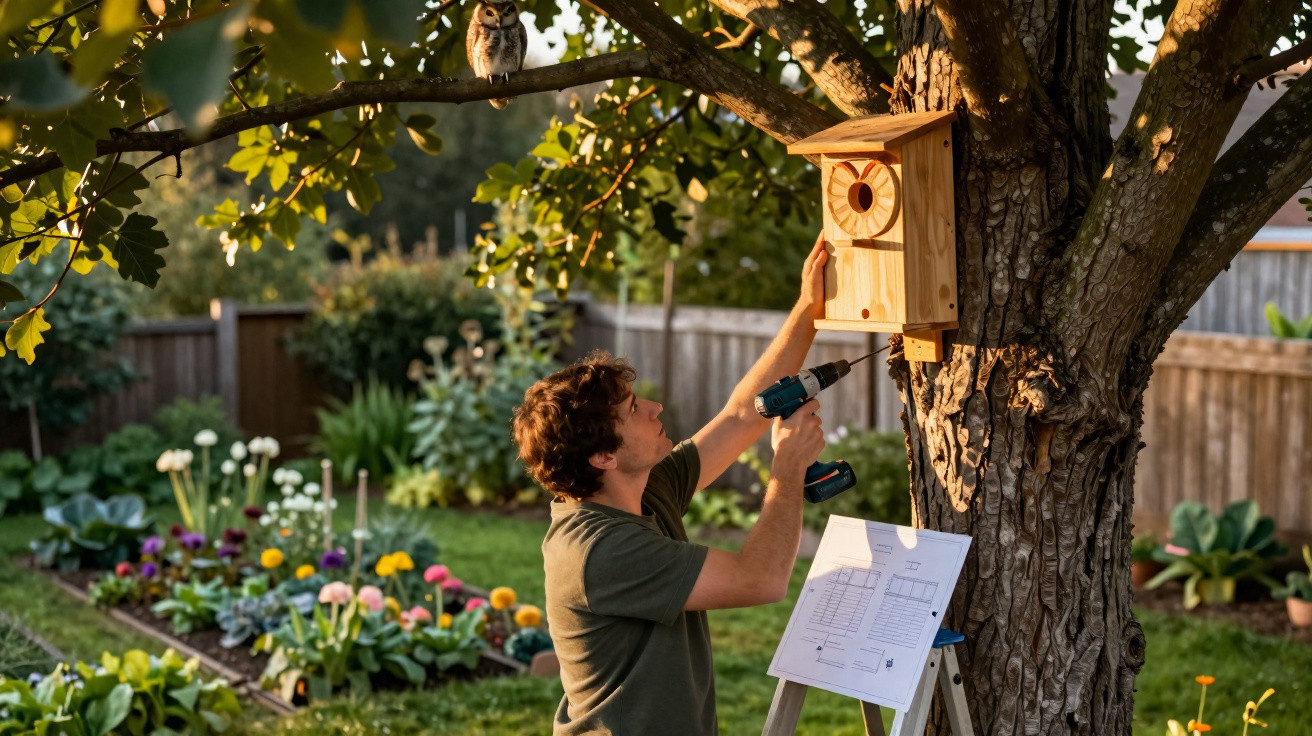
What owls need now is a sturdy, secure nest box. A purpose-built box can replace the lost tree hollows and recesses in walls. Anyone with a house, garden or even just a larger yard can offer direct support.
“A single nest box in the garden can enable a pair of owls to raise three to four young – year after year.”
Typical boxes for medium-sized owls generally allow for a clutch of three to four eggs. Incubation lasts almost a month. During this period, the birds are particularly vulnerable. They require quiet, dry conditions and protection from martens, cats and crows.
What a suitable owl nest box should look like
The ideal box depends on the species concerned. Nevertheless, there are several basic principles for many native owls that DIY enthusiasts can easily follow.
Key dimensions and materials
- Entrance hole: large enough, but not excessively so – roughly the size of a wide chicken-hole; openings that are too large can attract predators.
- Material: untreated, durable timber, ideally with a slightly rough inner surface so that young birds can climb more easily later on.
- Protection from damp: a water-resistant roof or a sheltered internal area prevents the wood from becoming saturated.
- Interior lining: a layer of straw, wood shavings or dry leaves makes the base softer and provides insulation.
Anyone wanting more precise guidance can use construction plans from nature conservation organisations. Many provide free diagrams with exact measurements tailored to tawny owls, little owls or barn owls.
Location: the best place in the garden
Even the finest box is of little use if it is installed in the wrong place. A few rules of thumb are useful:
- Height: at least 3 to 4 metres above the ground, preferably higher.
- Direction: as sheltered from the weather as possible, facing away from the prevailing wind and not in strong midday sun.
- Quiet: keep it away from brightly lit patios, frequently used paths or noisy play areas.
- Access: ensure a clear flight path, with no branches directly in front of the entrance.
If there is no suitable tree, the box can also be firmly fixed to a building wall, such as a barn or a tall garage.
Build your own or buy a ready-made nest box? Both options work
Not everyone enjoys sawing and screwing, but that need not be a barrier. Ready-made boxes are available from well-stocked pet shops, DIY stores and specialist online retailers. The important thing is to choose solid construction, sufficiently thick timber and a design suitable for the species.
| Option | Advantage | Disadvantage |
|---|---|---|
| Self-built | Individual dimensions, less expensive, easy to repair | Requires tools, time and some practical skill |
| Ready-made | Quick to install, often developed by specialists | Can be more expensive, and quality varies by supplier |
For added reassurance, contact a local nature conservation group or regional bird protection organisation. Many groups offer advice and sometimes even provide ready-made boxes.
How an owl box can also change your own garden
A pair of owls brings more than nocturnal calls: it can directly support the balance of the garden. Owls catch countless mice and other small rodents. Particularly on large plots or near fields, rodent numbers can decline naturally in this way – without poison bait.
“Supporting owls encourages biological pest control – silent and free.”
The garden also becomes more alive. Many people describe how their view of the night changes once they know that a pair of owls is breeding just a few metres away. Every rustle and every call suddenly becomes fascinating.
Common mistakes – and how to avoid them
To ensure that a nest box really is helpful, it is worth considering the most frequent problems:
- Installed too low: cats and martens can reach the box easily.
- Cheap plywood: it quickly becomes sodden, develops mould and offers very little insulation.
- Constant disturbance: curious people shining torches directly into the entrance cause stress to the birds.
- Incorrect cleaning: using harsh chemicals or opening the box repeatedly during the breeding season drives owls away.
Cleaning and inspection should take place only when the box is unoccupied, ideally in late autumn or winter, and should be kept to a minimum. Gloves are sufficient; coarse remains from the old nest can be removed, and little more is usually needed.
Everyone who takes part strengthens an entire ecosystem
Owls are among the species known as indicator species. When they are thriving, the wider ecosystem is generally in better condition too. A healthy population indicates sufficient insects, small mammals and suitable features in the landscape. Every additional breeding site helps to maintain this state.
Those wishing to do more can combine a nest box with wildlife-friendly garden design: less gravel, more hedges and a few untidy corners where mice and insects can live. This makes the site doubly worthwhile for owls.
In the end, neither a huge effort nor a major donation is required. One sturdy box, sensibly positioned, can often be enough. Many owls will find it on their own when the next breeding season begins. Then the night around the house and garden suddenly becomes a great deal more alive.

Comments
No comments yet. Be the first to comment!
Leave a Comment