
Many people give up on a lemon tree straight away – yet it can often be saved with a simple zero-cost trick.
Anyone who keeps a lemon tree in a pot will know the alarming sight: the little tree appears dead, the compost feels feather-light, and there is not a single trace of a green leaf. The plant is often thrown away at this point, even though it may still be recoverable. An old and remarkably straightforward method can encourage new buds within two weeks – with no specialist equipment, no expensive fertiliser, just water, patience and a few clear steps.
Is a dry, leafless lemon tree really dead?
The usual first reaction is: “It’s finished.” In many cases, that is not true. Lemon trees are exceptionally sensitive to a lack of water. If they remain too dry for several days, they switch into survival mode:
- they suddenly shed all their leaves;
- the branches look rigid and brittle;
- the pot feels extremely light;
- the compost pulls away from the sides and shrinks.
Although this looks dramatic, it simply means that the plant is trying to protect itself. It reduces moisture loss in order to save its roots. As long as there is still live wood, there is a good chance of rescuing it.
“A lemon tree without leaves is usually not dead; it is under severe water stress – and that is exactly where the rescue trick begins.”
Check for signs of life: a simple branch vitality test
Before doing anything else, check whether the tree is still alive. Use a fingernail or a sharp knife to lightly scratch the bark on the tip of a thin branch:
- green and moist beneath the bark – the branch is alive and the tree still has reserves;
- brown, dry and crumbly – this part has died and should be removed later.
Carry out this test in several places, working from the end of the shoots towards the trunk. This reveals how far the living wood extends.
Day 1: the zero-cost lemon tree rescue plan in detail
On the first day, the lemon tree needs something like emergency treatment: pruning, a water bath and a protected place to recover.
Pruning: lighten the crown and concentrate the sap flow
The aim of pruning is to direct the plant’s limited energy towards the parts that can survive. Follow this clear approach:
- Use clean, disinfected secateurs to remove every completely dry, brittle branch.
- Shorten thin, limp shoots that show no prospect of producing buds.
- Reduce the crown overall by around 30 per cent, cutting back to visibly green wood.
Large cut surfaces can be covered with pruning sealant, although this is not essential. What matters is that only firm, clearly living shoots remain at the end.
Water bath instead of a watering can: soak the whole pot
With the “dried-out pot syndrome”, the compost has contracted so severely that water simply runs down the sides. Ordinary watering is then of little help. The trick is to soak rather than water.
Here is how to use a water bath:
- Fill a tub or large bowl with water at around 20 degrees.
- Place the entire pot inside, with the water level just below the rim of the pot.
- Leave it for at least 15–20 minutes; if the compost is extremely dry, leave it for up to two hours, until air bubbles stop rising.
This bath allows the entire root ball to absorb water gradually again. Afterwards, take the pot out and let it drain thoroughly; do not place a saucer filled with water underneath it. Keep the plant in a shady spot for roughly 24 hours so that the root area can stabilise.
Why this method works so well
The central issue is the plant’s water balance. As compost dries out, it contracts. When it is watered later, the water cannot reach the fine root tips and simply drains through. The plant then continues to suffer from thirst despite a full watering can.
A water bath solves this problem because the root ball absorbs water from bottom to top. The fine root hairs can start functioning again, and the sap flow slowly resumes. However, the real boost comes afterwards.
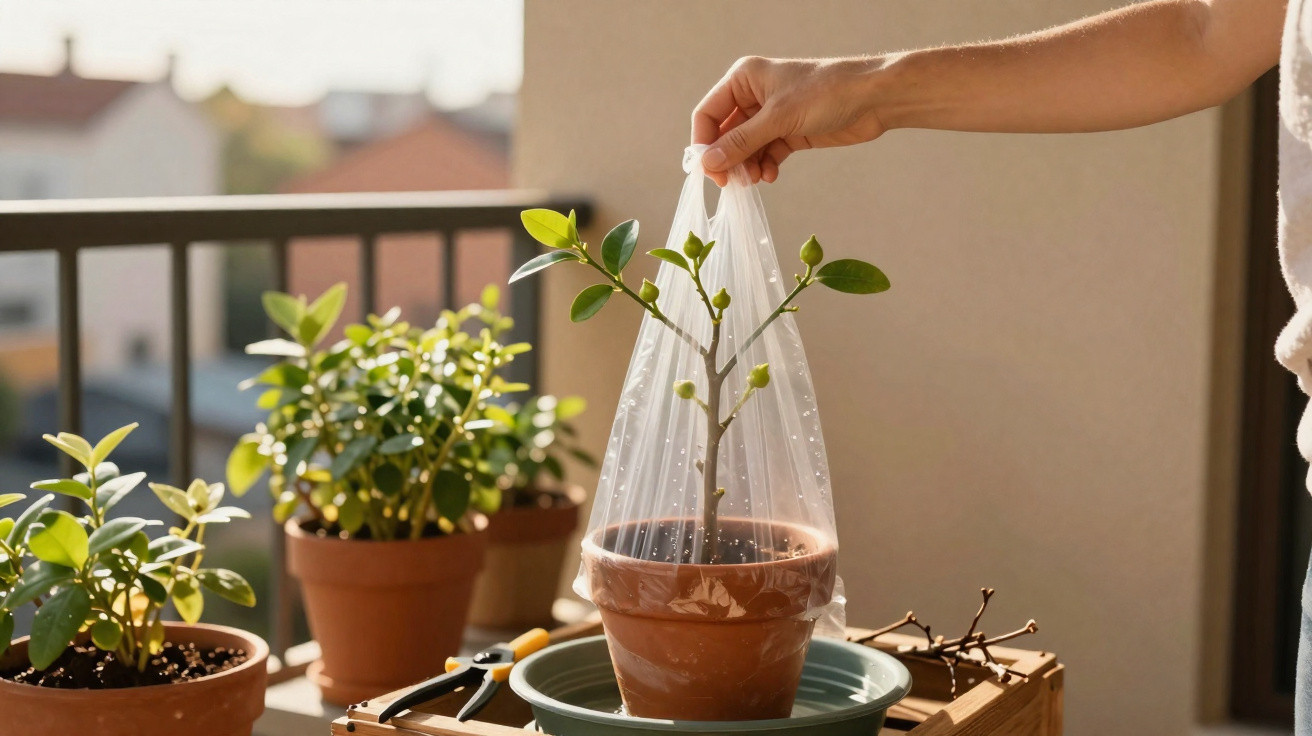
The plastic bag trick: a mini greenhouse with almost 100 per cent humidity
To stop the weakened tree drying out further through its bare branches, give it a kind of “recovery tent”:
- loosely place a transparent plastic bag or garment cover over the crown;
- lightly close it around the pot with string or an elastic band;
- position the lemon tree somewhere bright but out of direct sunshine.
This mini greenhouse creates humidity close to 100 per cent. The tree loses very little water while its roots gradually begin working again.
“In this humid protective zone, many lemon trees produce their first new buds after around 15 days.”
Important: open the bag for around ten minutes every two days to prevent mould. It may seem insignificant, but it has a major effect.
The critical 15 days: what is allowed – and what is not
Days 2 to 7: rest, light and no overreaction
During the first week after the water bath, restraint is what matters most. Common mistakes caused by “too much of a good thing” can ruin the rescue effort. Keep these points in mind:
- Give no fertiliser while no new leaves are visible.
- Check only with a finger: if the compost feels dry at a depth of around three centimetres, it can be watered again – but water thoroughly, not in tiny amounts.
- Keep the position stable: bright, without intense midday sun, and at temperatures between 15 and 18 degrees.
- Do not move the tree outdoors, repot it or keep changing its position.
Days 8 to 15: watch the buds and gradually open the microclimate
As soon as the first buds begin to swell visibly, adjust the plan slightly. The lemon tree now needs more air and gradually more light again.
Proceed as follows during this phase:
- Open the plastic bag a little further each day.
- After a few days, remove the protection completely if the shoots appear stable.
- Gradually raise the room temperature to 18 to 22 degrees.
- Increase the available light, but continue to avoid direct midday sun.
Once the tree has several fresh, fully developed leaves, liquid fertiliser for citrus plants can be introduced carefully. Half a dose every three weeks is sufficient, so that the root system does not become overwhelmed.
What remains important after the rescue
Pot, compost and position: avoid typical sources of trouble
The zero-cost trick will often get a lemon tree through the critical stage. Over the longer term, though, its surroundings are decisive. Three points deserve closer attention:
- Compost: Citrus plants need a free-draining, slightly sandy mix, not heavy garden soil.
- Pot size: Pots that are too small dry out extremely quickly, while oversized pots retain too much moisture.
- Drainage: A hole in the base of the pot plus a layer of expanded clay or coarse gravel prevents waterlogging.
Repotting is only worthwhile if the roots are already circling around the edge of the pot or the compost has become a solid, poorly aerated block. It is better to take this step a few weeks after the rescue, once the tree has visibly regained strength.
The right watering routine: the finger test as a simple guide
Many lemon trees do not die because they were short of water once, but because a period of drought stress is followed by constant flooding. Citrus plants dislike wet feet just as much as bone-dry compost.
One straightforward rule helps in everyday care:
- Push a finger around three centimetres into the compost.
- If it still feels slightly moist at that depth, do not water.
- Only water thoroughly when the compost feels noticeably dry – until a little water runs out at the bottom, then empty the saucer.
This establishes a rhythm that avoids both waterlogging and severe drying out.
Why lemon trees seem so sensitive – yet are surprisingly tough
Lemons originate from regions with mild winters, plenty of light and well-aerated, relatively lean soils. In a pot on a balcony or terrace, they can quickly face extremes: overly dry heated air, too little light and fluctuating temperatures. This makes them prone to water stress, leaf drop and root rot.
Even so, they have considerable powers of regeneration. As long as some roots are functioning and sections of the wood remain green, the tree can grow again. The rescue trick described here makes use of precisely this ability by breaking the cycle of dryness, stress and incorrect watering.
Anyone who does not give up on their own lemon tree too quickly at this critical stage can often enjoy fresh foliage and the characteristic citrus scent again just a few weeks later – while also learning how sensitive, yet how robust, these popular container plants really are.

Comments
No comments yet. Be the first to comment!
Leave a Comment