
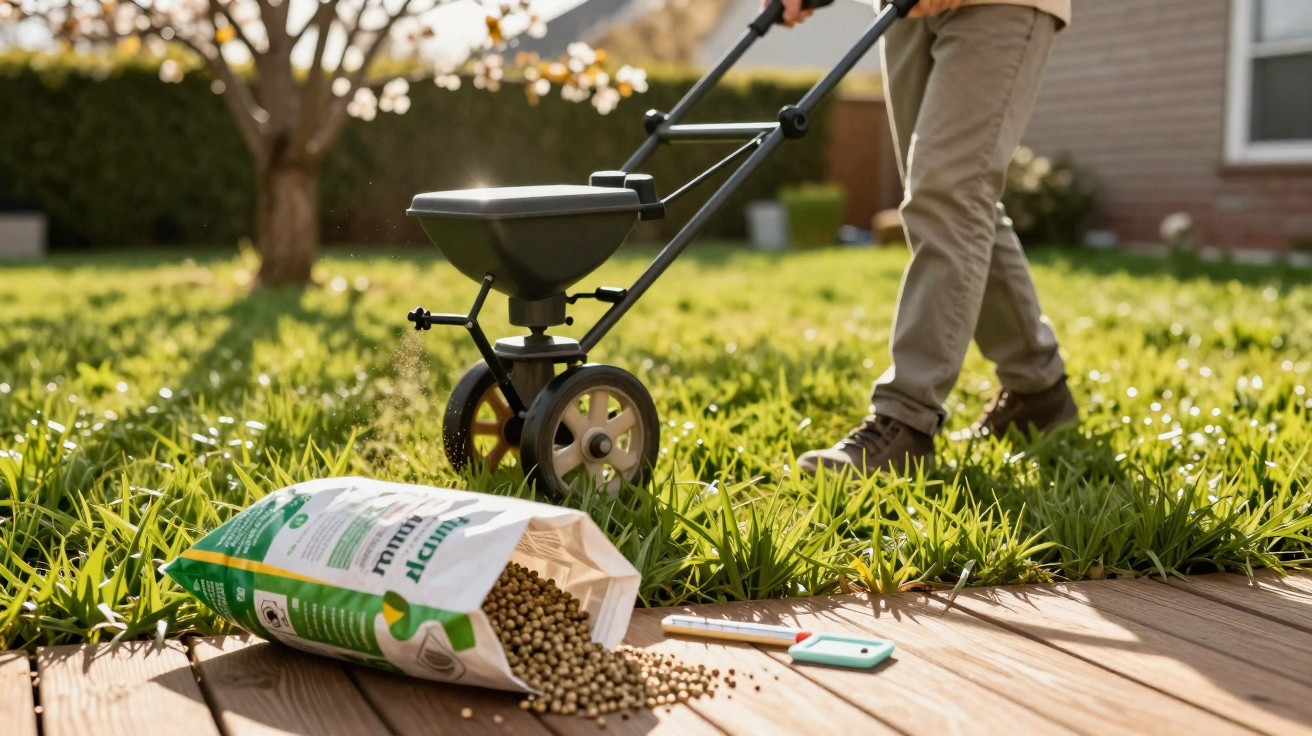
If, in March or April, you simply take out the lawnmower and expect everything else to sort itself out, you are missing a major opportunity. The crucial work happens below ground: at this point, the roots need targeted nutrients so the lawn can grow strongly, become dense and last throughout the summer.
Why lawns need targeted feeding in spring
After a wet, cold winter, a lawn is weakened. The blades are short, the roots are depleted and many nutrients have been washed away. Fertilising promptly now sets the course for the rest of the year.
“A well-nourished spring lawn grows more densely, stays green for longer and is far more resilient against drought and disease.”
Every lawn fertiliser pack displays three figures: the familiar NPK formula:
- N for nitrogen: promotes rich green colour and rapid growth
- P for phosphorus: supports the roots and downward growth
- K for potassium: improves resistance to drought, heat and disease
Many lawn professionals recommend applying fertiliser twice a year: once in spring and again in late summer or autumn. Heavily used areas, such as family lawns used by children or dogs, benefit from an additional light feed in June.
The right time: follow soil temperature, not the calendar
The date is not what matters; the temperature of the soil is. A lawn can only make proper use of fertiliser once the ground has warmed to around 10 to 12°C. In many areas, this period falls between March and April, although cooler locations may not reach it until May.
Signs that your lawn needs nutrients include:
- pale green or yellowing blades
- numerous bare patches where the soil is visible
- moss spreading despite regular maintenance
When these symptoms appear, mowing alone will not be enough. The lawn needs a targeted nutrient boost.
Which fertiliser in spring? Organic, organic-mineral or mineral
Organic fertiliser: family-friendly and kind to the soil
For domestic gardens, many people opt for an organic lawn fertiliser. It is generally made from natural ingredients such as poultry manure, horn shavings, dried blood, feather meal or plant-based residues.
Advantages:
- gentle, long-lasting action
- improves soil structure
- lower risk of “burning” the lawn
- usually suitable around children and pets, although you should still read the pack instructions
A light application of compost, known as topdressing, can also be highly effective. First aerate or scarify the lawn, then spread a thin layer of well-rotted compost and good-quality soil. This activates microorganisms, which release nutrients and gradually feed the grass roots.
Organic-mineral fertiliser: a faster start that remains sustainable
Those looking for a noticeable “kickstart” can choose an organic-mineral lawn fertiliser. Spring blends commonly have a ratio of around 10-2-4 (N-P-K). They combine a relatively quick nitrogen boost with a longer-lasting organic base effect.
This type of fertiliser is well suited to lawns that look tired after winter but are not yet completely ruined. It gets the grass growing again without the nutrient supply collapsing after just a few weeks.
Mineral fertiliser: highly concentrated and demanding
Purely mineral lawn fertilisers are very concentrated. Typical spring products have a ratio of around 30-5-5, or 12-5-20 later in spring. Above all, they supply plenty of nitrogen for fast growth and a deep green colour.
However, using them requires discipline:
- follow the manufacturer’s dosage instructions exactly
- never apply in intense heat or severe drought
- water thoroughly after spreading
“Anyone who applies too much fertiliser or feeds the lawn in blazing sunshine risks brown patches and scorched blades.”
Check the lawn’s condition and match the fertiliser to it
Slightly worn but still dense lawn
If the lawn is broadly dense but looks dull and somewhat lacking in vigour, a gentle approach is usually sufficient. An organic fertiliser at the standard dose will normally restore the green colour. Coffee grounds can be used as an addition: either stir around 250 grams into 15 litres of water and apply it as a liquid feed, or spread the dried grounds thinly and lightly rake them in.
So-called compost tea has also proved effective. This is made by steeping well-matured compost in water. Apply the diluted liquid at a rate of around 4 litres of finished compost tea per 100 square metres, every two to four weeks. It encourages soil life and supports root health.
Severely weakened, yellow lawn
Where the whole area looks tired and yellowish and is threaded with moss, it needs a small all-round treatment:
- Scarify or aerate thoroughly to remove moss and thatch.
- Apply topdressing made from fine compost and soil.
- Spread an organic-mineral fertiliser with a spring formula, for example 10-2-4.
This rebuilds the lawn from the ground up. The roots gain air and fresh nutrients, allowing them to branch more effectively.
New lawn: less is more
A newly laid lawn needs some time to settle before fertiliser is introduced. Only after several mowing sessions, once the grasses are standing firmly, should it receive its first reduced feed. Applying fertiliser too early or at too high a dose can weaken young blades and make them more prone to disease.
How to apply lawn fertiliser correctly
Even the best fertiliser performs poorly if it is applied incorrectly. This is a general sequence many gardeners follow:
- Mow beforehand, but do not cut too short: a cutting height of 4 to 6 centimetres is ideal.
- Remove moss and lawn thatch, scarifying or aerating where necessary.
- Spread on slightly damp soil, rather than on bone-dry ground.
- Use a fertiliser spreader to achieve even coverage.
- Avoid the edges and, wherever possible, keep fertiliser off patios, paths and flower beds.
- Water afterwards to wash the nutrients into the soil.
“Light rain shortly after fertilising is ideal – a heavy downpour can wash the granules away.”
What terms such as NPK, compost tea and topdressing mean
The abbreviation NPK brings together the three main nutrients grasses need most. The ratio changes depending on whether the lawn needs to grow, develop roots or become more resilient.
Compost tea is essentially an extract made from compost, in which microorganisms and soluble nutrients collect in the water. Its main purpose is to activate soil life and support plant health.
Topdressing – the thin application of soil-and-compost mixes – helps level minor unevenness, improve soil structure and place nutrients close to the grass roots. This measure is particularly worthwhile on heavily used areas once or twice a year.
Risks, mistakes and how to avoid them
The most common lawn-fertilising problems have the same cause: applying too much at once, doing it at the wrong time or fertilising in unsuitable weather. Anyone spreading a nitrogen-rich fertiliser in midsummer at 30°C should not be surprised to see brown patches.
Fertilising too frequently is harmful as well. The lawn may grow rapidly, but it becomes soft, vulnerable to disease and dependent on constant mowing. A more sensible approach is moderate basic feeding in spring and autumn, combined with soil-care measures such as aeration, topdressing and targeted watering during dry spells.
Smart gardeners also consider the full maintenance mix: a sharp lawnmower, an appropriate cutting height, mowing often enough and carefully planned watering all greatly improve the effect of fertiliser. Combining these elements means emergency action is needed less often – and lets you enjoy a dense, rich green lawn from spring onwards that lasts all summer.





Comments
No comments yet. Be the first to comment!
Leave a Comment