
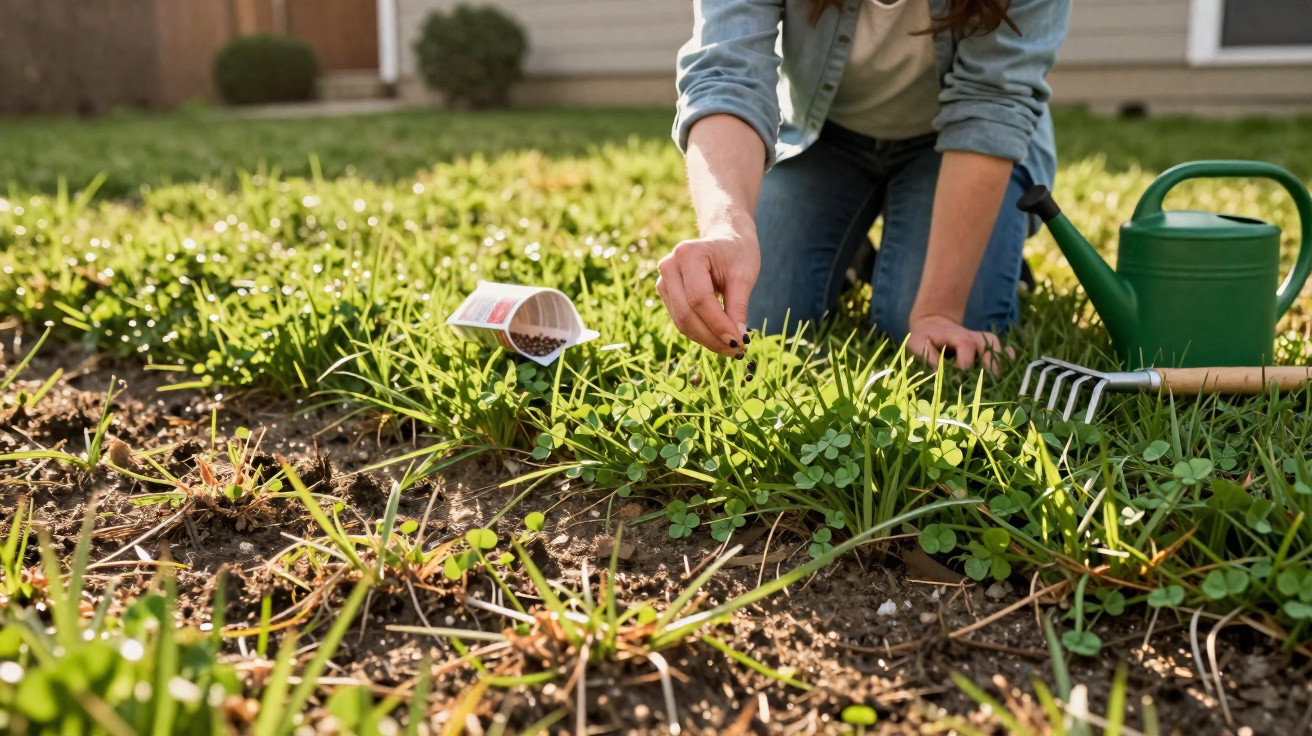
After winter, a look across the garden often reveals anything but the lush green shown in brochures: yellow patches, dry areas and genuinely bare islands. Many people instinctively reach for fresh lawn seed, wait for weeks, then find themselves frustrated again in summer by scorched, dusty ground. There is another option, popular in Poland and increasingly among professional gardeners in Germany: using microclover in lawns.
Why lawns are full of holes after winter
A spell of frost followed by temperatures of 10°C, then another night frost: this repeated fluctuation puts the turf under real strain. Roots suffer, some grass blades die off and others turn yellow. Other contributing factors include:
- compacted spots caused by frequent foot traffic
- dog urine, which can effectively “burn” the lawn
- moss spreading through shaded areas
- cutting too short in autumn, which weakens the turf
The result is bare, dull-looking patches that make the entire garden appear neglected. These gaps are especially annoying in front gardens, around seating areas or near a trampoline.
Rather than reseeding the same problem areas every year, a simple trick can make a lawn permanently more resilient.
The gardeners’ secret: microclover instead of lawn seed alone
Microclover is essentially a particularly low-growing form of white clover. Its leaves are much smaller, it stays close to the ground and blends almost invisibly into the turf. That is precisely where its main benefit lies.
Conventional lawn seed needs nutrient-rich soil with consistently even moisture, whereas microclover manages with far less. It grows where grass has already given up, closes gaps and creates a dense, pleasant surface to walk on.
How microclover tackles bare patches
- Closes gaps quickly: The plant spreads by creeping and grows across bare areas.
- Copes better with drought: Its roots draw water from deeper layers of soil.
- Withstands foot traffic: Children, dogs at play and garden parties all put it to the test, yet the surface remains stable.
- Stays low-growing: It generally reaches only 3 to 8 centimetres in height, making it very easy to maintain.
The contrast is particularly clear in busy gardens. While a purely ornamental lawn quickly suffers under pressure, a grass-and-microclover mix stays green even in heavily used spots.
Step by step: sowing microclover correctly
The ideal time is early spring, once the soil is free from frost and has dried out slightly. This gives the plant enough time to establish a strong root system before summer heat arrives.
Preparing bare areas for microclover
Before sowing, a little manual work is worthwhile. The following method is the most reliable:
- Remove old lawn debris: Thoroughly rake out dry grass blades, moss and leftover roots using a rake.
- Clear weeds: Dig out unwanted plants together with their roots so they cannot crowd out young seedlings.
- Loosen the soil: Lightly cultivate the top 2 to 3 centimetres or roughen it with a rake.
- Level the area: Break up larger clods of earth and even out any irregularities.
This small amount of preparation ensures the seeds make good contact with the soil and germinate evenly.
Mixing, sowing and watering
For an even distribution of microclover, a simple mix is recommended:
- combine microclover seed with a little fine potting compost or dry lawn soil
- optionally add a small proportion of lawn seed if the area has severely damaged turf
The mixture can be spread easily by hand. Then lightly rake in the seed or press it down with the flat side of a rake; it should be covered by only a thin layer of soil.
Watering is crucial during the first two to three weeks. Keep the soil consistently slightly moist, but never waterlogged. It is better to water briefly and frequently than rarely with a heavy flow that washes the seeds away.
Sowing microclover in spring gives the lawn a clear advantage before the summer heat arrives – without expensive specialist fertilisers.
Less fertiliser, more green: microclover as a natural nutrient source
With the help of root nodule bacteria, clover species can capture nitrogen from the air and store it in the soil. Microclover brings this ability into the lawn on a smaller scale.
In practical terms, this means:
- The lawn receives a continuing supply of fresh nitrogen through its roots.
- The turf looks richer and stronger without constant fertilising.
- Mineral fertiliser can often be reduced substantially.
This is particularly beneficial in dry summers. An over-fertilised lawn is more likely to scorch and become susceptible to disease. A clover-and-grass carpet is usually more stable and recovers more quickly after periods of stress.
Suitable locations and potential limitations
Microclover suits many gardens, but it is not a universal solution for every surface. A quick check before sowing can prevent disappointment.
| Feature | Suitability for microclover |
|---|---|
| fully sunny, dry position | very suitable, as it is robust and deep-rooted |
| light partial shade | suitable, although growth is somewhat slower |
| dense shade beneath trees | only conditionally suitable, as there is usually too little light |
| rather heavy, wet soils | improving the soil beforehand is sensible |
Anyone seeking a meticulously maintained ornamental lawn with the appearance of a golf course is unlikely to be pleased by visible clover. In family gardens, at holiday homes or on heavily used areas, however, microclover often proves its worth after only a few weeks.
Microclover lawn care through the year: mowing, watering and use
Microclover does not require care that is fundamentally different from an ordinary utility lawn, although a few points help put it into context:
- Mowing height: Avoid cutting too low; 4 to 5 centimetres is a useful guideline.
- Watering routine: Water less often but more thoroughly, encouraging roots to grow deeper.
- Use: Let children play on it, walk over it and lie on it as usual – the surface is designed for this.
Over time, the proportion of clover will vary according to the location and the care it receives. In dry, hard-worn spots, it often becomes the dominant plant, while grass prevails in more favourable areas. This interaction is exactly what makes the lawn adaptable.
Common questions: allergies, bees and children
The same questions regularly arise about clover in lawns. Here are several key points:
- Pollen allergy: Microclover generally flowers more delicately and less conspicuously than ordinary clover. Anyone who reacts strongly can mow a little more frequently during its flowering period.
- Bees and insects: Flowering clover attracts pollinators. In play areas especially, regular mowing is advisable to reduce the risk of stings.
- Walking barefoot: The fine leaves feel soft, and many people find the surface more pleasant than grass alone.
For families with children, a compromise works well: mow heavily used zones more closely, while allowing selected areas at the edge of the garden or behind the garden shed to grow a little taller, where clover and other flowering plants can provide food for insects.
When using microclover is especially worthwhile
Anyone who has to reseed the same spots every spring should seriously consider microclover. Typical trouble areas include:
- spaces around the patio or barbecue area
- routes repeatedly used by family members
- corners where the dog prefers to relieve itself
- areas beneath a trampoline or beside play equipment
This is where the plant mix shows its strength. The lawn looks less scorched at the height of summer, retains its colour for longer and recovers more quickly when it has suffered damage.
Anyone who invests one or two afternoons in preparation and sowing this spring can look at their garden far more relaxed in summer. Bare patches become less common, the lawn appears stronger – all without constant bouts of reseeding and continual fertilising.






Comments
No comments yet. Be the first to comment!
Leave a Comment