
The first time I noticed it was in the middle of a heatwave. Two neighbouring gardens on the same street had the same clay soil and endured the same unforgiving sunshine. One appeared exhausted, with plants drooping from thirst by early afternoon. The other remained unexpectedly fresh. Mulch played a part, as did some shade. Yet, while standing by the fence, it was clear that something more was influencing the result.
Each evening, I watched a hose follow the same route, with water running away down a slight gradient I had never previously noticed.
That was when I understood: the garden’s shape itself was determining which plants could thrive comfortably and which were left crying out for water.
Once you have noticed it, it is impossible to overlook.
The subtle feature that determines where your water goes
Take a walk around any garden just after heavy rain and your shoes will reveal what is happening. Some places are squelchy, others are already cracking, while a small stream may quietly be making its way towards the roadside gutter. The commonly missed factor is the shape of the ground, even where its variations measure only a few centimetres.
We spend a great deal of time discussing soil type, compost and fertilisers. However, the simple arrangement of higher and lower areas in a garden often determines whether water soaks in or runs away. It could be a shallow hollow beside a fence, a mild slope towards a path or a raised bed sitting slightly too high. Each of these small changes in ground level affects how long moisture remains where plants require it.
A garden can appear level to the eye, but it almost never truly is.
Consider Lisa, who moved into a small home on the edge of town. She took on a narrow lawn and several rather unhappy roses. Her soil was typical suburban clay: dense and prone to cracking every summer. Although she added new perennials and watered every evening, the beds were dry again only a few hours after sunrise.
One evening, following a sudden storm, she looked out from her kitchen window. Water travelled in a thin, silvery sheet through the centre of the garden and directly towards the driveway. The border on the left, which sat slightly higher, stayed moist. On the right, nearest the fence, puddles developed and remained for days. It was the same soil, yet there were three very different water conditions, created solely by the land’s subtle contours.
She did not require different soil. She required different curves.
What we usually mean by “garden layout” can sound purely decorative: paths, flower beds and perhaps a small pergola. In reality, layout is hydrology in disguise. Every path, border or raised bed we make tells water where it should move and where it should settle.
Level sections take in water gradually and consistently. Small mounds quickly send it towards the nearest lower point. Narrow paths, particularly when compacted, function as miniature channels. Eventually, this produces hidden patterns: dry patches, waterlogged corners and plants that inexplicably fail along one particular line.
The real driver of water retention at garden scale is rarely soil type alone; it’s how your garden’s shape invites water to stay or pushes it to leave.
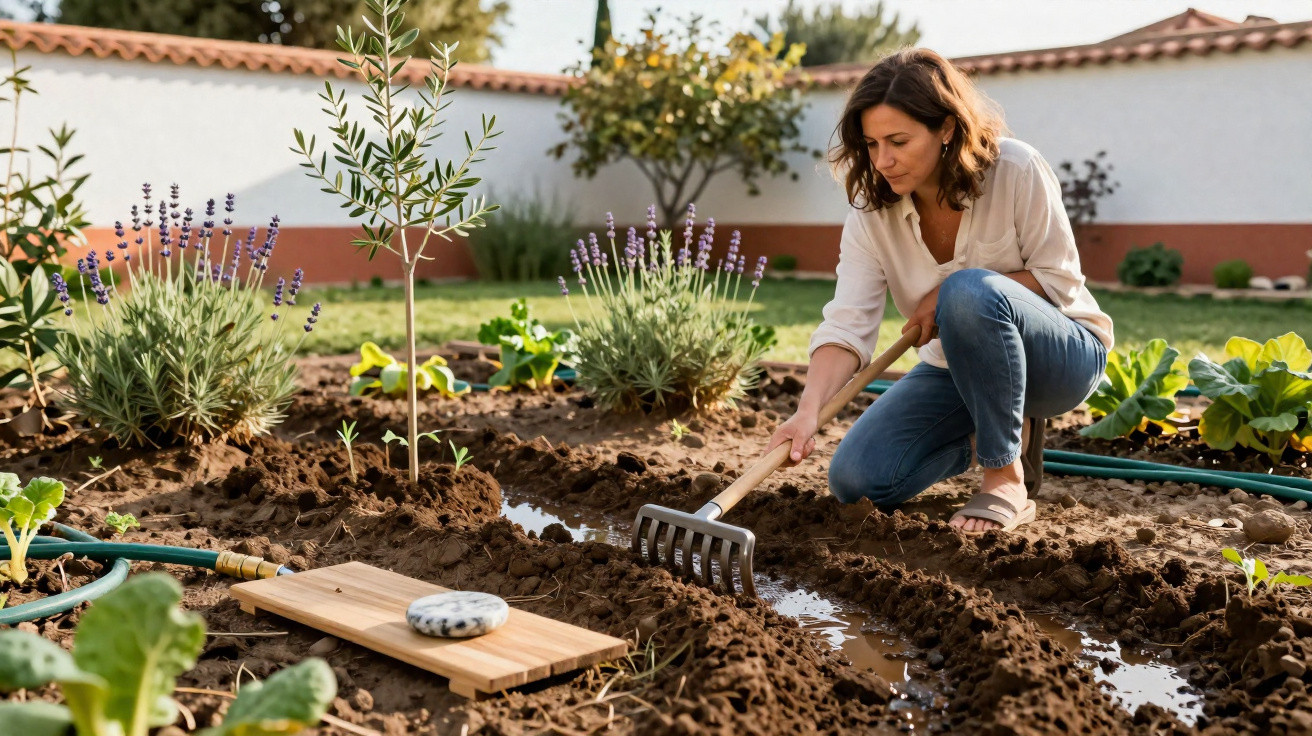
Use a rake, not a hose, to guide water
Begin by viewing your garden as a map rather than a picture. When it next rains, pull on your boots and walk around it. Which places collect water first? Which ones drain most rapidly? Follow the tiny streams you can see moving across the surface. This ten-minute walk may teach you more than a pile of gardening books.
Next, use a straightforward tool such as a rake or hoe. There is no need to remodel the entire garden; you are simply creating new routes for water. On slopes that lose water too fast, scrape shallow channels across them to direct water towards your beds. Around plants that need more moisture, form small, gentle basins-not perfectly flat circles, but slight saucers that encourage water to remain a little longer.
At that point, you are doing more than gardening. You are carrying out purposeful micro-landscaping.
Most of us make the mistake of treating the symptoms rather than altering the layout. When plants wilt, we water them more. When beds crack, we spread mulch and hope for the best. If a wet corner starts to smell, we simply avoid planting there. The hose then becomes a plaster over a design issue.
We have all had that moment when we decide our garden must be cursed, while a neighbour barely waters yet still grows abundant tomatoes. Often, they have simply ended up-whether deliberately or by chance-with a shape that keeps water where it is most useful. This may be a gentle ridge in the right position, a path that is slightly sunken or a rain garden that receives the runoff.
Let us be realistic: no one does this every day. Still, one carefully considered adjustment to the layout can prevent years of frustration.
“Once I stopped blaming my ‘bad soil’ and started watching where the water actually moved, everything changed,” says Marc, a self-taught gardener in his fifties. “I didn’t touch the soil type at all. I just reshaped the surface with a shovel, and my watering time dropped by half.”
You do not need a landscaping qualification to achieve this. A short checklist and some patience are enough:
- Inspect your garden immediately after rain and identify three places: the quickest to dry, the slowest to dry and the point where water leaves.
- Lower areas where you want water to gather by only 2–3 cm, and no more.
- Raise paths slightly, or give them a gentle crown, so water sheds towards beds rather than the street.
- Include at least one “catch zone”, such as a rain garden or a slightly sunken bed, to receive runoff.
- Check again after the following rainfall, then refine the ground level centimetre by centimetre.
How garden shape changes the way you garden
Once you start considering high and low points, your relationship with gardening changes slightly. Rather than only asking, “What should I plant here?”, you begin to ask, “What does water naturally want to do here?” It is a gentler and less tiring approach to caring for a garden.
You may spot fresh opportunities: a small sunken herb bed that remains moist without help, a raised curve of stones that prevents runoff escaping, or a reshaped lawn that sends rain towards your vegetables rather than the pavement. These features seldom appear in polished garden photographs, but they determine how much time you will spend pulling a hose around.
This overlooked aspect of garden layout does not make a fuss. It quietly speaks whenever clouds pass overhead and release rain. If you pay attention, you can create a garden that works with your climate rather than against it.
| Key point | Detail | Value for the reader |
|---|---|---|
| Micro-relief matters more than soil type | Minor height variations determine whether water infiltrates, runs off or stagnates | Understand why certain areas remain dry or soggy despite sharing the same soil |
| Observe after rain, not just when watering | Recording puddles, mini-streams and dry patches exposes the garden’s hidden layout | Gain a clear, practical starting point before replacing plants or purchasing amendments |
| Shape beds and paths intentionally | Gentle basins around plants, crowned paths and catch zones retain water where it is needed | Reduce watering time, plant stress and wasted rainwater |
FAQ:
- Question 1 How can I tell whether my garden layout is losing too much water?
- Answer 1 Look at your garden straight after heavy rain. Water streaming towards the street, rapidly drying strips across the lawn or plants that repeatedly wilt on slight slopes all indicate that the surface layout is shedding water instead of retaining it.
- Question 2 Must I level everything to improve water retention?
- Answer 2 No. A completely level garden can actually drain badly. The aim is to create gentle differences: slightly lower places where moisture should remain, alongside softly raised paths or edges that direct surplus water towards those areas.
- Question 3 Does this work with sandy soil too, or only clay?
- Answer 3 It works with every soil type. Because sandy soil drains rapidly, shallow basins and catch zones help each drop remain for longer. In clay soil, the layout can prevent puddles and move water away from places that stay waterlogged for days.
- Question 4 Is mulch not enough to hold water in the ground?
- Answer 4 Mulch reduces evaporation, which is very useful, but it cannot alter the direction in which water travels. If your garden layout sends half its rainfall into the street, mulch will not prevent it. Mulch and considered micro-relief are most effective when used together.
- Question 5 How large do the changes in height need to be before they make a difference?
- Answer 5 In small gardens, even 2–3 cm can alter the route of surface water. Begin on a small scale, reshape a limited section and observe the next rainfall. Make gradual adjustments rather than large, dramatic alterations all at once.




Comments
No comments yet. Be the first to comment!
Leave a Comment