
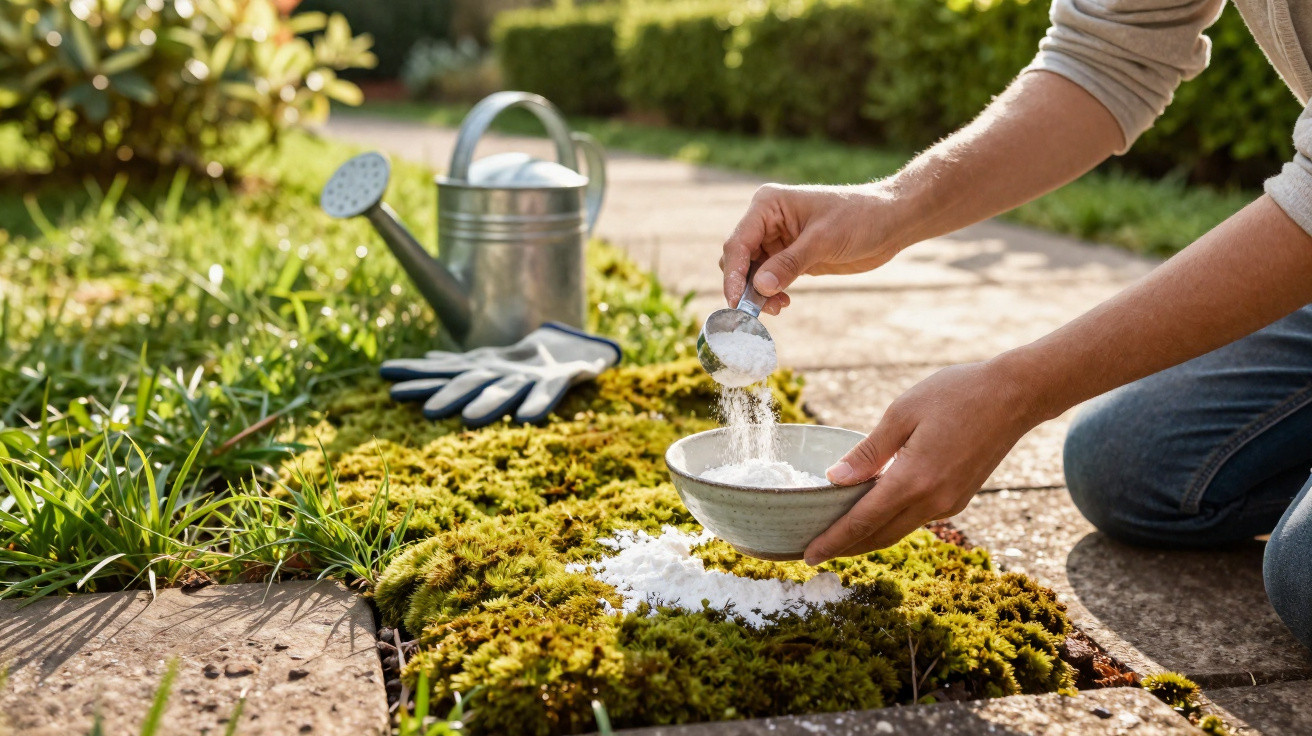
More and more amateur gardeners are looking for an effective solution that does not turn the garden into a chemical wasteland. Surprisingly, the answer is often found not on a DIY-shop shelf but in the kitchen cupboard: ordinary bicarbonate of soda, used for baking and cleaning, can substantially curb moss on paths and lawns - provided it is applied selectively, sparingly and with a little background knowledge.
Why moss thrives on lawns and paths
Moss is not evidence of “bad gardening”. Rather, it is a fairly honest sign that local conditions are ideal for this plant - and less favourable for grass.
On lawns, moss particularly benefits from the following conditions:
- acidic soil with a pH below roughly 6
- compacted ground that allows little air through
- persistently damp areas, often after rain or in shade
- weakened turf, for example because of nutrient deficiency or incorrect mowing
Where gaps appear in the grass, moss moves in. It captures light and moisture, causing the lawn to retreat further - a cycle that can turn many gardens into a green-grey, matted surface within a few winters.
A similar process occurs on paths, paving slabs and gravel areas. Moss establishes itself in joints, retains water, makes the surface increasingly slippery and turns a tidy driveway into a hazardous “carpeted track”. Since many synthetic pesticides have been banned from private gardens, the old high-powered moss killers are no longer available, prompting a search for straightforward alternatives.
“Moss is not the problem but the symptom: moisture, compaction and acidic soils provide its perfect stage.”
Bicarbonate of soda: a kitchen staple with surprising effects in the garden
Most people know the powder in question from baking recipes and cleaning tips: bicarbonate of soda, chemically sodium hydrogen carbonate. It makes dough rise, neutralises odours and helps clean pans - and it can visibly damage moss.
Its effect has two causes:
- Bicarbonate of soda raises the pH locally on the moss surface.
- Moss cells dry out, causing the plant to turn brown and die.
On lawns and hard surfaces, a change is often visible within a few days: bright green becomes dull yellow or brown, after which the moss can be removed mechanically. Bicarbonate of soda does not replace fundamental maintenance, but it acts as a precise “switch” for tackling moss cushions directly.
How to apply bicarbonate of soda correctly on a lawn
Getting the dose right is crucial. Too much can harm the grass as well as the moss. Starting cautiously greatly reduces the risk.
Step-by-step guide for lawns
- Choose a suitable day: Pick dry weather without strong sunshine, ideally with no rain forecast for 24–48 hours.
- Prepare the solution: Dissolve around 2–3 tablespoons of bicarbonate of soda in 1 litre of water, stirring thoroughly until no lumps remain.
- Spray precisely: Treat only the moss cushions, rather than covering the entire lawn. A pressure sprayer makes sparing application easier.
- Wait for the reaction: After 2–3 days, the moss should turn yellow to brown and look dry.
- Rake out the moss: Remove loose remains using a leaf rake or scarifier.
- Reseed: Lightly roughen bare patches, scatter some lawn seed, firm it down and moisten it.
Anyone dealing with very acidic soil should test a small area before the first larger application. If the grass discolours severely or dies, the concentration was too high or the site is exceptionally sensitive.
“Spray selectively rather than watering widely: this way, the bicarbonate of soda reaches the moss - not the entire lawn.”
Controlling moss on driveways and patios with bicarbonate of soda
Bicarbonate of soda works somewhat differently on block paving, slab paths and gravel surfaces because there is no sensitive lawn growing alongside it. However, there is another risk here: sterile joints in which even wanted plants can later struggle to take hold.
Dry application for joints and cracks
For ordinary moss patches, spreading the powder dry is often sufficient:
- Sweep the area thoroughly so the powder reaches the moss cushions directly.
- Sprinkle approximately 20 grams of bicarbonate of soda per linear metre of joint in a thin layer (a small handful).
- Work it into the joints with a stiff brush.
- Let the weather do the work: dew and light showers gradually dissolve the powder.
- Once the moss has turned brown, remove it with a brush or joint scraper.
Solution for severely slippery surfaces
For paths that are dangerously slippery, liquid application is a suitable option:
- dissolve 2–3 tablespoons of bicarbonate of soda per litre of water in a watering can or sprayer tank
- distribute it evenly across the affected areas
- leave it to work for 1–2 days
- then rinse lightly with clean water so residues do not run into beds
If a pond, vegetable bed or sensitive perennials are nearby, use solid edging or small barriers to prevent any solution from draining into these areas.
How often is acceptable - and when is it too much?
Bicarbonate of soda is considered comparatively harmless, but it is still an active substance that affects soil. Specialists advise treating the same area no more than once or twice a year. Significantly more frequent applications can lead to the following effects:
- Joints in paved surfaces become almost sterile, leaving even small flowering plants with no chance of growing.
- Grass at the edges of treated areas may turn yellow.
- In extreme cases, soil chemistry changes so much that soil life suffers.
“As little as possible, as selectively as necessary - that is the best way to use bicarbonate of soda in the garden.”
Without maintenance, moss will always return
Spraying, scraping and scattering powder alone primarily treats the symptoms. To limit moss over the long term, the lawn needs better conditions than its green competitor.
Strengthening the lawn: the most important measures
- Scarify regularly: In spring and autumn, comb out the thatch layer of grass debris and moss.
- Loosen the soil: Break up compacted areas using an aerator roller or garden fork.
- Improve drainage: Prevent waterlogging, for instance with sand or drainage channels in problem spots.
- Fertilise correctly: A balanced lawn fertiliser strengthens the grasses and helps them fill gaps.
- Mow appropriately: Neither too short nor too infrequently; a cutting height of 4–5 centimetres is usually ideal.
Those who address these points will need the kitchen powder only occasionally. The lawn regains control and allows moss to establish only in isolated spots.
What else you should know about bicarbonate of soda in the garden
Bicarbonate of soda affects plants differently from people. In baking, it breaks down into harmless components; on moss cushions, it alters the microclimate at the surface. A realistic view of both its benefits and limits helps it work in everyday use.
| Aspect | Opportunity | Risk |
|---|---|---|
| Use on lawns | Selective treatment of individual moss cushions | Scorched grass if overdosed |
| Use on paths | Longer-lasting cleaner joints | Little room for wanted joint plants |
| Environmental impact | A pesticide-free alternative to many older products | Harm to beds and ponds if heavily washed away |
In domestic use, bicarbonate of soda is not legally classed as a conventional plant protection product. Anyone applying it selectively as described is acting within what is common and accepted in a private garden. Large-scale, high-dose use, by contrast, is compatible neither with the environmental aims of legislation nor with a healthy garden.
In practice, a combination of mechanical work and targeted applications of the powder proves effective: scrape out joints, aerate the lawn, improve water drainage - and spray only where moss is genuinely troublesome or creates a slipping hazard. This keeps the kitchen powder a useful aid without turning the garden into a laboratory.

Comments
No comments yet. Be the first to comment!
Leave a Comment