
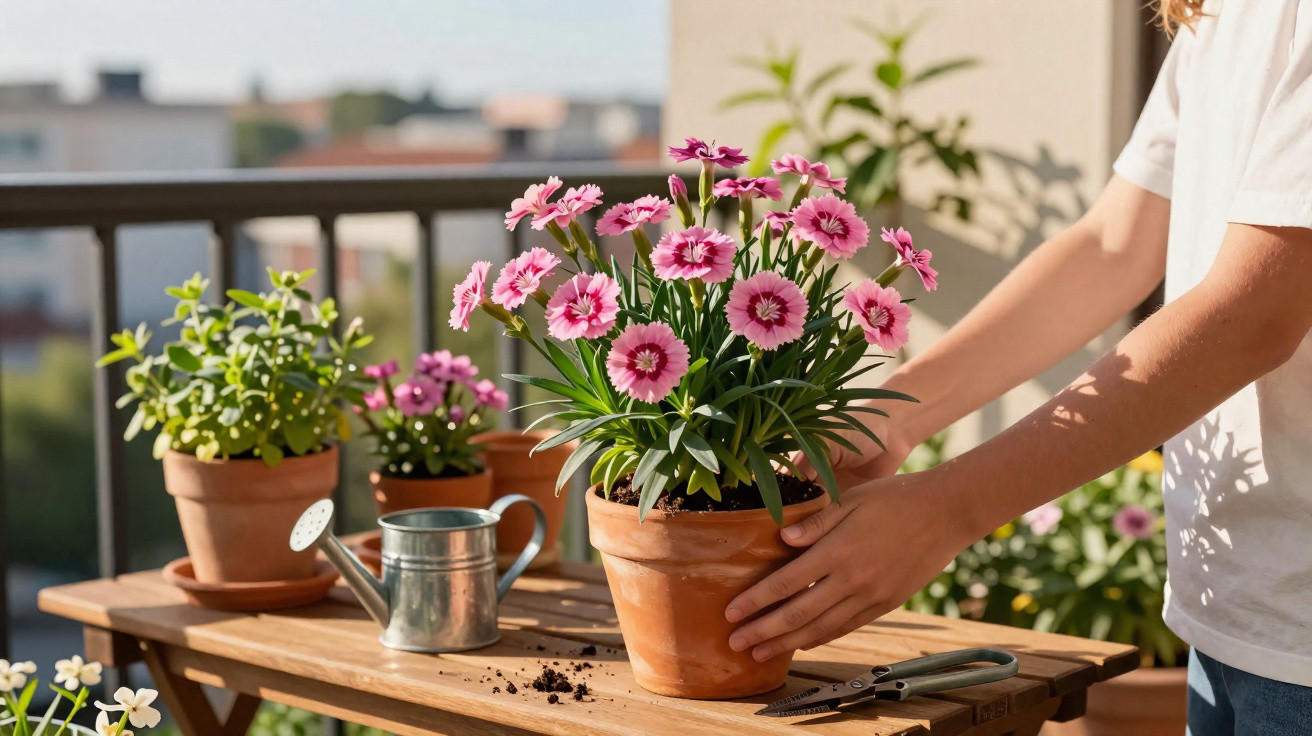
Anyone with a balcony, terrace or narrow front garden will know the challenge: limited space, limited time, yet still the wish for a truly beautiful summer full of flowers. This is exactly where a perennial comes in that is still something of an insider’s choice in garden centres: the perennial pink Dianthus ‘Bumbleberry Pie’. It stays compact, flowers for an exceptionally long time, has a pleasant fragrance and is considered easy to care for – ideal for anyone who does not want to be an expert but still wants a real focal point.
Why this perennial pink is attracting so much attention
Compact growth for almost any space
Dianthus ‘Bumbleberry Pie’ forms a dense, rounded cushion and reaches only around 25 to 30 centimetres in height. This makes it particularly suitable for:
- borders along paths or patios
- window boxes and planters
- rock gardens and gravel beds
- gaps between perennials or roses
Its grey-green foliage, with a subtle silvery sheen, looks calm and refined. It creates a cushion from which upright, sturdy flowering stems emerge. These stems rarely flop over, even in wind or a summer downpour. The plant therefore remains neat and well structured – an important benefit where space is tight and every corner needs to look its best.
“This perennial creates structure like a small box ball, only with fragrance and colour instead of just green.”
Watercolour-like flowers: vivid pink with a dark centre
The plant becomes especially striking once flowering begins. Its blooms are fringed, comparatively large and a bold, bright pink. At their centre is a clearly darker area, almost burgundy in tone. This produces an effect reminiscent of watercolour painting – not a flat splash of colour, but a lively interplay of shades.
There is also a delicate fragrance: characteristically clove-like, yet never overpowering. On a balcony or patio, even a light breeze is enough to carry the scent. Individual flowers can also be cut for tiny vases or small glasses, perhaps on the breakfast table or a windowsill.
Flowers from spring into autumn
The outstanding advantage of this perennial is its extended flowering period. The first buds open in spring. It then continues producing fresh blooms through late summer and, in favourable positions, even into autumn.
There is one condition: faded flowers need to be removed regularly. This encourages the plant to direct its energy into new buds rather than seed production. It does mean a few small jobs each week, but in return you get colour in pots or beds for months.
“Anyone who consistently pinches off the old flowers will be rewarded with fresh blooms almost continuously – a rarity among perennials of this size.”
From a wildlife perspective, this pink scores another point: it attracts bees, bumblebees and butterflies, while deer are largely uninterested in it. That is a genuine advantage for rural gardens.
Position and soil: where does the perennial thrive?
Sun, drought and modest requirements
This plant loves sunshine. Around six hours of direct sun a day is a useful guide, making a south- or west-facing balcony ideal. It will grow in partial shade, but its flowering will be less generous.
When it comes to soil, it prefers lean conditions rather than overly rich ones. Above all, it needs:
- free-draining soil with no waterlogging
- preferably slightly calcareous soil that is not too acidic
- an open texture that allows air to reach the roots
In heavy ground, a layer of sand or grit beneath the plant can help. If waterlogging is already an issue, it is better to plant in a slightly raised bed or choose containers instead.
When should you plant it? The ideal time
Spring is the best time, once the soil has warmed a little. The perennial can then establish its roots calmly before the hottest days arrive. Leave 25 to 30 centimetres between individual plants so that they develop into a dense row without being crowded.
Planting in early autumn is also possible, provided the soil is still warm. The important thing is that the perennial has time to make a few new roots before winter.
How to plant Dianthus ‘Bumbleberry Pie’ in pots or window boxes
The right container and compost
Dianthus ‘Bumbleberry Pie’ shows its strengths particularly well on a balcony. A pot at least 25 centimetres across is more than sufficient for one plant. A group of three plants in an elongated window box creates an even more attractive display.
Points to consider:
- drainage holes in the base are essential
- use a drainage layer of expanded clay, gravel or broken terracotta
- choose an open compost, such as multipurpose compost mixed with sand or lava grit
If the compost is particularly nutrient-rich, mix in some sand. This pink does not need “luxury treatment”; it prefers a robust, free-draining environment.
Watering in containers
Compost dries out more quickly in pots than it does in beds. Regular watering is therefore essential, particularly during hot spells. The plant does not tolerate water sitting in a saucer. It is better to water thoroughly, then allow all excess water to drain away.
“The rule of thumb: water generously once, then let it dry out, rather than constantly adding small sips.”
Care through the year: little effort, strong impact
Feeding, cutting back and deadheading
This perennial is not a heavy feeder. A light but regular nutrient boost is enough. Liquid feed added to the watering can every three to four weeks from May to August will do. If compost has already been worked into a border, feeding can be even more restrained.
The main jobs at a glance:
- remove spent flower heads by hand or with scissors
- water in the evening during prolonged dry weather
- cut back old, dried shoots in late winter
Cutting back before new growth starts ensures the cushion looks compact and fresh again. Usually, it is enough to trim back a few centimetres into the plant.
Winter protection and lifespan
The pink is considered hardy, especially in a border with free-draining soil. Cold is less of a concern than wet: persistently damp roots in winter can weaken the plant. A thin layer of grit or gravel around the base prevents water from sitting directly at the stem base.
In a pot, a sheltered position close to a house wall is advisable. Wrap the container in hessian, bubble wrap or an old sack to prevent the roots from freezing solid.
Planting combinations and design ideas
Which plants work well with this pink?
Thanks to its grey-green foliage and pink blooms, this perennial combines well with other drought-tolerant plants. Popular companions include:
- lavender (similar requirements and a contrasting blue shade)
- small ornamental grasses such as blue fescue
- thyme or other low-growing herbs
- white or pale-pink cushion-forming perennials
For instance, a long window box can be planted in a rhythm of pinks, lavender and grasses. This creates a varied yet uncluttered look – while the blend of herb and pink fragrances feels almost Mediterranean at the height of summer.
Who is this plant especially suited to?
This perennial pink is a good fit for people who:
- have little time for demanding maintenance
- want to make the most of small spaces
- enjoy scented flowers close to where they sit
- want to plant something bee-friendly without creating a whole wildflower meadow
Anyone unsure whether they have green fingers can start with this plant with relatively little worry. It tolerates short dry spells, only needs occasional deadheading and rewards you with flowers for months.
A closer look at its background and minor pitfalls
The name “Dianthus” comes from Greek and roughly translates as “flower of the gods”. Many varieties have been bred for rock gardens or cottage gardens and cope well with relatively sparse conditions. That heritage is clear in this variety: it does not need perfect, deep garden soil, but rather a spot with plenty of light and good air circulation.
One possible pitfall is too much care: soil that is too wet, compost that is too heavy, or excessive fertiliser. All of these can make the plant soft and lush, reduce flowering and leave it more vulnerable to rot. Treating it more like a small rock-garden plant than a thirsty summer flower is much closer to its natural needs.
Used in the right way, this pink can become a long-lasting highlight on a balcony or in a front garden: a small perennial that brings colour, fragrance and life for many months, without making you feel as though you constantly have to keep on top of it.

Comments
No comments yet. Be the first to comment!
Leave a Comment