
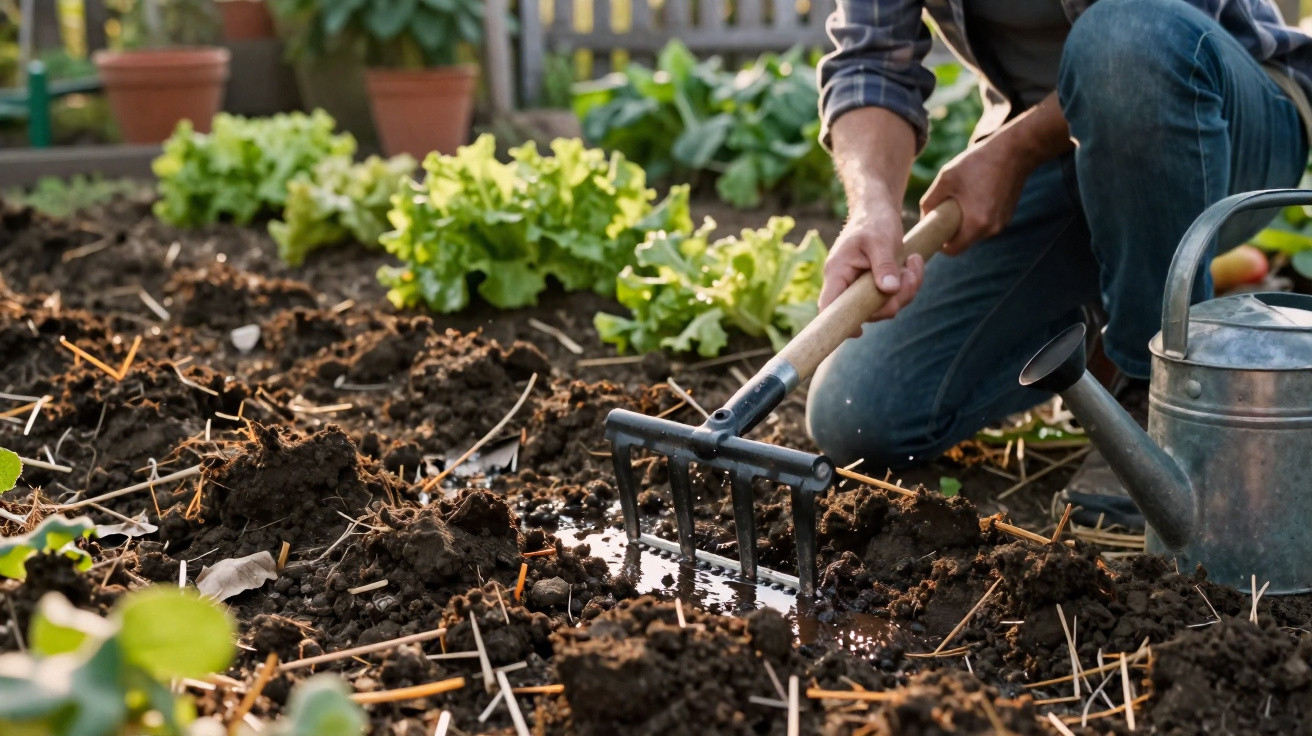
The first drops strike the freshly raked bed, turning its surface dark like coffee soaking into a sponge. For a moment, it seems encouraging. Then, as if on schedule, the water forms beads, darts sideways and rushes towards the path, while the soil beneath remains almost dry. The gardener steps away in annoyance, having spent an hour levelling the surface so it would “look clean”.
Two months on, the very same bed is uneven, speckled with old root channels, partly decayed mulch and worm casts. This time, nobody has bothered to make it level. When the next rain arrives, water simply slips into those small dips and vanishes with a quiet, self-satisfied hush.
Something that feels almost magical has taken place.
When you stop smoothing your soil like a carpet
Watch a neat, completely level vegetable bed for five minutes during heavy rain and the issue soon becomes obvious. Water has no particular route to follow. It settles, forms puddles and travels sideways in fine sheets, washing away the smallest particles and crusting over the surface.
Then consider an “ugly” bed, one unlikely to feature in a glossy gardening catalogue. It has small bumps, faded footprints and scattered leaf litter that sits somewhere between untidy and appealing. Across this miniature landscape, raindrops collect in tiny hollows, enter old root channels and gradually move downwards. What appears uncared for is often simply… doing its job.
A retired teacher with a small suburban garden near Leeds discovered this largely by chance. One spring, aching knees meant she gave up levelling her beds. She used no rake and did no heel-stamping, relying only on a light fork to loosen the ground before adding compost.
By the next autumn, she noticed an unusual difference. Following a week of nearly continuous rain, her neighbour’s billiard-table lawn held pools of standing water, like small reflective lakes. Yet her “lazy” beds, covered by a thin mulch and left with an uneven surface, had not a single puddle. Their soil fell apart into crumbs rather than sticking in clumps. She could push her hand into it as far as her wrist. The one meaningful difference was unplanned: she had simply stopped compressing everything into a flat surface.
This is not magic; it is physics and biology working together. Flattening soil forces out air spaces and damages the delicate passageways created by roots, insects and worms. The resulting surface is smoother and more compact, encouraging water to run off rather than soak in.
When the soil is left a little rough, those small imperfections become miniature reservoirs and access points. Water slows, falls into cracks and follows existing passages further down. Where air and organic matter are available, micro-organisms flourish and bind soil particles into stable crumbs. This crumb structure changes hard ground into soil that absorbs water rather than becoming waterlogged.
Stepping back from the rake for better water infiltration
To test this in your own garden, the first “technique” is really about doing slightly less. The next time you prepare a bed, stop once you have loosened the soil with a fork or broadfork. Apply a light layer of compost or well-rotted manure, distributing it loosely by hand, and resist making the surface flawlessly smooth.
Sow or plant straight into the irregular ground. With very small seeds, make only a slim, shallow drill using a finger or stick instead of levelling the entire bed. Water gently once, preferably with a rose attachment or drip hose, so that you do not destroy the structure you have just preserved. After that, allow rainfall and the life beneath the surface to take over.
Most gardeners level beds out of care and routine, rather than ignorance. Many of us learned that crisp edges and flat beds show that a job has been done properly. Soil, however, does not read gardening magazines. It responds to pressure, compaction and whether plant roots have enough air.
A frequent error is repeatedly walking over the growing area and then trying to “repair” the harm by raking it level. It is rather like ironing a shirt while still wearing it. A better approach is to establish defined paths and keep to them, making the bed itself off-limits to boots. Realistically, nobody manages this every day. Even doing it 70% of the time, though, gives soil the opportunity to restore its hidden plumbing.
“Once I stopped obsessing over flat beds, I realized my biggest irrigation problem had been my own rake,” laughs Marco, a city gardener who grows tomatoes on a windy rooftop. “The water infiltration improved in one season, and I didn’t buy a single gadget. I just stepped away from the soil a little.”
- Keep the surface rough – Once loosened, leave small clods, worm casts and plant debris in place. They interrupt water flow and encourage infiltration.
- Protect with organic cover – A light mulch of straw, shredded leaves or grass clippings cushions the impact of rain and nourishes soil life from above.
- Make permanent paths – Keep foot traffic on woodchip, stepping stones or fixed rows, allowing growing areas to remain open and airy.
- Observe after heavy rain – Note where water remains and where it vanishes quickly, then alter paths or bed edges rather than attacking the soil surface.
- Rely on natural structure – Roots, worms and fungi continually remodel the ground below. Your primary role is to stop working against their architecture.
Letting soil look “wrong” so it can work properly
After seeing water disappear into an uneven, living bed, it becomes difficult to ignore the contrast. You begin to spot how differently areas of the garden respond: the compacted lawn compared with the crumbly border, the bare, level patch beneath a swing compared with the mulched herb corner. You also start to recognise that much of gardening is about not interfering.
A subtle emotional change can happen too. Giving up the pursuit of perfectly flat beds means accepting a little more wildness in the appearance of your space, and that can feel freeing. Small rises and dips, pieces of mulch and the occasional worm cast reveal a story of natural processes at work. Water infiltration that seems to improve “by itself” is merely the visible chapter. Beneath the surface, roots are travelling deeper, microbes are multiplying and earthworms are working through the night.
Some people will test this approach and see a difference within one growing season. Others may garden on heavy clay and require several years of organic matter and patience. The underlying pattern remains: less trampling, less levelling, more cover and more life. The soil becomes darker, softer and more productive. The hose is needed less frequently. Then, on the evening of the next major storm, you may find yourself at the window, not anxious about flooding but quietly rooting for every uneven patch of soil prepared to absorb the rain.
| Key point | Detail | Value for the reader |
|---|---|---|
| Stop levelling soil surfaces | Retain a mildly rough, uneven texture containing clods, channels and tiny hollows | Helps rainwater slow down and soak in rather than run away |
| Preserve living structure | Use light tools, organic mulch and permanent paths to limit compaction | Supports lasting soil health, improved drainage and stronger root development |
| Watch after rainfall | Identify where water pools or drains rapidly, then adapt your methods | Enables straightforward, low-effort changes that improve infiltration without costly equipment |
FAQ:
- Question 1 Will seeds still germinate successfully when the soil surface is not completely level?
- Question 2 Does this approach work for heavy clay soils that already have poor drainage?
- Question 3 Will a rough surface make hand watering harder?
- Question 4 After I stop levelling, how soon might I see improved water infiltration?
- Question 5 Can this method be used alongside raised beds or balcony containers?
Comments
No comments yet. Be the first to comment!
Leave a Comment