
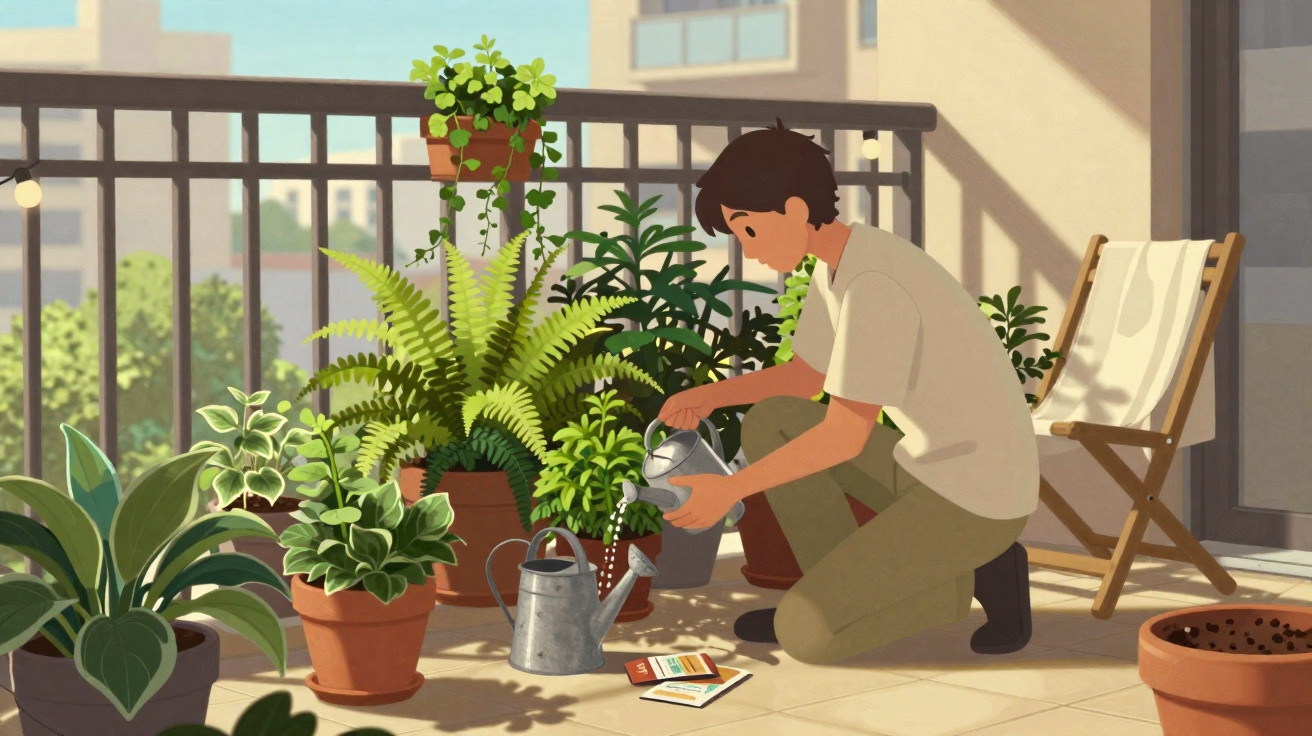
Rain lashes sideways against the windowpane as you look out at a balcony that resembles a storage cupboard more than an “urban jungle”. An old folding crate sits on the left; on the right is a pot of brown soil containing the sad remains of a dead tomato plant. It faces north. There is barely any sun. Your feed serves up flawlessly styled south-facing balconies, while your little corner looks more like a “forgotten back yard”. Yet you still feel like getting started. Surely something can grow there, can’t it?
Why your north-facing balcony is not cursed
Realising that your balcony faces north can initially feel rather like being told: “You can be anything – except happy.” We tend to associate plants with sunshine, summer and southerly aspects. Our brains tell us that life needs light. So you stand on the grey tiles thinking that this is it: only shade plants and cobwebs from now on.
This is often exactly where balcony-growing frustration begins. In spring, people head to the garden centre and buy what everyone else buys – tomatoes, peppers and lavender – then wonder why nothing survives or ever properly gets going. An acquaintance told me that she put “sun plants” on her north-facing balcony for three summers in a row. Every year brought the same hope, followed by the same weary, yellowing disappointment. She genuinely thought she simply did not have “green fingers”.
The plain truth is that you are not the issue; the setting is. North-facing balconies mainly receive indirect light, often just two to four hours of brightness, sometimes filtered by neighbouring buildings. For species that crave sunshine, that is like living in a shared flat’s kitchen with no windows. Plants accustomed to shade and partial shade, on the other hand, find it a spa retreat. Once you understand that, the balcony suddenly stops being a curse and becomes a secret specialist stage.
What actually grows: the quiet stars of shady corners
Start with the reliable classics that flourish in shade while other plants have long since given up. Hostas, ferns and sweet woodruff may not sound especially Pinterest-worthy, but they are tough little survivors on north-facing balconies. They appreciate cool spots, moister soil and minimal direct sun. Flowering favourites including busy lizzies, begonias and fuchsias also prefer the gentle, even light found on the north side to fierce midday sunshine.
One image I will never forget is an unassuming Berlin north-facing balcony on the fourth floor, just 2 metres wide at most. In summer, it held a rich green curtain of ferns, threaded with pale pink fuchsias dangling from hanging baskets. It smelled of damp soil and faintly of woodland, even though cars were sounding their horns below. Its owner, a nurse working shifts, simply said: “Sun would completely do me in here; I always get home at the wrong times anyway.” Her balcony was not an Instagram spot, but it was a refuge that worked with its light rather than against it.
From a botanical perspective, it makes a surprising amount of sense. Shade-loving plants are adapted to growing beneath trees in woodland. That means little direct sunlight, but plenty of diffused light. Their leaves are thinner and larger, allowing them to do remarkably well with limited light. A north-facing balcony therefore simply recreates “a woodland floor on the third storey” for them. Many foliage plants, herbs such as mint, lemon balm and chives, and some berries – especially bilberries or certain currant varieties – cope remarkably well in these conditions. Light is not merely brightness; it has character, and your balcony’s character is gentle and northern.
What you can plant on a north-facing balcony without despairing
If you want to get started, choose from three groups: edible plants, decorative plants and “soul plants”. For eating, north-facing balconies are particularly well suited to mint, lemon balm, parsley, chervil, chives and rocket. Decorative options include hostas, ferns, fuchsias, begonias, busy lizzies, astilbes and coral bells. Soul plants are those you simply love, even if they are only a moderately good fit – perhaps a single hydrangea in a large pot or trailing ivy creating a green curtain.
Many people struggle because they try to recreate a balcony “straight from the catalogue”. Let’s be honest: nobody waters at precisely the same time every day, fertilises to a schedule and turns pots by 90 degrees every fortnight, as guides suggest. Fortunately, north-facing balconies are more forgiving. The compost dries out more slowly and plants do not immediately scorch. Even so, waterlogging is the silent killer. Add a drainage layer of expanded clay, water less, and use your finger to check whether the top layer of compost is genuinely dry. The aim is a small, living corner, not a botanical competition.
Sometimes, one sentence is worth keeping in mind before your next plant purchase:
“Don’t buy plants to fight your balcony; buy them for it.”
- Begin with 3–5 hardy varieties that are proven shade lovers.
- Choose larger pots than you think you need, so the compost stays evenly moist for longer.
- Use height: hanging baskets, shelves and crates make much better vertical use of shade.
- Try one “experimental plant” each season to get to know your balcony better.
- Accept losses: a dead plant is not failure, but a data point.
Your north-facing balcony: an alternative to the perfect south-facing balcony
Ultimately, a north-facing balcony is a mindset too. While everyone else talks about getting “as much sun as possible”, you can create a space where you can breathe when the city is sweltering. It is a balcony where you can sit at three in the afternoon in high summer without burning. Mosses and ferns can evoke a little of a holiday in the Allgäu, while your morning coffee still will not evaporate in the cup even at 30°C.
Perhaps your balcony will soon tell a story that has nothing to do with perfection, but everything to do with adaptation: the confidence to garden against the norm. You can look at photos of bright geraniums in full sun while celebrating the quiet beauty of your shade plants. And if someone asks, “A north-facing balcony? Nothing grows there,” you can simply smile, look over your small shady kingdom, and know that the answer is no longer true.
| Key point | Detail | Benefit for the reader |
|---|---|---|
| Choose plants to suit the light | Shade-loving varieties such as hostas, ferns, fuchsias and mint | Less frustration and a higher plant survival rate |
| Use a north-facing balcony as an advantage | Cool, even lighting conditions with no heat stress | A pleasant place to spend time in summer and more relaxed watering |
| Start small and build experience | 3–5 robust varieties and one trial plant every year | A gradually developing, stable balcony ecosystem instead of overwhelm |
FAQ:
Question 1 Which edible plants work most reliably on a north-facing balcony?
Mint, lemon balm, chives, parsley and rocket are particularly grateful choices. They cope well with partial shade and do not need full sun to develop flavour.Question 2 Can I grow tomatoes or peppers on a north-facing balcony?
Only rarely with success. Tomatoes and peppers love sun and warmth. On north-facing balconies, they usually remain stunted and prone to disease. It is better to choose shade-tolerant alternatives such as Swiss chard or herbs.Question 3 How can I tell whether my north-facing balcony has enough light for plants?
Watch it over the course of a day: if you can comfortably read a book without direct sun and the balcony appears bright for several hours, many shade and partial-shade plants will be suitable. Very dark, narrow courtyards are better for exceptionally hardy varieties such as ivy or ferns.Question 4 Do I need to water less on a north-facing balcony?
The compost usually dries out more slowly, so you will generally water less often. Still, water only when needed: put a finger into the compost, and when the top 2–3 cm are dry, it is time to water.Question 5 What mistakes are most common on north-facing balconies?
Typical mistakes include buying sun-loving plants, overwatering, using pots that are too small, having no drainage, and starting with too many plants at once. Avoid those pitfalls and choose genuinely shade-loving varieties, and you are already halfway there.

Comments
No comments yet. Be the first to comment!
Leave a Comment