
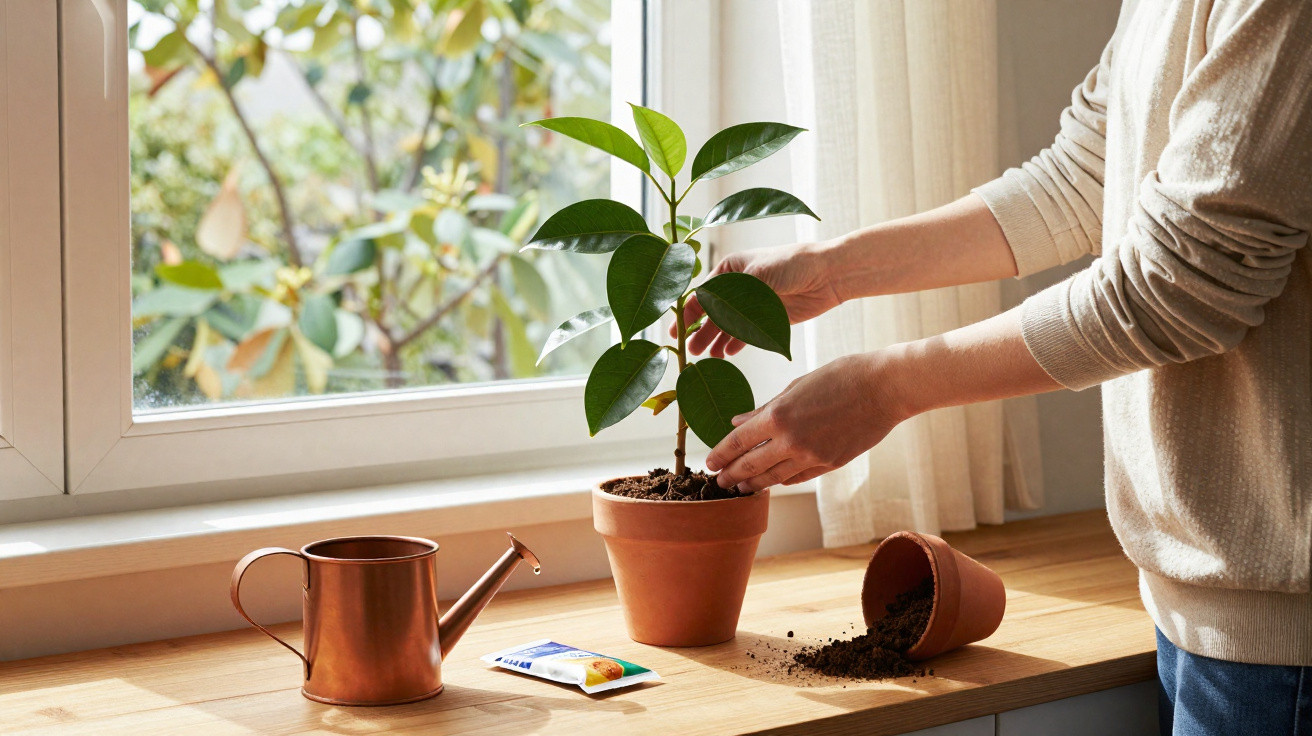
Many owners still care for their money tree in March as though it were the depths of winter: little water, hardly any change in light and no fertiliser. They then wonder why nothing happens. Yet this is when the plant enters its active phase. By adjusting a few aspects of care this month, you can encourage the popular succulent to grow far more vigorously.
Why March matters so much for the money tree
The money tree, also commonly called the jade plant, dramatically slows its growth during autumn and winter. At this time it needs very little water, no nutrients and can cope with reduced light. The issue is that many people continue with exactly the same routine, even though the days are already becoming noticeably longer in March.
As brightness increases, the money tree starts producing new buds at the tips of its shoots. The plant is effectively testing whether conditions are suitable for pushing out fresh leaves and branches. At this stage it needs an adjusted routine: not full summer treatment, but considerably more support than it received in the preceding months.
“Changing the care routine in March switches the money tree from energy-saving mode to growth, without overwhelming the plant.”
The key step: getting the light right now
After the darker months, light is the first factor to adjust. Moving the plant abruptly into intense sunshine, however, does more harm than good.
A bright position with plenty of indirect light is ideal:
- An east- or west-facing windowsill with many bright hours but no midday heat
- A south-facing window with a sheer curtain to soften harsh rays
- A bright spot in the room, 2 to 3 metres from a south-facing window
If there is insufficient light, the money tree will stretch its shoots. They become soft and elongated, then droop downwards. Too much sun all at once, on the other hand, can make the leaves turn pale; their edges may dry out and become brown.
A useful rule of thumb is to move the pot a little closer to the window each week, while turning it slightly every seven days. This helps create an even canopy instead of allowing only one side of the plant to grow strongly.
Watering a money tree in March: leaving winter mode behind
The second major change concerns watering. While a small amount of water once a month may be enough in winter, the compost dries considerably faster in spring.
You can establish the right schedule as follows:
- Check the top 2 centimetres of compost with your finger.
- Water only when this layer feels distinctly dry.
- Then water thoroughly until water runs out of the bottom of the pot.
- Empty the saucer or outer pot after a few minutes so that no water remains standing.
In a bright home, this often results in a watering interval of around 10 to 15 days during March. Small pots may need water sooner, whereas large containers retain moisture for longer.
Typical warning signs include:
- Too much water: Leaves become soft and yellowish, while the base of the trunk turns dark and mushy.
- Too little water: Leaves look wrinkled, become slightly drawn in and feel thinner.
“It is better to shift the schedule carefully by a few days than to jump from ‘almost never’ to ‘constantly damp’.”
Start feeding again from March: how to use fertiliser correctly
Alongside the new watering routine, the money tree can now receive nutrients again. After months without fertiliser, plants respond very positively to a cautious start in spring.
A liquid specialist fertiliser for cacti and succulents is suitable. Use it at half strength roughly every four to six weeks, from March through to autumn.
Important rules to follow:
- Never fertilise completely dry compost, as this can damage the roots.
- Do not apply nutrients immediately after repotting, so the roots can establish undisturbed.
- Do not fertilise in the depths of winter or when the plant is visibly weakened.
Ideally, fertilise a few days after watering, when the growing medium is lightly moist. This allows the solution to spread more evenly through the pot and reach the roots consistently. The results appear over time: sturdier shoots, plump leaves and a compact, robust growth habit.
Gentle pruning for a dense, sturdy money tree
Early spring is also a good time to improve the money tree’s appearance. Once new leaves are visible, a light trim is worthwhile.
Cut back long, straggly shoots just above a leaf scar. This encourages the plant to form new side shoots at that point. A single long branch can therefore develop into a branching canopy.
Keep these points in mind:
- Never remove more than 20 to 30 percent of the entire plant at once.
- Cut only with clean, sharp tools, such as scissors or small secateurs.
- Wipe tools with alcohol before use to reduce germs.
If you do not want to discard the cuttings, use them for propagation. Simply allow them to dry for a few days, then place them in lightly moist succulent compost. With patience, they will develop into new young plants.
Repotting in spring: when a money tree genuinely needs more space
The best period for repotting is between March and early summer. The plant is then full of energy for producing new roots. Not every money tree requires a new pot each year; usually, every two to four years is sufficient.
Signs that repotting is worthwhile
- Roots are growing out through the drainage holes.
- The compost stays wet for a long time and seems compacted.
- The plant becomes top-heavy and tips easily.
- Growth has stalled despite good care.
The diameter of the new pot should be only slightly larger than the old one; otherwise, the compost will remain wet for too long. A free-draining, mineral-based growing medium is especially important, such as a mix of succulent compost, pumice and a little sand.
After repotting, leave the plant undisturbed for two or three days, then water it lightly. Wait several weeks before fertilising, until the money tree has visibly established itself in its new pot.
Quick checklist: adjusting your money tree correctly in March
| Area | What changes in March |
|---|---|
| Light | Move it gradually into brighter conditions and avoid direct midday sun |
| Watering | Let the compost dry out more between waterings, then water generously |
| Fertiliser | Begin using half-strength specialist fertiliser every 4–6 weeks |
| Pruning | Shorten long shoots and thicken the canopy; never cut back drastically |
| Repotting | Only when necessary, using a free-draining, mineral-rich growing medium |
Common mistakes – and easy ways to avoid them
Many spring problems are caused by well-intentioned but unsuitable actions. Frequent pitfalls include:
- Changing position too quickly: Moving a plant from a dark corner straight to a full south-facing window causes sun scorch on the leaves.
- Keeping the compost permanently damp: Money trees tolerate dry periods better than waterlogging. Wet roots often result in root rot.
- Over-fertilising: Applying too much fertiliser after winter risks burnt roots and soft, unstable shoots.
- Drastic pruning on impulse: A weakened money tree that has been cut back heavily takes a long time to recover.
If you are unsure, choose the more conservative approach: water a little less, use slightly less fertiliser, but provide consistently good light. This combination works remarkably reliably for these resilient succulents.
What many people do not realise: how the position affects the whole year
The choices made in March often have an effect well into summer. If the money tree is now in a bright position, remains compact and is planted in good growing medium, its new shoots will grow much more sturdily. A location that is too dark in spring often produces branches that bend in high summer because they cannot support their own weight.
Temperature is another interesting factor: a relatively cool, bright spot in winter, such as an unheated but frost-free room, results in even more compact new growth in spring. If the plant spent winter somewhere very warm and dark, it reacts more sensitively in March. In that case, take particular care when adjusting light and watering.
By paying close attention to light, water, nutrients, pruning and pot size, you can deliberately give the money tree a boost in March. A tired plant that has made it through winter can become a strong, glossy succulent that remains robust throughout spring and summer.





Comments
No comments yet. Be the first to comment!
Leave a Comment