
Once the fairy lights have been packed away, the Christmas tree can seem like an awkward problem.
To older generations, however, it was a modest but useful resource.
Across Europe and North America, councils arrange dedicated collections, crushing facilities and depots for unwanted Christmas trees. For decades – and perhaps centuries – gardeners have instead regarded the needles they shed as a valuable winter material, rather than rubbish to leave at the kerb.
Why your old Christmas tree still has work to do in the garden
Most people haul the tree outside, complain about the needles left on the carpet, and forget about it. Yet those fallen needles offer a gradual, dependable means of helping soil to aerate, nourish and protect itself during winter. When used properly, they can sustain healthy, living soil through to spring 2026 and afterwards.
“Fir-needle ‘waste’, used before the end of December 2025, can lastingly improve the structure and fertility of the vegetable garden.”
Evergreen needles rot down slowly, and that slow process is important. As they decompose, they can open up dense soil, stop the surface from forming a crust and make overly alkaline ground slightly more acidic. In gardens with hard water or chalky subsoil, this modest adjustment may help plants that do not thrive in strongly alkaline conditions.
Their tough, narrow form also shields the soil against familiar winter pressures: heavy rain, recurring freeze-thaw cycles and exposed areas where weeds can take hold. Beneath a thin covering of needles, soil organisms remain more consistent. Fungi, bacteria, earthworms and small arthropods can continue their work rather than becoming inactive beneath compacted, unprotected clumps.
How to turn Christmas tree needles into winter mulch
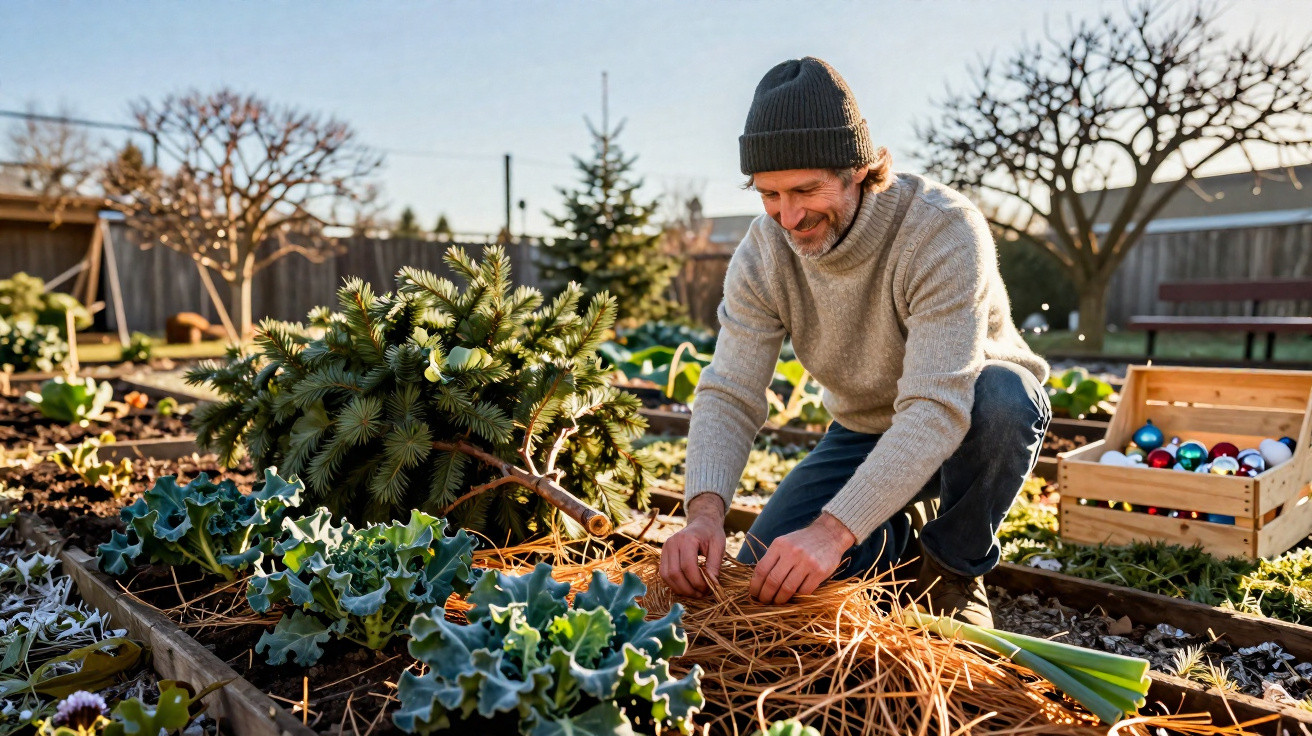
Using this method safely depends more on preparation and timing than on costly tools. The aim is to turn the tree into an airy, blended mulch, not a dense layer that smothers the soil.
Step 1: begin with a clean, real tree
Only natural trees that have not been treated should be used in the garden. Flocked trees covered with imitation snow, glitter spray, paint, coloured foam or artificial fragrances must be kept away from food-growing areas and wildlife habitats. Nor should plastic netting wrapped around a tree be allowed to rot in place.
- Take off every decoration, hook and piece of tinsel.
- Inspect the trunk and branches for staples or metal fittings.
- Shake the tree outside over a tarpaulin to catch loose needles.
After stripping the tree, deal with it in stages: use the loose needles first, followed by the smaller branches and finally the trunk.
Step 2: chop and loosen the needles
Needles spread in dense heaps may repel water and restrict oxygen. They should therefore be chopped or blended with other materials. If you have a shredder, put the branches and needles through it once to produce a fine, uniform material. If you do not have one, there are still several ways to prepare them:
- Snip off small branches with secateurs, then pass over them with a lawnmower fitted with a collection box.
- Cut twigs into 3–5 cm lengths using pruning shears, and crush handfuls of needles while wearing gloves.
- Combine the needles with dry leaves or straw in a wheelbarrow, which prevents them from forming compact clumps.
Aim for a loose, fluffy mix: if you grab a handful and squeeze, it should spring back, not form a solid cake.
Step 3: spread it before winter sets in deeply
For winter 2025–2026, the best period is from late December 2025 until late February 2026, according to local conditions. Apply it only when the soil is neither saturated with water nor hard-frozen.
Before laying the mulch:
- Pull out visible weeds, including their roots.
- Gently fork or rake the upper few centimetres to loosen any surface crust.
- If you have recently dug or harvested the area, leave the soil for a day to settle.
Next, distribute the needles in a layer roughly 2–5 cm deep. Leave a narrow space around stems and trunks to reduce the risk of rot. In exposed, windy gardens, water the mulch lightly once so that it settles and interlocks with the soil surface.
Where Christmas tree mulch works best – and where it does not
Pine and fir needles are considerably better suited to some plants than others. Their faint acidifying effect and physical structure suit woody perennials and particular fruits more than delicate roots and bulbs.
| Best uses for needle mulch | Uses to avoid or limit |
|---|---|
| Blueberries, blackcurrants, redcurrants, strawberries | Carrots, beetroot, parsnips |
| Grapevines, raspberries, established fruit trees | Onions, garlic, leeks |
| Rhododendrons, azaleas, camellias, hydrangeas | Pelargoniums and other tender bedding plants |
| Ornamental shrubs and mixed flower borders | Seedbeds and freshly sown rows |
The “acid lover” group benefits especially well. Blueberries, currants, rhododendrons and azaleas frequently develop improved leaf colour and fewer signs of chlorosis when soil pH moves nearer to the range they prefer.
Root crops and alliums respond differently. They favour lighter, more neutral soil. A thick layer of fresh, unrotted needles can retain excessive moisture around their necks and crowns, which can lead to rot. Use a light compost mulch or properly rotted leafmould on these beds instead.
Common mistakes gardeners still make
When gardeners try this old practice for the first time, three mistakes occur repeatedly:
- Applying too thick a layer: more than 5 cm of unmixed needles can seal the soil and slow its spring warming.
- Using fresh, resinous branches: thick green wood uses up nitrogen as it decomposes; reserve it for paths or brown compost material.
- Using needles alone: soil organisms need diversity, so combine them with other dry “brown” materials for a more balanced result.
Think of needles as one instrument in the orchestra of organic matter, not the whole performance.
What the needles actually do to soil over time
A common gardening myth says pine needles “ruin” soil by making it sharply acidic for years. Research points to a subtler effect. While fresh needles contain acidic compounds, rainwater removes much of this acidity as the material weathers and breaks down. The humus left behind is close to neutral.
Their more meaningful influence is on soil structure and biology. The waxy needle surface slows decomposition sufficiently for the protective layer to last throughout winter. When fungi colonise this mulch, they create fine filaments that join soil aggregates together and form networks that assist tree and shrub roots. The dry covering also provides refuge for helpful insects, including ground beetles and centipedes, offering a small additional measure of pest control when aphids and slugs appear in spring.
Using the whole tree: branches, trunk and even the stand
By late December 2025, many households will be asking the same question again: what should happen to the whole tree? The needles provide one answer, but the remainder of the tree also has uses.
- Small branches, cut into short sections, can define bed edges or indicate seed rows.
- Long, straight pieces can become free supports for peas, beans or dahlias.
- The trunk may be chipped for paths or long-lasting mulch, or dried for kindling if you have an appropriate wood-burning stove.
Even a basic wooden stand can be reused as a support for water butts or incorporated into a cold-frame structure, instead of being sent directly to landfill. Reusing each part slightly lowers the need to buy new garden materials.
Planning a needle-mulch strategy for winter 2025–2026
Planning in advance lets you make that one tree part of a deliberate soil project. Before Christmas 2025, identify the beds and borders most likely to benefit. Mark where your acid-loving plants grow, and make a note of spots where winter weeds are persistent or where bare soil is usually cracked by March.
When the tree is taken down, you will already know where its needles are needed, how much material to use and which other dry ingredients to add. This small amount of preparation keeps the task quick and manageable: 30 minutes spent cutting and spreading, rather than an undefined weekend job that never quite gets done.
Extra ideas: pairing needles with other low-cost soil boosters
Needles work effectively with two inexpensive and readily available materials: autumn leaves and homemade compost. Equal quantities of shredded leaves and needles make a gentler mulch that holds more moisture while still resisting compaction. A thin base layer of mature compost, topped with needles, helps prevent soil nutrients from being washed away and keeps the surface insulated.
For gardeners focused on soil health, a Christmas tree can represent the visible beginning of a wider change: treating organic “waste” as part of a cycle instead of a final destination. Coffee grounds, cardboard, hedge cuttings and kitchen peelings all follow the same principle. Sensibly used, they can alter how a small urban garden or suburban lawn performs in winter, transforming bin-bound material into a quiet, continuing restoration for depleted soil.


Comments
No comments yet. Be the first to comment!
Leave a Comment