
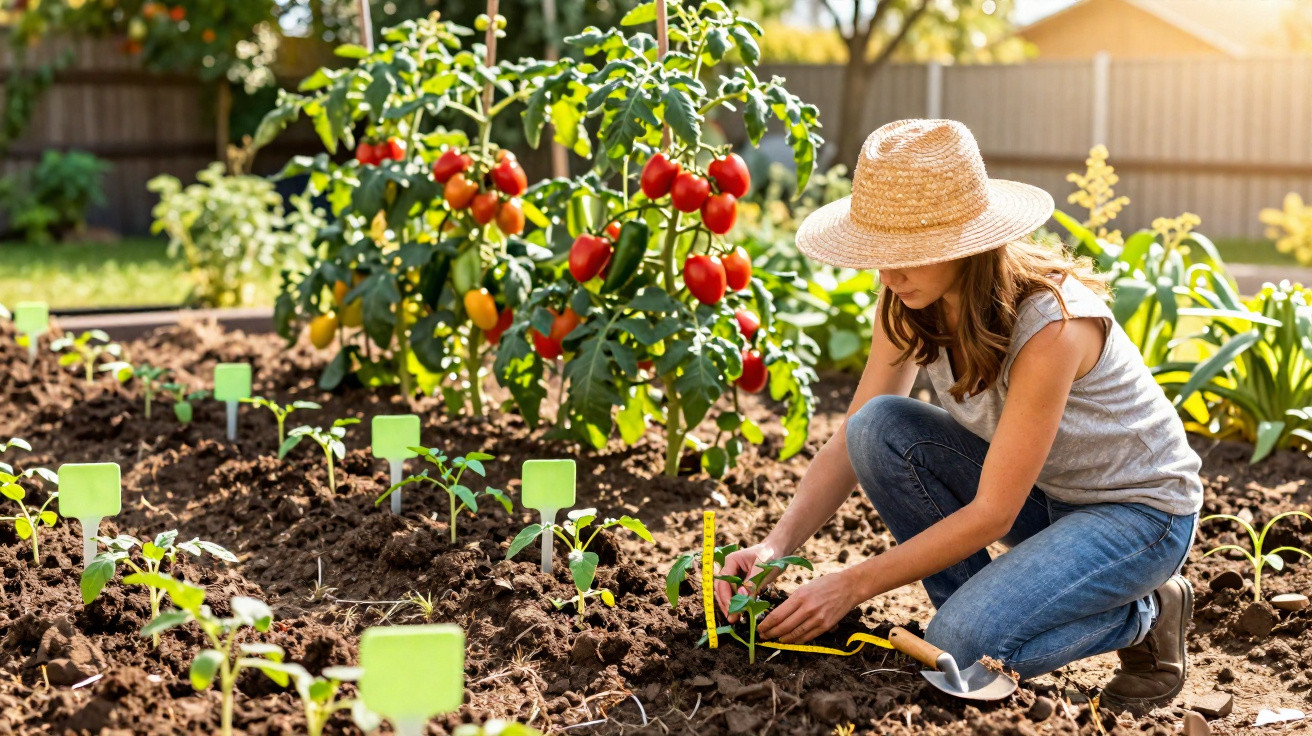
The first time I watched a neighbour plant tomatoes, the silence between us felt oddly stubborn. She made small holes, scarcely 30 cm apart, and set out the seedlings like people packed at a bus stop. I looked over at my own bed, where the uneven empty spaces seemed almost extravagant. Her plot appeared full, lush and impatient. Mine looked thin, tentative and slightly embarrassing.
Three weeks later, her tomato plants were pressing into one another. Their leaves crossed over, the shade deepened, and a tangled cover hid the soil. My bed still seemed only half planted, yet something was beginning to change: every plant was steadily reaching into its own patch of light.
By the middle of the season, the contrast was harsh. Her plants started yellowing from the bottom as they competed for air and water. Mine simply… breathed.
That was when I truly understood mature size.
Why crowded beds look great in spring but crash by summer
At the start of the season, every garden feels full of possibility. Small transplants sit there, modest and well behaved, surrounded by dark soil that looks like untapped potential. It can feel almost unbearable not to add “just one more”.
This is where most of us go wrong. We plant for the charming, compact plants we have on planting day rather than for the jungle that will arrive later. Summer always makes us pay for it.
Visit almost any community garden in July and the same pattern appears. Overplanted beds are impressive from afar: an unbroken wall of green. Move closer, though, and the warning signs emerge: leaves hanging limp at midday, mildew marks on the lower foliage, and thin stems stretching towards any available sunlight.
Gardeners who allow for mature size have beds that seem more settled. There is visible soil. There is air between plants. It can look almost too straightforward, until you notice that their tomatoes hold heavier trusses, their lettuces are slower to bolt, and their peppers are not sulking beneath the shade of a pumpkin vine.
The reasoning is nearly dull, which may be why we resist it. Plants grow sideways as well as upwards. Their roots spread out in search of water and nutrients, while their leaves cast shade over whatever sits below. Packed too closely, they begin competing sooner and more intensely. By mid-season, you are dealing not only with heat and pests, but also with the effects of your own enthusiasm.
By planning spacing around mature size, gardeners avoid that unseen conflict. Their beds become a collection of small, separate territories rather than one disorderly battlefield. There is less stress, less disease and a greater harvest from fewer plants. It can seem like cheating, but it is really just patience.
How to space for mature size without feeling like you’re “wasting” soil
When planting, begin with one ruthlessly simple question: “How big will this be in August?” Do not think about next week, or when it is still in its cute 10 cm pot. Think about its maximum size.
Most seed packets provide a spacing range: “45–60 cm apart”, “30 cm apart”, “90 cm between plants”. Choose the higher figure rather than the lower one. That additional room is your protection against mid-season panic and decline. Those spaces allow air to circulate, light to reach the lower leaves, and your hands to fit between stems in July.
The difficult part is emotional rather than technical. Bare soil can feel wrong, particularly when you have spent weeks imagining a rich, overflowing garden. We have all had that moment of holding the final seedling and thinking, “There’s a bit of room… it’ll be fine.”
That is the point to stop. If you want an early sense of abundance, use quick-growing crops as temporary fillers: radishes around tomatoes, lettuce between young cabbages, or basil along the borders. Remove them when the larger plants begin to fill out. You get the visual reward at first without giving up the long-term plan. Let’s be honest: nobody follows spacing charts perfectly every time, but deciding to “respect the distance” for one or two crops can change your whole season.
“Once I started planting for the plant my tomatoes would become, not the seedling I was holding, everything changed,” says Marta, a backyard gardener who used to lose half her crop to blight by August. “Now it feels like I’m giving each plant a reserved seat, not asking them to stand in the aisle.”
- Tomatoes & peppers: 45–60 cm between plants, 60–90 cm between rows. Picture a single-file queue rather than a crowd at a concert.
- Squash, pumpkins, cucumbers: 90–120 cm for each plant or mound. If space is limited, train the vines up a trellis.
- Brassicas (cabbage, broccoli, kale): 45 cm apart. Before you realise it, those leaves can become as large as dinner plates.
- Lettuce & greens: 15–20 cm apart, or sow densely and thin them by eating the extras as baby leaves.
- Herbs: 20–30 cm apart, apart from aggressive plants such as mint, which should stay in pots so they do not take over.
The quiet power of leaving space
After seeing a bed in July where every plant has what it needs, it is difficult to return to overcrowding. The struggle in the middle of the season eases. When you water, the soil absorbs it rather than having it run off a thick mass of foliage. Air circulates. Bees can reach the flowers hidden within.
Spacing for mature size is less about rigid rules than about trusting time. You are trusting that small seedlings will become the large plants they are meant to be. When they do, there is no surprise. You allowed for it. You gave them room to thrive.
| Key point | Detail | Value for the reader |
|---|---|---|
| Plant for July, not for May | Use mature-size spacing from packets or reliable guides, and favour the wider number | Reduces mid-season competition and stress on plants |
| Use temporary fillers | Interplant quick-growing crops such as radishes or lettuce between slow-growing, large crops | Creates an early “full” appearance while retaining long-term space |
| Protect air and light | Leave visible paths and gaps so air can circulate and sunlight can reach lower leaves | Limits disease, improves harvest quality, and makes maintenance easier |
FAQ:
- Question 1 What if my garden is really small – can I still respect mature spacing?
Answer 1
Yes. Plant fewer crops, choose high-yielding varieties and use vertical supports. One properly spaced tomato on a sturdy stake will often outperform three crowded plants.
- Question 2 Why do seed packets give a range of spacing distances?
Answer 2
The ranges account for different aims: closer spacing produces smaller plants and quicker harvests, while wider spacing allows larger plants and better airflow. For healthy plants that last longer, use the wider end of the range.
- Question 3 Can I fix overcrowding mid-season?
Answer 3
Up to a point. You can remove weaker plants, prune surplus foliage and create open paths. It may feel severe, but thinning an overcrowded bed can save the plants that remain.
- Question 4 Is closer spacing ever a good idea?
Answer 4
Yes, for cut-and-come-again greens or crops harvested while young, such as baby carrots or salad mixes. They are not left in the ground long enough to reach their full mature size.
- Question 5 How do I visualize mature size before planting?
Answer 5
Place upside-down pots, plates or cardboard circles at the recommended distances where each plant will sit. Seeing those “future footprints” can help your brain accept the empty space now.
Comments
No comments yet. Be the first to comment!
Leave a Comment