
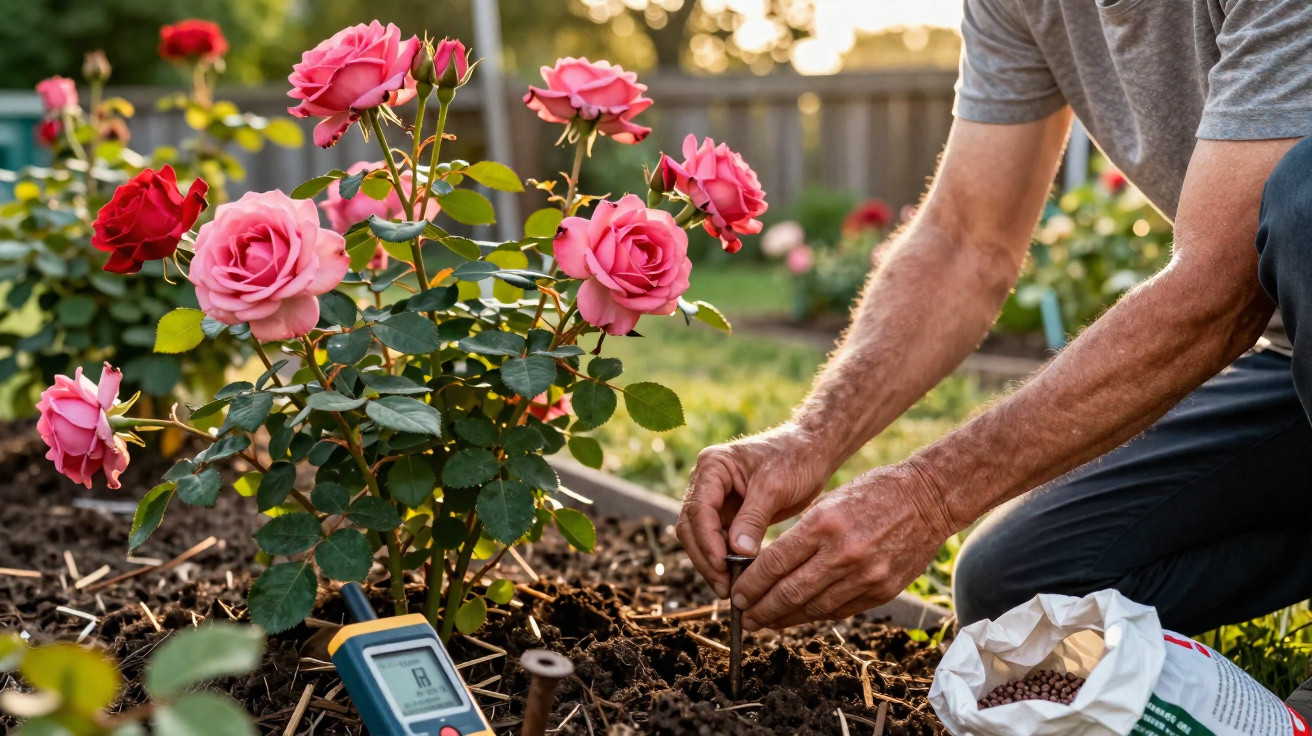
In an old flower bed, amid the scent of damp earth and fallen petals, a small metallic secret lies hidden beneath the roots.
Anyone who has inherited a garden from grandparents or great-grandparents may have encountered this curious scene: digging beside a vigorous rose bush and finding an old nail, orange with rust. It is not discarded rubbish, but a deliberate gesture passed down through generations of gardeners. Behind this seemingly folkloric habit lie chemistry, close observation of nature and a very particular way of tending roses.
An old-fashioned trick that still puzzles gardeners
Before shop shelves were filled with brightly packaged fertilisers, garden care drew on whatever was available at home, in the workshop or in the kitchen. Nothing was thrown away before its usefulness had been considered. A rusty nail became a “remedy” for a rose bush, wood ash fed the vegetable patch and food scraps went straight onto the compost heap.
For roses, the ritual acquired the air of a charm: burying a nail or piece of iron beside the stem to ensure more richly coloured flowers and deep green leaves. Many people continue the practice without knowing why. Others swear that the rose bush “improves” after receiving its secret metal.
The rusty nail became a symbol of a kind of gardening in which observation, reuse and patience mattered more than any eye-catching label.
Where did the idea of putting rust in the soil come from?
Accounts of this practice appear in market conversations, old gardening notebooks and even rose-growers' clubs. The reasoning was straightforward: whenever a rose bush started to turn yellow, someone would recall the advice about buried iron. The tradition spread through both rural gardens and small urban plots, often without any scientific explanation, simply “because that is how it has always been done”.
The role of iron in the health of rose bushes
There is a clear agronomic basis beneath the superstition. Iron is an essential micronutrient for plants. It is involved in processes linked to photosynthesis and the production of chlorophyll, the pigment that gives leaves their green colour.
When iron is lacking, the rose gives a warning
In soils with too little available iron, or in highly chalky ground, a rose bush can struggle. New leaves emerge yellow while their veins remain green. This condition is known as iron chlorosis. The result is a weaker shrub, with less energy for flowering and greater susceptibility to disease.
- Pale, almost yellow leaves, especially at the tips of shoots
- Veins that remain green, forming a “map” across the yellow areas
- Smaller buds and flowers with less intense colour
- Slow growth, thin stems and limited vigour
When these signs appear, iron is one of the first likely causes to consider. It is not always the only issue, but it is often involved when chlorosis is concentrated in the youngest parts of the plant.
Why roses “like” iron so much
Iron does more than give leaves their colour. It takes part in internal reactions that help the plant with the following:
| Function | Observed effect on the rose bush |
|---|---|
| Chlorophyll synthesis | Greener leaves and a greater ability to capture light |
| Cellular respiration | More energy to grow, heal and produce new shoots |
| Natural defences | Greater resistance to stress and certain diseases |
When the soil supplies iron in the right amount and form, the rose bush has more strength to develop healthy shoots, support heavy buds and repeat its flowering throughout the year, according to each region's climate.
What happens when a rusty nail is buried
In practical terms, a nail is simply a slow, improvised source of iron. Once buried near the roots, it continues to rust beneath the soil. Rust, which is iron oxide, interacts with moisture, organic acids in the soil and the activity of micro-organisms.
Releasing iron gradually into the root zone
As the metal breaks down, some of its iron moves through the soil as ions that can be taken up by the rose bush's fine roots. This is a very gradual process. Depending on the soil type and pH, it may offer some help where there is a mild deficiency.
The nail is not a powerful fertiliser, but a quiet, almost symbolic mineral drip that communicates with the roots over the months.
In very chalky soils, common in areas with hard water and pale stone, iron tends to become chemically bound and unavailable to the plant. A nail alone will not solve this blockage, but it may supply small additional amounts directly in the band of soil where the roots are most active.
The limits and risks of relying on rust alone
Relying solely on buried nails to correct a serious iron deficiency means depending on a slow and unpredictable solution. Results vary according to:
- Soil acidity
- Moisture levels throughout the year
- The depth at which the iron is buried
- The type and size of the metal item
Too much scrap metal in the garden can introduce unwanted metals, old paint or chemical residues. For that reason, using any piece of iron without knowing where it came from is not a good idea. This traditional gesture worked better when nails and tools were made mainly of iron and little else.
How to adapt the tradition for today's gardens
The appeal of the rusty nail now exists alongside a wide range of products made specifically for rose bushes. Those who enjoy old rituals can keep the habit, but it is worth combining it with modern methods that produce more predictable results.
Modern alternatives for correcting iron deficiency
Experienced gardeners commonly use options such as:
- Iron chelates, applied to the soil or in watering, for rapid uptake
- Fertilisers formulated for rose bushes, with balanced micronutrients
- Well-rotted compost, which improves soil structure and helps iron move through it
- Rock dust and other remineralising products, in moderate doses
- Leaves and stems from green plants, incorporated into the soil after decomposition
These options make it possible to correct deficiencies with greater control. In many cases, the issue is not the amount of iron present, but excessively high soil pH, which “locks up” the element. Adjusting that pH with professional guidance usually achieves more than burying a handful of old metal.
Common mistakes that undermine the health of roses
Before blaming a shortage of iron, it is worth checking a few basic aspects of care:
- Constant waterlogging, which suffocates roots and encourages fungi
- A lack of organic matter, leaving soil compacted and poor in microbial life
- Poor pruning, which weakens the shrub and reduces its active leaf area
- Too much nitrogen fertiliser, producing plenty of “green” growth and few flowers
When the whole system is balanced, iron becomes a fine point of nutrition rather than a magical solution.
What this old tip reveals about our relationship with the garden
More than a recipe, the rusty nail tells a story of long timescales. Rust recalls slow, nearly invisible processes taking place underground while life unfolds above the surface. Gardeners in the past knew how to wait. They watched the shade of the leaves, the sheen of the petals and the plant's response to each winter.
The tradition does not guarantee perfect results, but it serves as a constant reminder that the soil needs feeding too, not only the plant.
When it is worth trying a rusty nail
For anyone who enjoys experimenting, one approach is to turn this tip into a small home trial. Plant two similar rose bushes in comparable conditions, give both the same care and bury a nail beside only one of them. Over six months or a year, record any genuine difference in leaf colour and flowering.
This kind of simple comparison helps distinguish myth from the placebo effect. It also encourages the gardener to see the flower bed as a living laboratory, where tradition, science and sensitivity can work side by side.
There is another, less discussed point: iron does not work in isolation. When soil is well structured, with good aeration, deep roots and active micro-organisms, the plant makes better use of every nutrient, including the iron released by a forgotten nail. In compacted, trampled soil with little life, any expensive fertiliser or old trick loses much of its effect.
For this reason, the greatest improvement often comes from simple actions: loosening the earth around the rose bed, renewing the mulch, alternating gentle organic feeds and calmly observing how the plant responds. In this more balanced setting, the famous rusty nail becomes a poetic detail, not an obligation or a miracle.

Comments
No comments yet. Be the first to comment!
Leave a Comment