
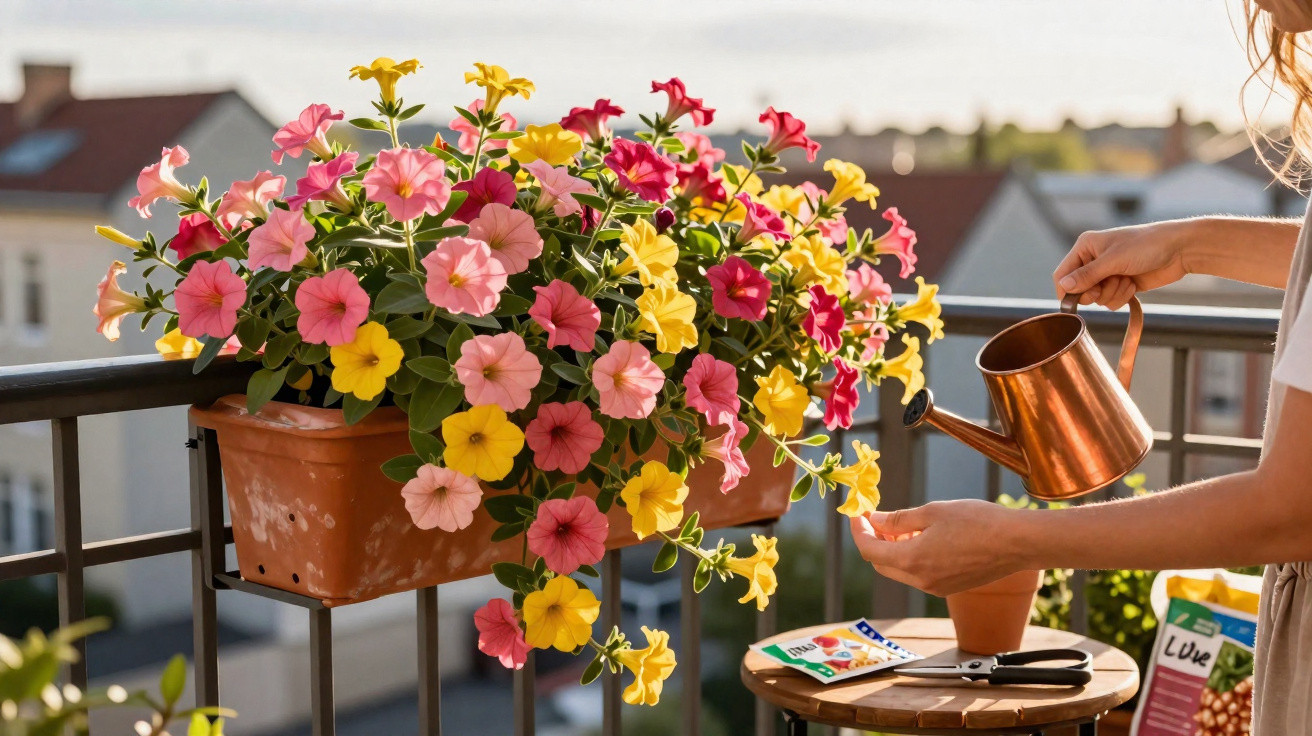
In many garden catalogue photographs, the effect is unmistakable: containers spilling over with colourful clouds of flowers that trail down for metres. There is rarely a secret trick behind this display. Usually, it comes down to one particular plant and planting it at the right time. Make the most of this spring window and your balcony boxes can stay full for months.
The “Million Bells” that make balcony boxes overflow
The star of this floral display is Calibrachoa. In shops, it is often sold under names such as “Million Bells” or “Mini Petunia”. Botanically, it belongs to the same family as the traditional petunia, but it has a more compact habit, branches more freely and flowers much more densely.
Calibrachoa creates a rounded, trailing cushion of growth. Plants reach around 15 to 30 centimetres in height, while spreading 30 to 60 centimetres wide. In balcony boxes, hanging baskets or suspended planters, this produces the well-known cascading effect: a dense cushion of blooms tumbling over the edge.
Calibrachoa produces hundreds of little bells from spring until the first frosts – provided its position and care are right.
The flowers resemble miniature petunias, with small bell-shaped blooms in yellow, pink, purple, orange, red or speckled bicolour combinations. More recent cultivars even offer double flowers and colour gradients that shift in tone during the day or over the course of the season.
Why Calibrachoa seems so easy to care for
One key benefit that balcony gardeners quickly appreciate is that the plant cleans itself. Faded flowers drop away naturally, so there is no need to go through the containers with scissors every other day to remove spent blooms.
This keeps the overall display looking fresh for a long time. Anyone with limited time, or who sees their balcony as a place to relax rather than a permanent worksite, will particularly value this quality. Another advantage is that the plant flowers almost continuously, as long as it receives enough light, water and nutrients.
Among growers, cultivars such as “Superbells Magic Double Grapefruit” are regarded as small stars. Their double flowers move between yellow and shades of pink, making the plant appear to constantly reinvent itself.
The right time in spring: when the planting season begins
Calibrachoa prefers warmth and is sensitive to frost. In central European climates, it survives only as an annual. Starting too early can lead to stalled growth or damage to the roots and shoots.
Plant only once there is no longer a risk of overnight frost and temperatures remain consistently above around 8 to 10 degrees.
In many areas, this period falls between mid-April and late May. At higher altitudes or in particularly cool locations, it may be early June instead. The safest rule of thumb for amateur gardeners is to wait until after the Ice Saints.
Planting boxes immediately after the last frosts gives the roots several weeks to grow through the compost. During this period, the shoots tend to grow fairly tidily upwards and outwards. By high summer, they will hang much more noticeably over the edge – precisely when most people spend the most time on their balconies and patios.
How many plants per box?
Trials generally recommend three to four young plants for a medium-sized balcony box or hanging basket. This creates a full, even display without plants crowding one another too severely.
- 60 cm box: 3 plants
- 80 cm box: 4 plants
- Large hanging basket (30 cm diameter): 3 to 4 plants
The ideal pot: no waterlogging and plenty of air around the roots
Calibrachoa reacts poorly to compost that stays constantly wet. Waterlogging quickly causes root rot, after which plants either struggle or suddenly collapse. A free-draining container set-up is therefore essential.
- Use a container with generous drainage holes.
- Add a layer of expanded clay balls or coarse gravel for drainage.
- Use only a loose, structurally stable balcony compost mix.
- Do not fill the box with heavy garden soil.
Composts specifically intended for balcony boxes or hanging containers generally contain enough coarse material for water to drain away while still allowing air to reach the roots. A highly free-draining mix that is slightly sandy or lightened with perlite works well.
Watering and feeding: keeping the floral display active all summer
Calibrachoa grows rapidly and flowers profusely, which requires energy. Cutting corners here results in sparse cushions with pale flowers. The plant therefore needs a combination of measured watering and regular feeding.
The surface of the compost should dry slightly between waterings – the roots must never remain permanently wet.
During average spring weather, watering every few days is usually enough. When temperatures rise significantly in high summer, hanging baskets in particular may need checking daily or even twice a day. Wind dries their compost especially quickly.
For abundant flowering, it is advisable to:
- Mix a slow-release fertiliser or some organic fertiliser into the compost at planting time.
- From around three weeks after planting, add liquid fertiliser for flowering plants to the watering water every 14 days.
- Increase feeding to once a week in high summer if growth is especially rapid.
As soon as plants begin to become bare from the bottom upwards or their flowering weakens, check their nutrient supply. Reserves are used up particularly quickly in small containers.
The July pruning trick: trigger a second wave of flowers
Many balcony gardeners are surprised when their plants suddenly look slightly tired from mid to late July. The cushions may still be trailing, but the quantity of flowers declines. This is rarely due to “old age”; rather, the shoots have become too woody and too long.
A small rejuvenating trim can help: shorten several shoots by one to two centimetres, distributing the cuts across the entire plant. This is not a drastic hedge-style cut, but a gentle pinch back.
A light trim encourages new side shoots – shortly afterwards, the plant produces fresh green growth and begins another round of flowers.
Afterwards, water well and feed again. In many cases, the second flush of flowers will then continue into October, provided no early frosts intervene.
Position, cultivar choice and clever combinations
Calibrachoa thrives in sunny to partially shaded positions. On a south-facing balcony exposed to heat and wind, it will need watering more often, but flowering will be at its most abundant. North-facing balconies are more challenging because the plant receives considerably less light and consequently remains less compact.
Cultivars in rich, pure colours are popular for creating strong contrasts. Varieties with bicolour patterns or double flowers that almost resemble tiny roses offer a more fashionable look. Many nurseries label suitable balcony plants with descriptions such as “for hanging baskets”, “trailing” or “cascading”.
Mixed planting in one box can be particularly effective. Calibrachoa combines well with the following partners:
- Trailing geraniums for bold colour accents
- Scented verbenas
- Structural plants such as sweet grass or ornamental sage
- White-flowering companions that visually soften strong colours
The important point is that all partners should have similar requirements for sun, water and nutrients. Combinations that are heavily watered and shaded are less suitable.
Common mistakes – and how to avoid them
Anyone who has had disappointing results with Calibrachoa will often recognise one of these issues:
- Planting too early: cold nights permanently slow growth.
- Compost that is too heavy: garden soil or clay causes waterlogging and root rot.
- Irregular watering: repeatedly switching between bone-dry and soaking wet conditions stresses the plant.
- No feeding: for continuous flowerers such as Calibrachoa, the nutrient reserve in the compost alone is not sufficient.
Avoid these pitfalls and, with comparatively little effort, you can achieve impressive cascades of flowers that turn a balcony or patio into a small yet distinctly professional-looking display.
One further note for beginners: the name Calibrachoa may seem awkward at first, but it appears in the balcony plant section of almost every nursery in spring. Sometimes plants are simply labelled “Million Bells” or “Mini Petunias”. Ask for a trailing variety with lots of small flowers and retailers will usually direct you to these plants.
The colourful bells are also well suited to families with children because they deliver quick results: the first cascades are visible only a few weeks after planting. At the same time, children can learn basic terms such as “free-draining”, “continuous flowering” and “slow-release fertiliser” through play, while seeing directly how proper care affects a plant.


Comments
No comments yet. Be the first to comment!
Leave a Comment