
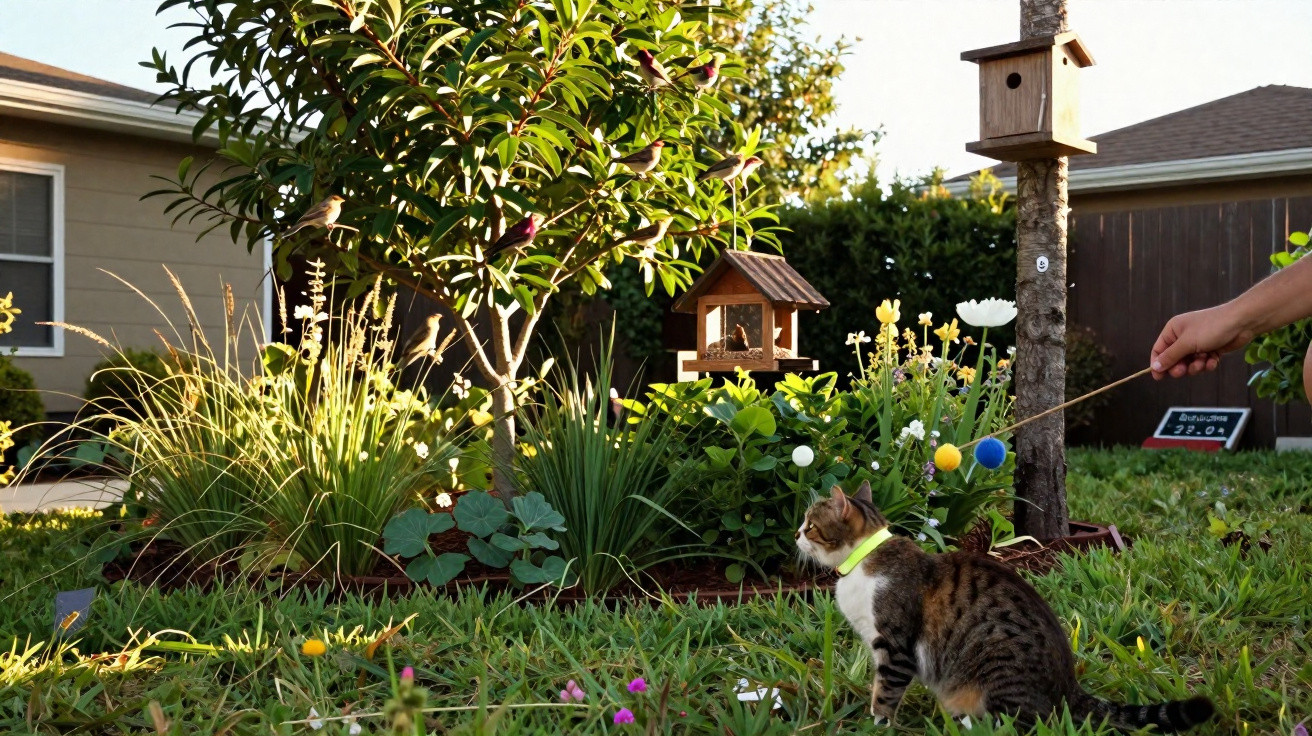
Many owners know the uneasy feeling: you adore your cat, enjoy every blackbird in the garden, yet repeatedly find a dead bird by the patio door. Do you have to choose between protecting cats and protecting birds? No. A few well-considered measures can reduce the harm significantly without making your cat unhappy.
Why the garden becomes a hunting ground for cats
Domestic cats are generally fed high-quality food nowadays, but they still hunt. Their hunting instinct runs deep, even when their bowl is full. Some cats rarely bring prey home, while others patrol the garden and neighbourhood several times a day.
The period from March to July is particularly sensitive. Many native species breed at this time, and fledglings often stay close to the ground in hedges or shrubs. They cannot yet fly properly and are curious and clumsy – easy prey for any nearby cat.
There is another factor: the modern, ‘tidy’ garden makes hunting easier. Clearing away every leaf pile, old branch, patch of long grass and dead stem removes countless hiding places for birds. Nests are left more exposed and escape routes disappear. For a bird, this means stress; for a cat, it is like an open shooting gallery.
The tidier the garden, the easier the cat's task – a few deliberately ‘untidy’ corners save many fledglings.
The ‘Refuge 3-2-1’ principle: turning your garden into a bird fortress
Rather than cutting everything back drastically in spring, it is worth adopting a different approach: create a layered sanctuary for birds where cats find it difficult to navigate. Think of it as a small green fortress.
Level 1: dense ground cover
At ground level, sturdy ground-cover plants and densely growing perennials provide shelter. Suitable choices include:
- grass-like plants such as sedges;
- mat-forming cranesbill varieties;
- other low, bushy perennials that do not need constant cutting back.
They create a dense tangle in which fledglings can hide more effectively. Cats cannot spot or reach them as easily.
Level 2: a protective shrub layer
Above this should be a layer of shrubs, ideally thorny varieties or those with very dense growth. Typical options include:
- hawthorn;
- blackthorn;
- dog rose;
- barberry;
- hazel.
Many species build their nests in shrubs of this kind. Cats will have a far harder time creeping close or climbing into them.
Level 3: small trees for visual cover
The third layer consists of smaller trees or tall-growing shrubs. These break up sightlines and deny cats a clear overview. Birds can retreat upwards while dense planting remains below.
A three-tiered garden area confuses the silent hunter – it is less able to find nests, and encounters become less frequent.
Practical bird protection in the garden: achieving a great deal with little effort
Anyone who does not want to redesign everything can start with a few focused adjustments. Treating the garden gently is especially worthwhile from mid-March to the end of July.
- Leave at least one square metre of leaf litter beneath hedges. Insects shelter there, while birds can find nesting material and food.
- Make a small pile of wood and branches in a quiet corner. It offers a refuge for insects and hedgehogs – and, ultimately, birds too.
- Before the first mow, set aside a strip of lawn and allow the grass there to grow longer. Fledglings and insects use this zone for cover.
- Do not cut back faded perennials with hollow stems straight away. Beneficial insects overwinter inside them and provide food for birds in spring.
- Apply a thick layer of organic mulch to bare beds. It teems with small creatures that feed birds – and encourages them to remain in sheltered areas for longer.
Even one well-protected corner can make a noticeable difference. If you are unsure where to start, choose a ‘key tree’ or central hedge and make that particular area bird-friendly and safer from cats. The same principle can then be extended to the rest of the garden step by step.
Safe nest boxes: how to protect birds properly
Nest boxes help only if cats cannot reach them. Many well-intentioned installations achieve the opposite and become traps. A few rules can prevent this:
- Position them at a height of around three metres: cats can then barely reach them.
- Keep them away from horizontal branches or wall ledges: there must be no point from which a direct jump is possible.
- Face the entrance hole east or south-east: this gives fledglings better protection from heat and driving rain.
- Do not fit a small perch in front of the entrance: it may look attractive, but it gives predators a foothold.
- Leave sufficient distance between the entrance hole and the base of the box; 15 to 20 centimetres is ideal. A cat's paw will then be unable to reach the fledglings.
If you provide feeding stations, place them so that no cat can jump at them from below or from the side. Railings, walls and low hedges are unsuitable locations.
A securely installed nest box saves entire broods – one hung incorrectly brings the cat straight to a laid table.
Bringing the cat on board: gentle ways to reduce hunting success
Working on the garden alone is rarely enough. The second key factor is the cat's behaviour and the times at which it goes out.
Restrict high-risk times
Most birds are particularly active at dawn and in the evening. These are also the times when many cats like to roam their territory. Managing outdoor access during the breeding season reduces the risk considerably. In practice, this means:
- from March to July, avoid unrestricted outdoor access during the early morning where possible;
- limit evening twilight outings, for example by feeding your cat indoors and closing the cat flap.
Many cats accept this routine surprisingly quickly when appealing indoor alternatives are available, such as food puzzles or short fishing-rod toy games.
A more visible cat is a less successful hunter
Another approach concerns camouflage. Birds respond strongly to colour and movement. Eye-catching, colourful collar ruffs or wide coloured bands around the collar make a cat recognisable earlier. Specially designed products are intended to avoid causing choking or entanglement.
Certain barriers can also help, including:
- special rings or collars fitted around tree trunks to stop cats climbing them;
- scents that many cats avoid, such as used coffee grounds or fresh citrus peel in sensitive areas;
- strongly scented plants that cats find unattractive.
In the long term, neutering and providing plenty of activity at home also matter. Cats that are physically and mentally stimulated roam less far and less intensely.
What you should never do
The most common mistake is putting feeding stations or nest boxes within jumping distance on walls, low trees or hedges. From the cat's perspective, this is an invitation to wait in ambush.
- Do not install a nest box at head height on a climbable tree with a wall beneath it.
- Do not place bird feeders on balcony railings if the cat has access.
- Do not position bird baths directly on the ground beside dense shrubs where a cat can hide.
Bird protection does not mean ‘locking the cat out’; it means making success difficult for it and giving birds several escape routes.
How to balance the garden, cats and birds over the long term
Anyone who gradually turns their plot into a richly structured habitat benefits twice: bird populations become more stable, while the cat still has plenty of stimulation without bringing home fresh prey every week. Many owners report that the number of ‘gifts’ drops markedly once hedges are denser, lawn areas are more varied and nesting sites are positioned more intelligently.
A lively garden can accommodate a little untidiness. Leaf-filled areas and deadwood piles can sit between beds where vegetables are growing. On the patio, one well-positioned bird bath at a safe height can achieve more than three unsafe feeding stations. And anyone who knows their cat will soon notice the spots where it prefers to lie in wait – those are precisely the areas where alterations are most worthwhile.
The aim is not to eliminate a cat's hunting instinct completely. That is unrealistic. The goal is to reduce the number of victims and protect the particularly vulnerable fledglings. A structured garden, adjusted outdoor times and a little creativity make this balance far more achievable than many animal lovers think.




Comments
No comments yet. Be the first to comment!
Leave a Comment