
Many keen gardeners automatically reach for moss killer and fertiliser in spring. Yet a matted, moss-covered lawn usually points to a deeper issue: the soil itself. By scheduling a few targeted jobs in March, you can make your lawn permanently denser, greener and far less mossy – without resorting to harsh chemicals.
Why moss in the lawn is a cry for help from the soil
After a wet winter, the lawn reveals its true condition: puddles, yellow patches and soft cushions of moss. While this may look like weather that ruins lawns, it mainly indicates poor drainage and compacted soil.
Moss is particularly likely to thrive when:
- the soil remains constantly damp;
- waterlogged areas barely dry out;
- too little light reaches the grass surface;
- the top layer of soil is hard and compacted.
“Moss is less an enemy than a warning sign: the soil is poorly aerated and water cannot drain away properly.”
Simply applying moss killer tackles the symptom rather than the cause. As a result, the issue returns after the next wet winter. March is the ideal opportunity to address it properly, once the ground is no longer frozen but is still slightly moist.
Task 1: Aerate the soil with a garden fork
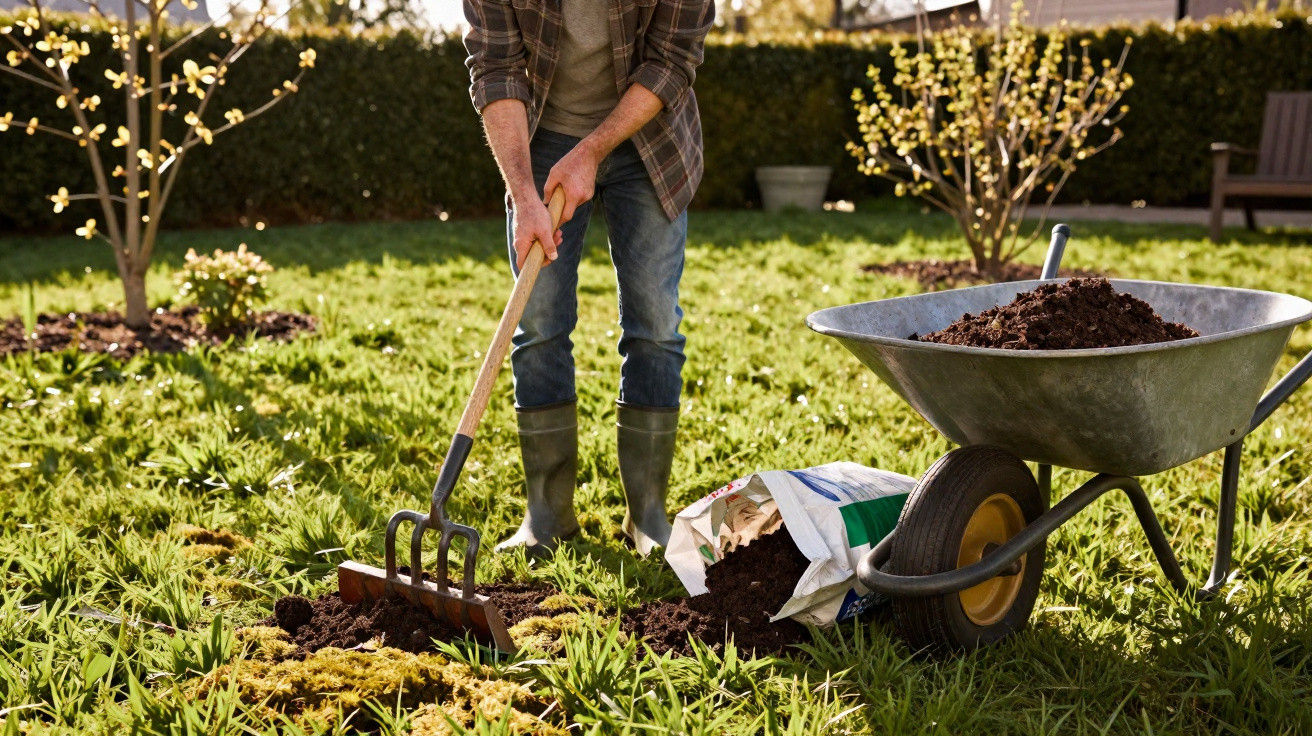
For a dense, healthy lawn, aerating the soil is the most important step. You do not need professional equipment: for smaller areas, an ordinary garden fork or a sturdy lawn-aerating fork is entirely sufficient.
How to aerate your lawn correctly
Work across the lawn in strips, following a loose but methodical pattern:
- Push the fork tines around 8–10 centimetres into the ground.
- Tilt the handle slightly backwards to crack open the soil a little.
- Pull out the fork, move roughly 15 centimetres along and push it in again.
Pay particular attention to trouble spots:
- areas where puddles remain after rain;
- spots where the ground sounds “hard” when tapped with your heel;
- heavily used areas, such as in front of the patio, beside the trampoline or around the play area.
The many small holes act as channels for air and water. They allow rainfall to soak into deeper layers instead of lingering on the surface. More oxygen also reaches the roots, strengthening the grass while weakening the moss.
Task 2: Apply a thin layer of soil mix
Aeration should be followed by a light application of soil mix, often called topdressing. This blend fills the fork holes, improves the soil structure and supplies nutrients.
A proven soil mix
A light, free-draining mixture of the following is ideal:
- finely sieved garden soil;
- coarse sand, or river sand;
- mature, sieved compost or leaf mould.
Add roughly equal quantities of each ingredient to a wheelbarrow, combine them thoroughly, then spread the mix thinly over the aerated areas.
How to spread the layer properly
The mix should not smother the lawn. Its main purpose is to fill the holes and settle between the grass blades. Proceed as follows:
- Scatter small heaps over the lawn with a shovel.
- Pull a stiff broom, outdoor broom or rake across the grass.
- Keep brushing until the blades are visible again and the holes appear filled.
“The thin layer of soil, sand and compost improves drainage and provides the grass with nutrients over the long term.”
You can still take action even if you do not have every ingredient available. Coarse sand on its own can significantly improve water drainage, while compost can always be added later.
Task 3: Rake out moss and thatch, then mow higher
Before mowing the lawn for the first time of the year, give it a thorough spring clean with a rake. The aim is to remove dead grass blades, old clippings and moss cushions from the turf.
Raking out moss and thatch effectively
Use a robust rake with metal tines or a dedicated scarifying rake, and work the lawn in two directions: first lengthways, then across.
- Rake with moderate pressure rather than merely skimming the surface.
- Collect moss, thatch and dead material, then place it on the compost heap.
- Let the lawn rest briefly afterwards before using the mower.
Straight after this treatment, the lawn will often look very sparse and may even seem “bare” in places. This is normal and is a positive sign: the moss has been removed, allowing light and air back into the turf.
First mow: higher is better than lower
Take a cautious approach with the first cut of the year. Set the lawnmower slightly higher than you would in summer. As a guide:
- Play lawns: a cutting height of 4–5 centimetres;
- hard-wearing areas used by children or pets: closer to 5 centimetres.
“After vigorous raking, the lawn may look temporarily ragged, but it will grow back denser and stronger within a few days.”
Cutting too low weakens the grass and encourages moss to return. Starting gently in March gives the blades time to develop a strong root system and a vigorous turf.
The right timing: neither too early nor too late
All three tasks can be completed in one dry afternoon, provided the conditions are right. The soil should be:
- no longer frozen;
- only slightly moist, rather than muddy;
- firm enough not to sink too deeply underfoot.
In milder parts of the country, you can begin in late February. In colder areas, it is better to wait until mid-March, when the ground has warmed slightly and the frost has largely gone. Poking around in waterlogged soil only worsens compaction and leaves deep footprints.
Extra tips for a lawn with permanently less moss
The three March jobs provide an excellent foundation. To support your lawn in the long term, you can also adjust a few other factors:
- Light: Dense hedges and low-hanging branches shade the lawn. Pruning them back can make a dramatic difference.
- Nutrients: A balanced lawn fertiliser in spring promotes thick growth, helping grass compete more effectively with moss.
- Watering: Water less often but thoroughly, rather than sprinkling lightly all the time. This encourages deep roots.
- Use: Where possible, direct heavy foot traffic onto paths or stepping stones.
If your soil is especially heavy and clay-rich, regular sanding in spring is particularly beneficial. With every season, the top layer becomes a little looser and more permeable, waterlogging decreases and moss loses its advantage.
Stress-free lawn care: realistic expectations matter
Maintaining a perfectly uniform, deep-green ‘carpet lawn’ in a home garden requires considerable effort. A few islands of moss or bare patches will remain in almost every lawn. What matters more is that the area is robust, recovers quickly and looks healthy overall.
That is exactly what these three simple March tasks help achieve: aerate the soil, apply a thin topdressing, rake thoroughly and mow carefully. Set aside half a day in spring and, just a few weeks later, you will usually notice a denser, greener lawn that stands up better to foot traffic – all without specialist products from the DIY shop shelf.




Comments
No comments yet. Be the first to comment!
Leave a Comment