
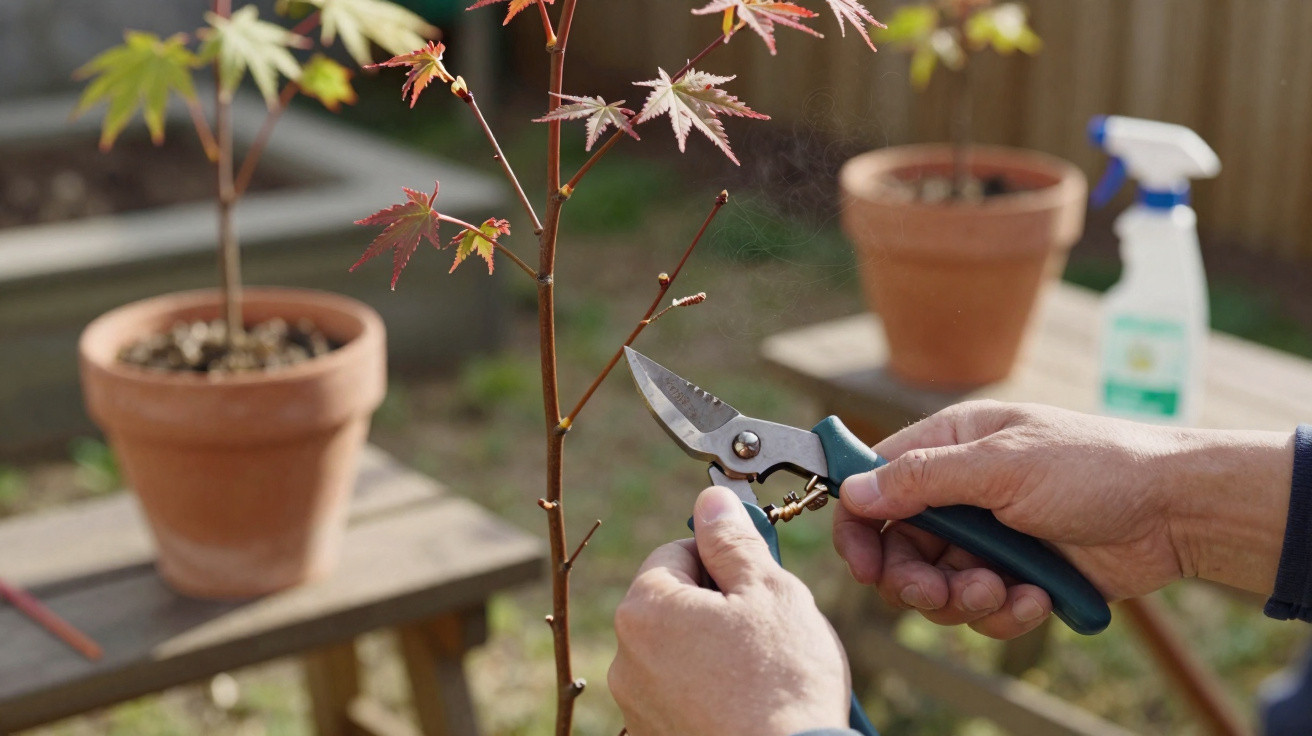
Many garden owners regard their Japanese maple as a prized feature – yet pruning it incorrectly or at the wrong time can leave it weakened for months.
When people begin tidying the garden with secateurs in late winter, the delicate Japanese maple is often among the first plants they turn to. This is precisely where an often-overlooked danger lies: careless cutting can cause heavy sap loss, frost damage and disease. Specialists are urging far greater restraint.
Why Japanese maple responds so sensitively to pruning
The Japanese maple (Acer palmatum) is slow-growing, has exceptionally thin bark and struggles to seal larger pruning wounds. This makes it considerably more vulnerable than hardy fruit trees or ornamental shrubs.
Once sap flow begins in late winter, pressure rises within the tree. Removing a substantial branch at this point may cause it to effectively “bleed”: sap can run from the wound for minutes or even hours.
Heavy sap loss deprives the Japanese maple of stored resources, delays wound healing and leaves it vulnerable to fungi and bacteria.
Unlike many native trees, Japanese maple forms protective barrier tissue slowly. Its wounds therefore remain exposed for longer, giving pathogens an easy route in. Its naturally fine wood can also dry out more quickly, especially in wind or frost.
The right time: when pruning is still safe
Garden experts recommend pruning Japanese maples only within a clearly defined period: while they are fully dormant. This begins in late autumn, once the leaves have fallen, and ends before buds start to develop noticeably towards the end of winter.
- Late autumn: a suitable time for light adjustments and removing dead branches.
- Midwinter (on frost-free days): ideal for minor work on dead or diseased wood.
- Late winter: take only very cautious action, as sap flow will soon begin.
Many tree specialists consider February the final reasonably safe opportunity before the tree truly “wakes up”. As soon as the buds begin to swell visibly, every cut brings a greater risk of substantial sap loss.
Anyone pruning in February should remove only small, clearly dead branches – everything else is best left until the following winter.
Avoid frost and heavy pruning
Weather conditions and the severity of the pruning matter just as much as the date. Cold temperatures and drastic cuts can place additional severe stress on a Japanese maple.
- Never prune in frost: frozen wood is brittle, and fresh wounds may split later.
- Remove no more than one quarter of the living canopy: heavier work stresses the tree and slows its growth.
- Do not use hedge trimmers: coarse tools tear the bark and create numerous poorly positioned wounds.
Pruning too hard often makes the maple respond with vigorous, uneven new growth. Not only does this spoil its elegant outline, but it also uses energy the tree would be better directing into strong, healthy branches.
How to prune Japanese maple safely in winter
Anyone wishing to care for a Japanese maple responsibly should work methodically and allow time to plan. Begin by calmly assessing the entire canopy.
Step 1: Identify dead and diseased wood
With no leaves on the tree, dead branches are usually easy to spot. Dead shoots tend to be grey and brittle, with no green layer visible beneath the bark.
- Lightly scratch the bark with a fingernail: if it remains brown, the shoot is dead.
- Obvious fungal fruiting bodies or black discolouration indicate disease.
- Always remove broken or split branches to prevent rot.
Winter pruning should focus precisely on these areas. Living, healthy branches should be left largely untouched.
Step 2: Reduce crossing and rubbing branches
Branches that cross, rub together or grow strongly inwards will eventually create abrasion points. The bark may split there, creating an entry point for disease.
Rather than broadly “tidying up” the tree, remove one of the troublesome branches selectively. This retains the natural shape while keeping the canopy open and well ventilated.
Step 3: Use clean tools and make precise cuts
Sharp, clean secateurs or a narrow pruning saw are essential. Blunt blades crush the wood and extend the time needed for healing.
- Briefly disinfect pruning tools before starting work, for example with alcohol.
- Always cut just above the branch collar, the small swelling at the point where the branch joins.
- Never cut into the trunk wood, to avoid creating large wounds on the trunk.
Every cut should look deliberately placed – not torn away or “chewed off”.
What to do if you have already pruned too late
Many amateur gardeners notice only after cutting that the tree is bleeding heavily or that they chose an unfortunate moment. Panic is unhelpful, but careful observation is worthwhile.
- Watch the cut surfaces: if the sap flow stops after a while, corrective action is not necessarily required.
- Do not apply wound sealants as a precaution – many products are more harmful than helpful for maples.
- Keep the base of the tree free from weeds, apply a thin layer of mulch and water adequately during dry conditions.
Rather than making further cuts, the priority after late pruning is to reduce stress. The maple needs rest, nutrients and as little competition around its roots as possible.
Position, care and common mistakes with Japanese maples
In addition to pruning, the site has a major influence on the tree’s resilience. A Japanese maple ideally needs a sheltered, partially shaded position with evenly moist, humus-rich soil.
- Too much sun: particularly in summer, this can cause leaf scorch.
- Waterlogging: weakens the roots and encourages root rot.
- Repeated hard pruning: causes the distinctive, elegant form to disappear.
Anyone who trims it all around every year risks turning the tree into an anonymous ball or cone. The appeal of a healthy Japanese maple lies precisely in its open, almost graphic silhouette.
Why less pruning is often better
Many specialists agree that the best pruning cut for a Japanese maple is usually the one not made. Healthy trees need only minimal correction. Over the years, this allows a natural, balanced form to develop.
The Japanese maple is not a shapeable box plant, but a tree with character – it rewards restraint with grace and longevity.
If in doubt, seek advice from a nursery or ask a certified tree surgeon before carrying out major work. Once a main branch has been cut incorrectly, it cannot be “stuck back on”.
Additional advice for container plants and young trees
Japanese maples are often grown in containers on patios or balconies. These specimens dry out more rapidly and are more susceptible to freezing through. Any pruning mistake therefore has an even greater impact.
- Protect containers from severe frost in winter, for example with horticultural fleece or hessian sacks.
- Never prune immediately before a forecast frost period.
- Shape young trees only minimally during their first few years, allowing them to establish a strong framework.
Following all these points protects not only a costly garden tree, but also preserves a living design feature that becomes more beautiful year after year – without risky drastic treatment.
Comments
No comments yet. Be the first to comment!
Leave a Comment