
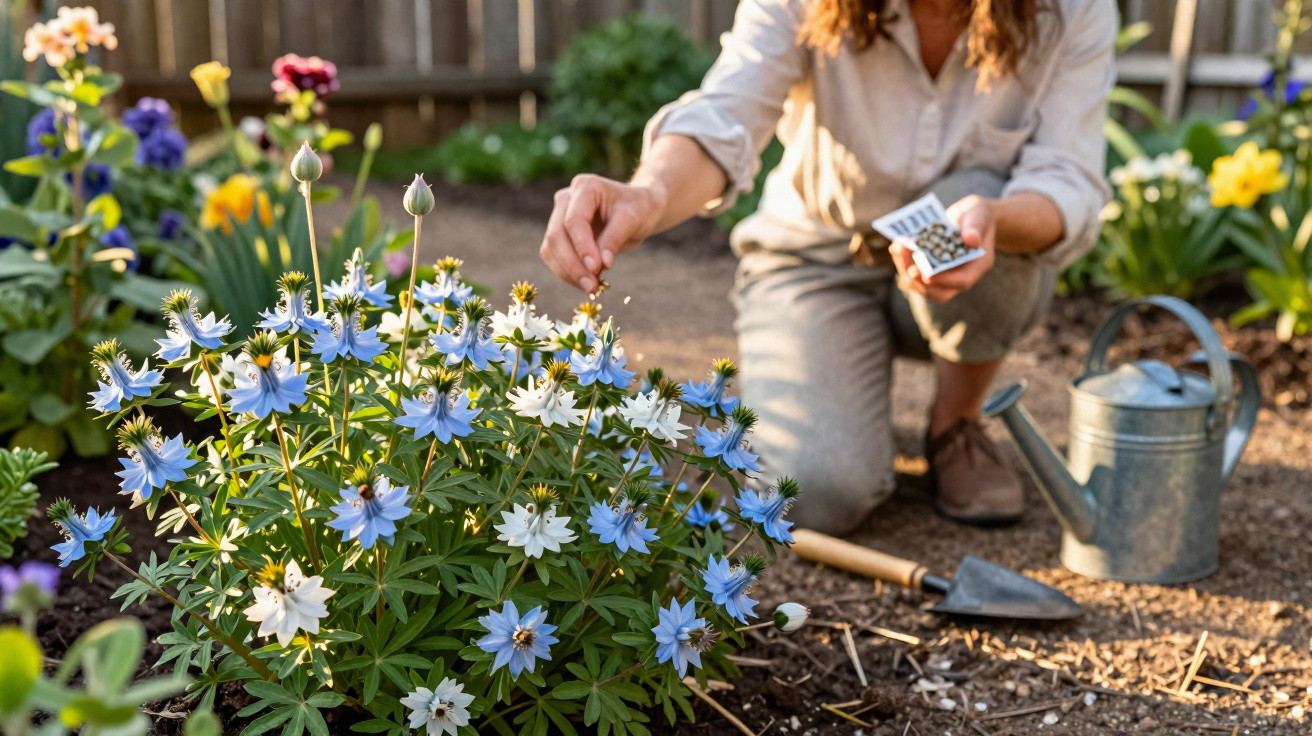
Spring may be slow to arrive and the beds may still look bare, but a single flower can turn your garden into a summer sea of delicate colour.
In March, many amateur gardeners look at empty beds and wonder where to begin. The soil is only gradually thawing, with no sign yet of summer abundance. Yet this is exactly the moment to lay the foundations for a season full of flowers with an understated but remarkably dependable plant – requiring neither daily watering, complicated care nor professional expertise.
The unassuming summer star: what makes Love-in-a-Mist so special
The plant in question is Love-in-a-Mist (Nigella damascena). It is one of the traditional annual summer flowers, although its fine growth gives it an almost wildflower-like character. It is an excellent choice for anyone who enjoys natural-looking gardens with a lightly informal feel.
Love-in-a-Mist is recognisable by its star-shaped blooms, framed by delicate, thread-like foliage. This makes the flowers appear to float within a green veil, which is where its evocative name comes from.
“From mid-June until the end of August, Love-in-a-Mist provides an almost uninterrupted display of flowers – with very little effort required.”
More specifically, the plant has the following qualities:
- It normally reaches 40 to 60 centimetres in height.
- Its flowers range from pale blue and white to soft pink.
- Its open, airy habit is ideal for naturalistic beds.
- It flowers for several weeks, often continuing into early September.
- It copes well with ordinary garden soil.
Anyone who has grown it in a bed once will immediately recognise it in later years. Many gardeners find that it returns seemingly of its own accord the following year, as it self-seeds reliably. This is precisely what makes it appealing to those who like a lively, self-renewing garden.
Why March is the ideal time to sow Love-in-a-Mist
During March, the soil begins to warm and the hardest frosts have usually passed. This signals the time to sow hardy annual summer flowers. Love-in-a-Mist is one such resilient species and handles the temperature fluctuations typical of spring well.
When it is sown directly into the bed in March, it has time to establish a strong root system. As the days become longer and warmer, its growth then gathers pace. By early summer, this produces a dense yet airy cover of plants.
A typical timetable looks like this:
- Sow in March or early April.
- Germination takes around two to three weeks, depending on the weather.
- The first noticeable growth appears in April.
- Flowering generally starts from mid-June.
- Blooms continue until the end of August and, in mild weather, can last even longer.
The benefit is that, while many perennials and roses are still getting established, Love-in-a-Mist is already bringing colour to the bed. Empty patches disappear and the garden feels alive early in the season.
Sowing Love-in-a-Mist made simple: a step-by-step guide
There is good news for gardeners with little experience: few summer flowers are easier to grow. Love-in-a-Mist can be sown straight into its final position in the bed, without raising seedlings on a windowsill.
Choosing the right position
For a successful floral display, the plant chiefly needs sunshine. A site with plenty of light is best; partial shade is still suitable, but full shade will noticeably reduce flowering.
Ordinary soil is perfectly acceptable, provided it does not become waterlogged. A loose, free-draining growing medium is especially suitable. In heavy clay soils, it is worthwhile working in some sand or fine grit to improve drainage.
Preparing the soil and sowing
Prepare the chosen area briefly before sowing. It takes only a few minutes, but makes a considerable difference:
- Remove weeds thoroughly so young plants are not crowded out.
- Loosen the soil and break down any large clods.
- If the ground is very poor, work in a thin layer of well-rotted compost.
Then scatter the seeds broadly over the prepared surface. Unlike vegetable seed, they do not need a deep drill. The lightest covering of soil is quite enough, as Love-in-a-Mist seeds need light to germinate well.
“Cover the seeds with only a fine veil of soil and press them down gently – that is all they need.”
A brief shower or a gentle spray from a watering can will help the seeds make good contact with the soil. Most importantly, do not let the ground dry out during the first few days after sowing, otherwise germination may be interrupted.
Thin seedlings properly – the most common beginner’s mistake
Because the seeds are so small, many people sow them too thickly. The result is a tangle of weak, spindly plants. Once the seedlings emerge, it is better to thin them out decisively.
As soon as the first true leaves appear, rather than just the seed leaves, create space between the plants. Around 20 to 25 centimetres is ideal, or 30 centimetres in large, generous beds. This allows sturdy individual clumps to form instead of forcing every plant to compete for light.
Keeping the display in flower throughout summer
Once Love-in-a-Mist is established, it is exceptionally undemanding. Normal summer rainfall will usually be enough; only during extended dry spells is an occasional deep watering worthwhile.
The most important care tip concerns faded flowers. Regularly cutting off spent flower heads encourages the plant to produce fresh buds. This small task noticeably extends the flowering period and helps prevent gaps appearing in the beds.
“Remove faded heads and let fresh blooms follow – the plant will almost do the work for you.”
Another advantage is that the stems are excellent for a vase. Arranged in a simple glass with a few grasses or other summer flowers, they create a relaxed, natural bouquet that can last for up to ten days.
Self-seeding: when the garden decorates itself
If you do not want to sow again each year, leave some flowers in place at the end of the season. They will form striking, balloon-like seed heads. Once these have dried, the fine seeds fall out and spread across the bed.
The following spring, new plants will germinate in many places. Over time, this creates a gently random yet highly harmonious effect, as though the garden itself had chosen where blue, white or pink should shine.
One small consideration: this untamed distribution can sometimes look untidy in very neat, formally designed gardens. Anyone who prefers clear lines should collect the ripe seeds deliberately and sow them only in selected areas the following year.
Which plants pair particularly well with Love-in-a-Mist
Combining Love-in-a-Mist with other plants will make beds more interesting. Its delicate flowers look especially effective beside sturdier companions with stronger growth.
Reliable pairings include:
- Poppies and cornflowers for a classic country meadow look.
- Roses, where it can fill gaps at the front of the bed.
- Lavender or catmint for a Mediterranean-style planting scheme.
- A loose accompaniment to perennials such as coneflowers or coreopsis.
The plant also works in containers on a balcony or patio, as long as the container is sufficiently deep and the compost does not remain constantly wet. Groups of several pots in different heights are particularly charming here.
Practical advice on care, risks and benefits
Many amateur gardeners ask whether the seeds or plants are poisonous. Love-in-a-Mist is not among the plants commonly considered poisonous, but its seeds should nevertheless not be eaten. For pets that occasionally nibble the leaves, there is normally no acute danger, although they should not be deliberately fed the plant.
There is also a benefit for wildlife gardeners: the flowers attract numerous insects, particularly bees and other pollinators. Anyone who values a bee-friendly garden will find Love-in-a-Mist an easy starting point, without having to create an entire wildflower meadow.
Here is a brief overview of its strengths and potential drawbacks:
| Advantages | Limitations |
|---|---|
| Easy to sow directly into the bed | Needs sun and flowers very little in shade |
| Long flowering period with minimal care | Prone to rot in very wet soil |
| Suitable for beginners | Self-seeds heavily if left unchecked |
| Ideal for natural, informal gardens | Less suited to strictly formal designs |
Spending a few minutes in the garden this March will lay the groundwork for weeks of summer enjoyment. A packet of seeds costs only a few pounds, yet the effect in the bed appears far greater. It is often the moment when a cautious beginner becomes an enthusiastic gardener: when an unremarkable scattering of seed turns into a whole carpet of light, dancing flowers.

Comments
No comments yet. Be the first to comment!
Leave a Comment