
Many amateur gardeners are frustrated by yellow leaves and pale blooms on their hydrangeas – yet the solution is often hiding unobtrusively in the kitchen.
Anyone hoping for proud hydrangeas with vigorous flowers in the border may soon turn to costly specialist fertilisers and blame the weather. However, a completely free leftover from breakfast or dessert can restore some energy to these shrubs. This approach makes use of an ordinary natural material that would otherwise go into the bin or compost heap – where it frequently takes far too long to have an effect.
Why hydrangeas in the garden often struggle
Hydrangeas are classic acid-loving plants. They prefer soil that is fairly acidic, with a low pH value; a level of roughly 5 to 6.5 is ideal. Yet, in many areas, the ground is rich in lime. This raises the pH value and makes the soil “too mild”.
As a result, the plants find it harder to absorb essential nutrients. Iron, magnesium and other trace elements may be present in the soil, but can barely reach the roots. Many gardeners will recognise these signs:
- Leaves turn yellow while their veins remain green
- Flower heads stay small or fail to develop properly
- Overall growth appears sluggish and lacking in strength
- Despite watering and fertiliser, the shrub simply looks “drained”
Rather than applying ever stronger liquid fertilisers, it is worth checking the pH level and using organic material that gently acidifies the soil while improving it over the long term.
“Those who gradually acidify the soil while fertilising gently will get noticeably more colour and vitality from hydrangeas.”
The surprising kitchen helper
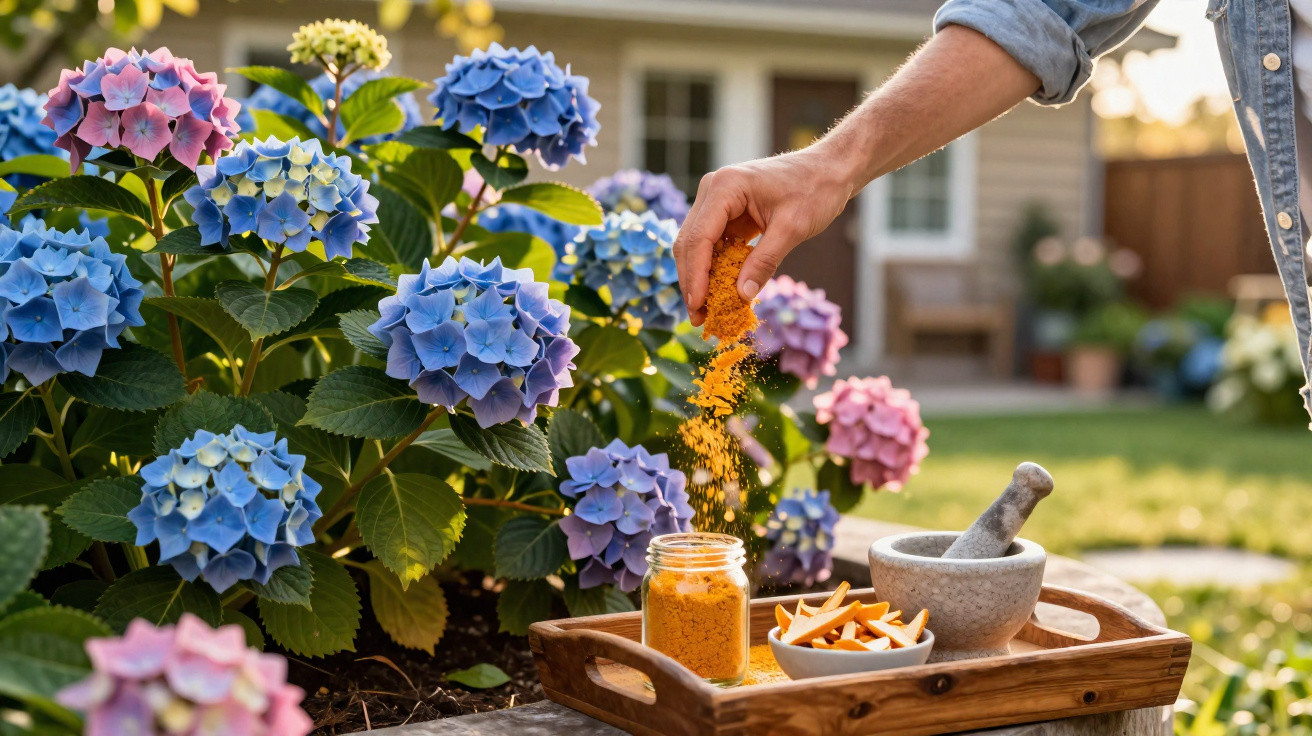
Something many people discard can benefit plants: citrus peel, particularly orange peel. It is among the organic leftovers that have a mildly acidic reaction and also provide a small amount of nutrients.
The peel contains, among other things:
- Potassium – supports sturdy shoots and strong blooms
- Magnesium – essential for the formation of leaf green
- Calcium – strengthens the plant’s cell structure
- A small proportion of essential compounds – encourages soil life and humus formation when well distributed and pre-dried
This combination works gradually and gently. Although it cannot replace a complete soil improvement programme in gardens with extremely lime-rich soil, it can give hydrangeas a noticeable lift where the remaining conditions are reasonably suitable.
Preparing orange peel correctly for hydrangeas
Placing fresh pieces of peel directly on the soil does not work well. They decay slowly, attract fruit flies and take a long time to break down when left whole. Preparation is the key.
Step 1: dry thoroughly
The peel needs to become completely dry and genuinely brittle. Here is how:
- Tear or cut fresh peel into strips as thin as possible.
- Spread the strips across a tray or baking sheet so that none overlap.
- Leave them to dry for several days in a warm, well-ventilated spot, such as on a windowsill above a radiator or on a sunny balcony.
- For a quicker option, set the oven to a low temperature of around 50–70 °C, leave the door slightly ajar and check regularly. The peel may become crisp, but should not turn dark brown.
When the pieces snap like crisps, they are ready for the next stage.
Step 2: crush for better results
The smaller the pieces, the more quickly soil organisms can process them. An almost powder-like texture is best.
Possible methods include:
- Grinding them into a coarse powder in a blender or mini chopper
- Crushing them with a pestle and mortar
- Putting the dry peel into a bag and rolling over it with a rolling pin
The result does not have to be a perfectly even powder, but the pieces should be clearly smaller than a fingernail.
How to use orange peel powder in a hydrangea bed
The powder acts like a mild organic specialist fertiliser for acid-loving plants. Getting the quantity right is important.
“Less is more here: a thin layer around the plant works far better than a thick pile placed directly against the stem.”
Recommended garden application:
- Apply once a month throughout the growing and flowering period, from April to August
- Use around one small handful of powder for each medium-sized shrub
- Scatter the powder around the root area within a radius of approximately 30 to 40 centimetres
- Cover it lightly with soil, bark mulch or compost
- Water well afterwards so the compounds dissolve and seep into the soil
With very heavy soil prone to waterlogging, be slightly more cautious when watering so the roots are not left sitting in water. Loose, humus-rich soil can take a little more water.
Hydrangeas reach their colour potential with additional measures
Orange peel alone will not turn a shrub planted in entirely the wrong place into a flowering showpiece. It delivers its full potential when a few basic principles in the hydrangea bed are also right.
Keep an eye on position and soil
- Partial shade: direct midday sun weakens plants, while morning or evening sunshine is often sufficient.
- Loosening: regularly loosen compacted soil without damaging the roots.
- Humus: work a layer of well-rotted compost around the shrub every year.
- Mulch: bark mulch or pine and spruce needles can help lower the pH value slightly.
Combining orange peel with these measures gives hydrangeas a stable foundation. The plants repay this with vigorous new growth and a denser display of flowers.
What orange peel cannot do
In gardens with extremely lime-heavy irrigation water or substantial building rubble in the soil, the peel method alone will not be enough. These situations often require:
- Larger amounts of specialist rhododendron compost when planting
- Rainwater for watering, where necessary
- A position in a large container if the garden soil is completely unsuitable
Dried peel remains a useful addition nonetheless, as it supplies nutrients slowly and stimulates soil life.
Practical tips, mistakes and questions about using it
Many gardeners wonder whether citrus waste could acidify soil too strongly or whether essential oils might damage roots. In normal garden quantities, this risk is minimal, provided that the peel is genuinely dry and finely crushed.
| Question | Answer |
|---|---|
| Can peel from sprayed fruit be used? | It is better to choose organic produce. Although residues from treatments are low in small quantities, anyone wishing to be certain should use untreated fruit. |
| Only oranges, or other citrus fruits too? | Mandarin and lemon peel are also suitable. They should likewise be fully dried and crushed. |
| Can peel go directly into the compost? | Yes, but it will break down much more slowly there. For hydrangeas, it works faster when dried and ground separately. |
| Is it possible to overdo it? | Applying large amounts every week can upset the soil environment. Small doses once a month are entirely sufficient. |
How to make the trick part of everyday life
Surprisingly large quantities of peel accumulate in a household over several weeks. Throwing it away immediately means losing out on free fertiliser. A simple routine is useful:
- Set out a shallow dish or baking sheet on which the peel can dry
- Keep adding new scraps until a worthwhile quantity has built up
- Every few weeks, grind the dry mixture and store it in a jar
This gradually creates a supply of natural specialist feed for hydrangeas, rhododendrons, azaleas and other acid-loving woody plants with very little effort.
Those who enjoy experimenting can extend the effect by mixing the powder with coffee grounds. Both ingredients are mildly acidifying and rich in organic matter; together, they provide a strong but still gentle nutrient boost that produces noticeable effects especially during spring growth.
Comments
No comments yet. Be the first to comment!
Leave a Comment