
Push a fork into the ground and it scarcely penetrates. Its tines rasp against a layer that seems closer to aged concrete than soil. A handful of determined weeds survive, the lawn ends suddenly at a tough crust, and rainwater lies in lifeless pools on the surface before draining along the path. Pull out a plant and its roots are brief, blunt and seemingly resentful. It is nothing like the rich, living earth shown on gardening programmes. Instead, it seems sealed up. Stalled. Slightly lifeless.
Then a neighbour comes over, rubs their hands on their jeans and carries out one small, rough-looking soil check that shifts the entire discussion.
They do not inspect the plants. They listen to the ground.
The simple “squeeze test” that exposes tired, dead-feeling soil
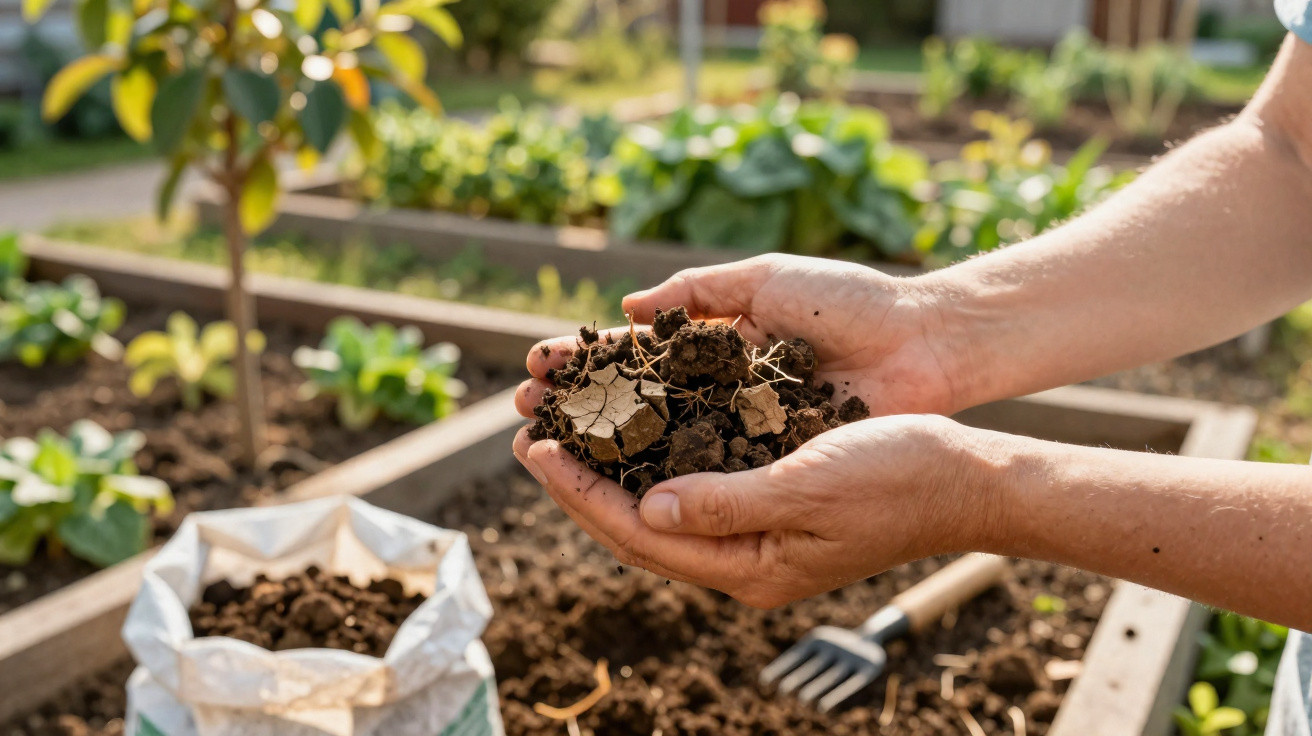
Begin with something that is almost childishly simple. Collect a handful of garden soil from roughly 10–15 cm below the surface, where plant roots should be growing. Avoid the dry surface dust and the waterlogged patch near the drain. Take the proper soil beneath.
Compress it in your palm as though shaping a small snowball. Next, open your hand and see how it responds. That is the whole test.
When it immediately collapses in a dry, powdery cloud, the soil is desperately short of organic matter. When it remains a firm mass, much like a lump of modelling clay, it is suffocating. But if it separates into soft, friable pieces resembling chocolate cake, your position is better than you may have realised.
Last spring, I saw a retired landscaper use this method on a friend’s “dead” vegetable bed. She had been close to abandoning it, convinced she simply could not garden. Her raised beds contained compacted soil, beetroot no larger than marbles and lettuce that bolted almost overnight. Everything looked exhausted.
He pushed his hand into the bed, lifted out a handful, squeezed it and gave a nod. The soil stayed in a dense clump with virtually no loose crumbs. When he split it with his thumb, the centre was pale and streaked, with no obvious traces of old roots, leaves or life.
“That’s not bad soil,” he said. “That’s hungry soil.” She stared at him as if he had criticised her cooking. Yet he crumbled more of it in his hand and showed her what was really there: no structure, no scent and nothing wriggling. Only silence.
What, then, does this squeeze test actually show? It is not an elaborate laboratory assessment. It is about soil structure. Healthy soil contains countless small clusters known as aggregates, held together by living processes: fungi, bacteria, roots and the remnants of everything that has grown there before. These clusters retain moisture and air, functioning like miniature sponges with spaces to breathe.
When the soil in your hand either becomes dust or sets into a solid clod, those living “glues” are likely absent. There are no earthworms, few fungal threads and barely any decaying plant material to give the soil its spring.
This is why a garden can look green on the surface, yet secretly be running on fumes underground. The squeeze test acts as a swift pulse check. It is not flawless or scientific in a white-coat sense, but it can reveal a great deal.
What your soil is begging for (and how to give it back)
If the squeeze test reveals soil that is dusty or as hard as stone, the missing component is nearly always identical: organic matter. This does not mean costly fertiliser in a colourful packet or another emergency feed. It means genuine, slow-working brown and green material that was once alive.
Consider compost, leaf mould, well-rotted manure, shredded autumn leaves and even the exhausted plants left from the previous season. Apply a 3–5 cm layer across the top of your beds, then leave the worms to handle the hard work. There is no need to dig it through as if you were stirring cake mixture. Spread it, stand back and allow time and living organisms to do their work.
Repeat the squeeze test a few months afterwards and the difference may be striking. A clod that once resembled pottery clay begins to fall apart between your fingers. You may notice fine fibres, darker markings and a smell more like a woodland floor than a car park.
A reader in a small town outside Bristol wrote about her front garden: a bleak strip of builders’ rubble over compacted subsoil. She experimented with every “quick” solution: slow-release fertiliser spikes, coloured bark and soluble blue crystals promising miracles. Her roses sulked, the lawn went yellow and each summer the soil hardened into a brick.
One winter, she stopped relying on gadgets and used what her grandfather had always used: council compost, a wheelbarrow full of rotted manure and a deep covering of chopped leaves. She did not double-dig, rotavate or injure her back. She simply mulched and waited.
By the second year, the result of her squeeze test had changed beyond recognition. The handful she took held together softly before breaking into crumbs. Earthworms wriggled through it, a light, sweet earthiness was present, and the roses finally pushed roots downwards rather than spreading them across the surface.
In truth, nobody does this every day. We do not solemnly walk around squeezing soil as though it were a ritual. Daily life already contains school runs, emails and overloaded dishwashers.
However, when you pause to notice, the pattern becomes obvious. If soil feels dead, it lacks something alive. It is not only short of nutrients, but also of the untidy, partly decomposed remains of leaves, stems, roots and kitchen scraps. These materials are food for microbes and worms, the unseen workers that restore soil structure.
“Fertility isn’t in the bag,” that same landscaper told me once. “It’s in the crumbs. You’re not feeding the plants first. You’re feeding the soil that feeds the plants.”
- Apply 3–5 cm of compost or leaf mould to the surface of your beds every year.
- Avoid frequent rotavating and deep digging, which break apart soil crumbs.
- Keep bare soil covered with mulch, plants or a straightforward green manure.
- Take care with chemical fertilisers high in salts, as they can put soil life under stress.
- Carry out the squeeze test at least once per season as a rapid health check.
From hard crust to living sponge: letting the ground wake up
A quiet change occurs when you quit battling with the garden and begin listening to it. It is the point at which you press your fingers into last year’s mulch and the boundary between plant material and soil begins to disappear. The fork enters more easily. Rain no longer skims across the top; it soaks in with a dark, gentle gleam.
Although simple, the squeeze test becomes less of a technique and more of a routine, like tasting a dish as you cook. You learn the sensation of a healthy handful: resilient and crumbly, neither overly compact nor excessively loose. You also see that plants growing in these spots manage heat, cold and your occasional neglect more successfully.
| Key point | Detail | Value for the reader |
|---|---|---|
| Soil squeeze test | A handful of soil is squeezed and released to judge how it crumbles | A quick, free method for identifying soil that lacks structure and life |
| Organic matter is missing | Compost, leaves and manure restore crumbs while feeding microbes | A clear step towards changing hard, lifeless soil into a living sponge |
| Gentle, surface-focused care | Mulching, reduced digging and seasonal checks rather than quick fixes | Hardier plants, improved drainage and less work over time |
FAQ:
- Question 1 My soil is like dust when I squeeze it. What does that mean? It generally indicates very little organic matter and poor structure. Begin adding compost, mulching and avoiding permanently bare soil so it can retain water and nutrients more effectively.
- Question 2 The clump stays hard and won’t crumble. Is my soil ruined? No, although it is compacted or clay-heavy. Organic matter, roots from plants such as clover or other deep-rooted varieties, and reduced heavy traffic will gradually open it up and rebuild it.
- Question 3 Can fertiliser fix a bad squeeze test? Fertiliser may feed plants temporarily, but it cannot form crumb structure. Decaying plant material is still needed to support the microbes and earthworms that create those crumbs.
- Question 4 How often should I do the squeeze test? Once or twice annually is enough. Try it in early spring, then again in autumn, to notice changes after a season of mulching or planting.
- Question 5 What if my soil feels good but plants still struggle? Healthy texture is only one part of the picture. Shade, unsuitable watering practices, pH problems or plants that do not suit your conditions may be responsible.

Comments
No comments yet. Be the first to comment!
Leave a Comment