
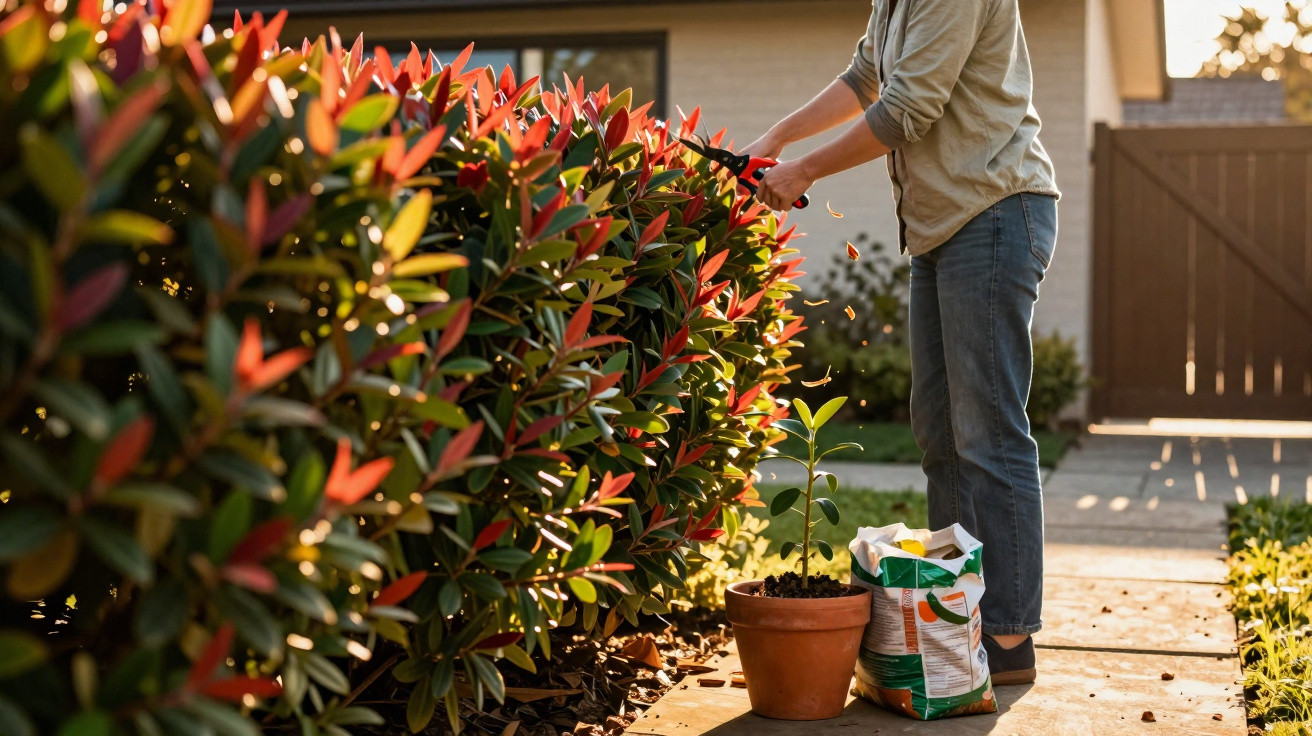
In countless housing developments, the red-flushing hedge was long considered the ideal privacy screen. It grew quickly, stayed evergreen and was available in every garden centre. Now, experts are predicting a genuine wave of replacements for spring 2026. A colourful, remarkably straightforward shrub is moving into front gardens – and could finally displace the familiar standard hedge.
Why the red standard hedge is now failing in gardens
Homeowners moving into newly built properties during the 2010s and having a contemporary hedge planted often chose an evergreen shrub with vivid red new growth. Within a short time, it formed a dense, uniform “green fence” and was seen as a smart alternative to the old monocultures of thuja.
The downside is now becoming apparent after several milder winters. Plant-health specialists are observing a fungal disease that visibly damages the foliage within a few months. Attractive red shoots develop spotted leaves, which later turn brown and eventually fall.
Experts estimate that affected hedges lose 15 to 30 percent of their leaf volume in a single season – leaving little chance of restoring their appearance.
Fungal spores survive in fallen leaves and in the soil. During damp, mild springs, the infestation can spread dramatically. Entire streets lined with identical hedges lose their screening effect, becoming thin and bare in places.
From the thuja problem straight into the next dilemma
The situation strongly echoes the rise – and subsequent decline – of thuja hedges. For decades, they lined new-build estates for miles, until fungal diseases and tired soils caused widespread losses. The red alternative then arrived, once again as a one-size-fits-all solution.
Garden advisers now caution against relying so heavily on a single species. Monocultures are extremely vulnerable to new diseases and weather extremes. When a pest or disease affects the favourite plant of a particular decade, an entire generation of estate hedges can collapse at once.
The new favourite: why Pittosporum is taking over hedges in 2026
Increasing numbers of landscapers and local-authority planners are turning to Pittosporum, often sold under cultivar names highlighting its attractive leaf patterns. The shrub has long been used in mild-climate regions, but it is now gaining ground in areas with more transitional conditions too.
What makes it so appealing?
- evergreen, dense foliage
- annual growth of usually 20–30 centimetres – easy to manage
- far less susceptible to the fungal problems affecting red hedges
- moderate water requirements once established
- low-maintenance care: a light trim once a year is often enough
Depending on the variety, Pittosporum has glossy dark-green, grey-green or white-edged leaves. Combined with other shrubs, it creates a very contemporary, graphic look – without the burden of trimming and spraying every few weeks.
Pittosporum provides what many amateur gardeners have been looking for for years: lasting privacy without turning into a full-time job.
A practical example from a terraced-house estate
On a typical terraced-house development, one homeowner had a 20-metre hedge of red-flushing shrubs planted almost ten years ago. After three unusually mild winters, only a framework of bare branches remained, dotted with a few weak shoots. The neighbour’s patio was once again fully visible.
A specialist contractor calculated that “saving” the old hedge would require several years of intensive maintenance, including frequent pruning appointments, consistent disposal of diseased leaves and targeted fungicide treatments. The cost quickly exceeded that of planting an entirely different hedge from scratch.
The answer was to remove the diseased hedge and replace it with a mix of Pittosporum, hardy Elaeagnus ebbingei and native shrubs. After two years, it once again provided dense screening and needed only one shaping or maintenance cut each year.
Making the change: from a problem hedge to a mixed hedge
As soon as red hedges show obvious bare patches and blotched foliage, it makes sense to look ahead. Many homeowners ask themselves whether to remove everything or hope it will recover “by itself”. Plant pathologists are sceptical about the latter.
Anyone who simply replaces badly damaged hedges without changing the planting concept is inviting the next failure – after all, the spores remain in the surrounding area.
Step by step to a new hedge
- Assess its condition: If substantial sections of the hedge are bare, heavily discoloured or ageing, renovation will usually no longer be worthwhile.
- Remove old plants: Take out the root stumps. Do not compost diseased material; dispose of it with household waste or via a local-authority waste facility.
- Prepare the soil: Remove large roots and leaf debris, loosen the soil and, where necessary, improve it with compost or structural organic material.
- Choose diversity: Rather than using one species, combine several: Pittosporum, Elaeagnus ebbingei, native hazel, cornelian cherry or common dogwood.
- Allow for planting distances: It is better to plant a little more closely together – 60–100 centimetres depending on the species – so the hedge closes within three to four years.
A mixed hedge of this kind reduces the risk that one fungus or pest will disable the entire planting. It also makes the garden feel more alive, while offering birds and insects more food and shelter.
Care tips for a new hedge with Pittosporum
Although Pittosporum is regarded as easy-going, it responds well to a few basic measures. Here are the key points:
- Position: Full sun to partial shade; a sheltered spot is beneficial, especially in more exposed areas.
- Soil: Free-draining and not permanently wet. Avoid waterlogging in winter, as this can damage the roots.
- Watering: Water regularly during the first two years after planting; afterwards, water only during extended dry spells.
- Pruning: Trim lightly once a year after the main growing period. This keeps the hedge dense and neatly shaped.
- Fertiliser: For most soils, one application of mature compost in spring is entirely sufficient.
At colder, higher-altitude sites, a sheltered location is advisable, as is combining Pittosporum with tougher native shrubs. This allows the hedge to withstand icy easterly winds more effectively and remain more stable overall.
What amateur gardeners can learn from the hedge disaster
The foreseeable retreat of the red standard hedge is about more than fashion. It clearly demonstrates how vulnerable a garden becomes when it is designed only for appearance and short-lived trends. Climate change, emerging diseases and more extreme weather affect uniform planting schemes far more severely than diverse structures.
Anyone planning now can take deliberate action: Pittosporum can provide a calm, low-maintenance backbone, while native flowering shrubs add colour, structure and habitat to the garden with little additional work. Many local authorities already support such climate-resilient planting because it saves money in the long term and improves the urban climate.
The same benefits apply to private gardens. A well-planned mixed hedge brings lower follow-on costs, remains more resilient when disease strikes and looks lively throughout the year. Pittosporum has a central role in this approach – not as a new monoculture, but as one component of a robust, future-ready garden.

Comments
No comments yet. Be the first to comment!
Leave a Comment