
A balcony looks straight into the garden, conversations fall quiet and discomfort grows – but one remarkably fast-growing tree can put an end to prying eyes.
Anyone who suddenly has new neighbours with a direct view of their patio or garden soon realises that privacy is a luxury. Conventional screening panels usually solve only part of the problem: they can look harsh, weather poorly and block out light. One particular tree species, however, grows upwards so quickly that it can create a green, living shield within just a few years.
When the neighbour suddenly feels as though they are in your garden
Many homeowners and flat owners know the situation: a new build goes up, a balcony is added, or a taller neighbouring house suddenly towers over the garden. What once felt secluded can become an uncomfortable sense of being watched all the time.
The search for a quick fix often follows. Common options include:
- privacy screens made from timber or WPC
- bamboo mats or reed fencing
- plastic panels or ready-made privacy fences
These solutions can provide immediate help, but they also come with several drawbacks: they weather, can soon appear dull and cut off light. Anyone who does not want to turn their garden into a fortress needs a natural alternative that adds height without feeling oppressive.
Fast-growing hedges – useful, but not without drawbacks
Garden centres stock several familiar choices for rapidly growing hedges, including:
- Leyland cypress: growth of around 0.9 to 1.5 metres per year, with heights of up to 18 metres possible.
- Thuja varieties such as “Green Giant”: a dense, tall “wall”, reaching about 15 metres if enough space is available.
They are dependable options, but can become extremely bulky. They need regular trimming, cast substantial shade and tend to resemble a wall rather than a living garden backdrop.
The aim is a tree that grows quickly, provides broad screening, yet still feels light and welcoming – without plunging the garden into gloom.
Paulownia tomentosa: the fast-growing star
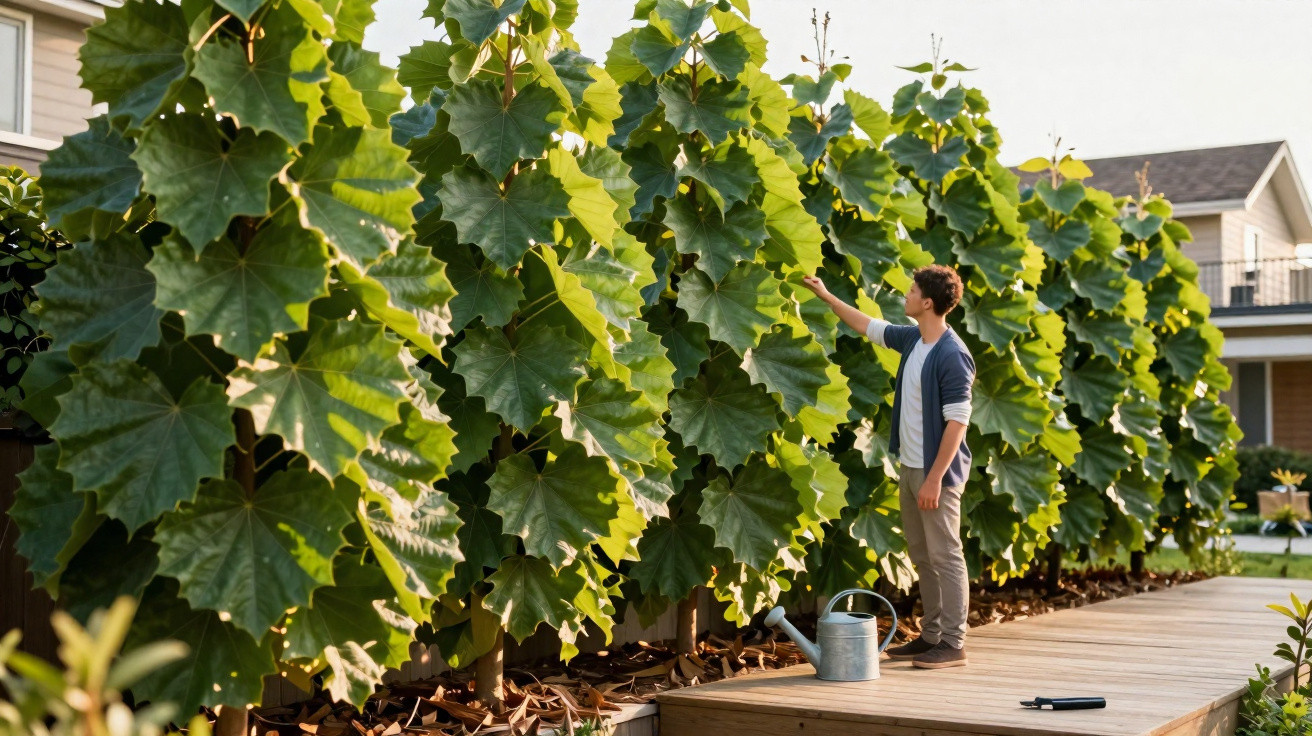
This is where the so-called empress tree, botanically known as Paulownia tomentosa, comes in. It is regarded as one of the quickest-growing deciduous trees for private gardens. In favourable conditions, it can put on up to 2 metres of growth per year.
Its secret lies in its enormous leaves. They can grow to around 60 centimetres wide and act like giant solar panels, converting every ray of light into growth. Within a few years, this produces a substantial yet airy canopy.
One practical example involved three paulownias planted in a row, each four metres apart, in front of a two-storey house with balconies. After roughly three years, the green screen had already reached more than five metres in height. From May to November, it blocked every view from the neighbours – from ground level to the upper floors.
After only three growing seasons, a dense seasonal privacy screen is created, turning patios and gardens back into places of retreat.
As the tree is deciduous, its screening effect is strongest in the warmer months – precisely when people spend time outdoors. In winter, the garden becomes more open and brighter again, which many people find pleasant.
Creating dense privacy screening in only three years
For a young paulownia to become an effective “green curtain”, choosing the right site and providing care during its first few years are especially important.
The right planting time and location
- Planting time: autumn or early spring
- Soil: deep, well-drained and not permanently wet
- Light: sunny to very bright; more sun means more growth
Loose, nutrient-rich soil gives the tree a turbocharged start. It does not tolerate waterlogging well, and it also struggles with drought stress during its first years.
Recépage: the crucial technique for maximum density
One specialist term is central to growing an empress tree: recépage. It refers to a radical but deliberate form of pruning.
This is how it works:
- At the end of the first winter, cut the trunk back to around 10 centimetres above ground level.
- Several fresh shoots will emerge from the base.
- During the second year, retain 3 to 4 strong shoots and consistently remove the rest.
This treatment encourages stronger branching, creates denser crowns and makes the tree much more closed as a privacy screen. Without this “training”, a paulownia quickly grows taller but remains comparatively open and sparse.
Watering and mulching: the first years are crucial
Water generously during the first two summers. During dry periods, around 20 litres of water per week for each tree is a useful general guide. A thick mulch layer of bark mulch, woodchip or leaves reduces evaporation and keeps the soil moist for longer.
Following this approach lays the foundations for the impressive growth of up to two metres per year.
Spacing, legal rules and roots: what neighbours should know
Before putting a spade in the ground, it is worth checking neighbour law. In many cases, the relevant rule is that a tree taller than two metres must be planted at least two metres from the property boundary.
If it is planted closer to the boundary, the tree must not exceed the two-metre limit. However, that removes exactly the screening effect it is intended to provide. If the required distance is not maintained, a neighbour may demand corrective action, including pruning or removal.
Planning the correct distance from the boundary from the outset avoids later disputes and costs, while protecting good relations with the neighbour.
There is another factor to consider: paulownia roots have almost as much energy as the crown. Near patio slabs, walls or house foundations, a root barrier is advisable, such as robust membrane or a plastic barrier extending at least one metre into the ground. This helps keep paved surfaces and structures stable over the long term.
Privacy screening through the seasons: combining elements cleverly
The empress tree carries its foliage from late spring through to autumn. During this period, it provides almost complete screening. In winter, its crown is considerably more transparent. Those wanting fewer sightlines at this time can combine it with other features.
Suitable additions include:
- a narrow evergreen hedge at knee to chest height
- a light pergola over the seating area with climbing plants
- trellis with slow-growing evergreens to complement the tree canopy
This creates balanced year-round privacy without making the garden feel heavy or confined. With its spectacular foliage, the paulownia remains the main feature, while lower companions primarily fill gaps in winter.
Opportunities and risks: who the empress tree really suits
The empress tree is particularly well suited to medium-sized and large gardens where leaving a few metres between it and the property boundary is not a problem. In small terraced-house gardens, it can quickly become too dominant if allowed to grow unchecked.
Anyone planting one should be willing to carry out some gardening maintenance: regular pruning, managing shoots and monitoring the roots. In return, the tree offers several benefits:
- a rapidly growing green “wall” without the cold appearance of concrete
- large leaves that create a distinctive, almost exotic feel
- shade during high summer without completely darkening the garden
As a deciduous tree, the empress tree sheds many leaves in autumn. Anyone who prefers a very tidy garden style should expect some extra sweeping and raking. The soil benefits in turn, as the leaves can be composted or used as mulch.
The tree is also interesting from a gardening perspective: terms such as recépage show how extensively its shape and density can be controlled. In effect, the right pruning technique turns a fast-growing tree into a tailored garden feature – somewhere between a tree, a large shrub and a natural privacy wall.
Anyone who plans carefully, observes the legal requirements and gives the tree some attention in its early years can use Paulownia tomentosa to regain the feeling of being completely private in their own garden within a remarkably short time.




Comments
No comments yet. Be the first to comment!
Leave a Comment