
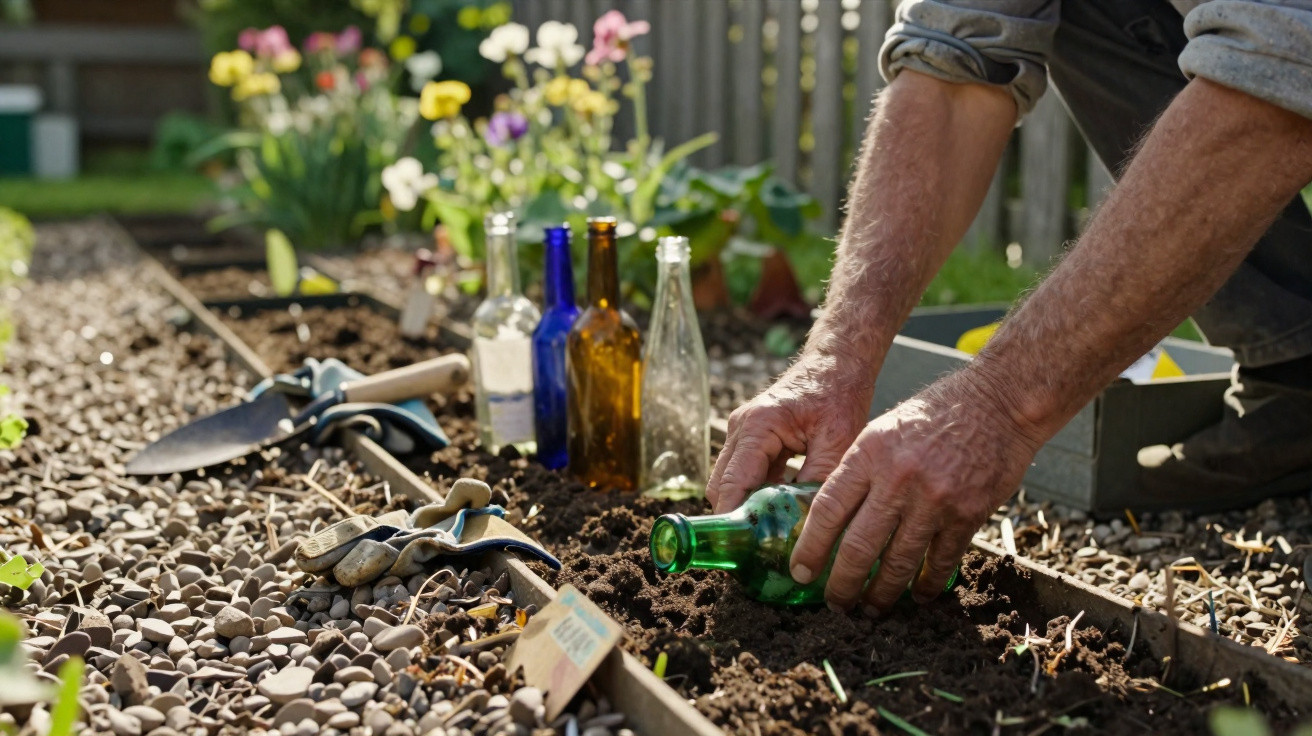
One Sunday morning, in an old village garden, long grass almost conceals an unusual edging: the bases of green, brown and clear bottles, pushed upside down into the ground along a path. Some have lost their shine, while others still catch the sunlight like tiny pieces of stained glass. At first glance, it might seem like a forgotten whim or a makeshift feature with little purpose. Yet previous generations did not create it solely for decoration. During the 1970s, many households kept empty bottles rather than throwing them away, turning them into sturdy borders for vegetable plots and flowerbeds. Today, the idea is returning to gardens, driven by an interest in reuse and uncomplicated landscaping. This small detail is worth a closer look.
A humble-looking border filled with memories
The method was disarmingly straightforward: bury glass bottles upside down, side by side, with their rounded bases left showing. This created a clear division between a path and cultivated soil, without the need to buy plastic edging or paving slabs. In small gardens, that separation made a real difference. It stopped newly turned soil from spilling onto the walkway, kept woodchip or gravel in place, and gave the vegetable garden a tidier appearance. We all know how a garden can suddenly feel calmer simply because its areas are more clearly defined. Bottles provided exactly that, for next to nothing and with a little patience.
In parts of rural France, lemonade, wine and beer bottles formed uneven lines around vegetable beds. A standard bottle measures between 28 and 32 centimetres: by sinking it roughly halfway into the ground, gardeners created a low yet visible barrier that did not interrupt the view. Green glass was often the most common, simply because there was little choice, although mixed colours could produce an unexpected effect after rainfall. One retired woman from Yonne recalled finding the border her father had installed in 1974 beneath a patch of brambles. Several bottles were still in position. Not bad for a material thought to be temporary.
This approach also followed a very practical logic: in the past, people did not fill a car boot just to buy every small garden accessory. They used whatever was available at home and improvised from there. Glass is inert and moisture-resistant; unlike wood, it does not rot, and unlike certain metals, it does not rust. It does not feed the soil or miraculously protect plants, but it holds a boundary. That is its genuine purpose. A garden does not always require a brand-new solution to become a more pleasant place to spend time. Nostalgia undoubtedly contributes to its appeal, but the idea remains remarkably relevant.
Installing bottle borders without turning a path into a hazard
To make a bottle border, begin by marking out a gentle line using string or a garden hose laid on the ground. Then dig a shallow trench, 12 to 18 centimetres deep depending on the bottle size, and position the bottles neck-down, almost touching one another. Their bases should protrude enough to be seen, but not so much that they obstruct a lawnmower or wheelbarrow. Replace the soil around the necks, firm it down by hand, then water lightly to help the whole arrangement settle. Thick, uncracked bottles with similar shapes give a more even finish. A slightly curving line also makes minor height differences less noticeable.
The most common mistake is collecting every available bottle without checking its condition. A chipped or weakened bottle may break under a kick, frost, or the weight of a wheelbarrow wheel. It is better to reject very thin examples, cracked bottles, and any with an existing impact mark on the base. Wear thick gloves, especially while pushing them into place. Let us be honest: nobody does this every day, so it is worth taking the time to do it properly. In a garden used by young children, animals or older people, low untreated timber or brick edging may remain a more reassuring option.
Before you begin, keep one straightforward rule in mind: this technique works primarily as a visual divider, not as a defensive barrier against slugs, cats or roots. An amateur gardener from Dordogne puts it sensibly:
“Bottles do not make tomatoes grow; above all, they stop you walking on soil you have just worked.”
- Select bottles that are intact and reasonably thick.
- Set them deeply into the ground to reduce the risk of tipping.
- Avoid areas used barefoot or crossed by a lawnmower.
- Keep the colours consistent if you want a discreet finish.
The most attractive result rarely comes from perfectly straight alignment. It comes from a stable border, installed at a consistent height, that looks as if it has always belonged there.
The quiet return of an almost forgotten garden practice
This rediscovery says something about the present day. After years of heavily equipped gardening, many householders are looking for options that cost less, feel less standardised and offer a more personal touch. Upside-down bottles will not replace professional edging in a large landscaping scheme, nor are they suitable for every type of ground. Even so, they revive a valuable idea: an everyday object can enjoy a useful second life before entering the recycling stream. In a garden, that second life becomes visible. Every bottle base catches the light, defines a route and evokes a family habit. Reuse then takes on a tangible form, far removed from broad statements.
| Key point | Detail | Added value for the reader |
|---|---|---|
| Primary function | Define paths, flowerbeds and vegetable plots | A neater garden without costly materials |
| Benefit of glass | A durable, reusable material that resists moisture | A simple, decorative reuse solution |
| Essential precaution | Use undamaged bottles, bury them securely and keep them away from heavily used areas | Reduces the risk of breakage and injury |
Comments
No comments yet. Be the first to comment!
Leave a Comment