
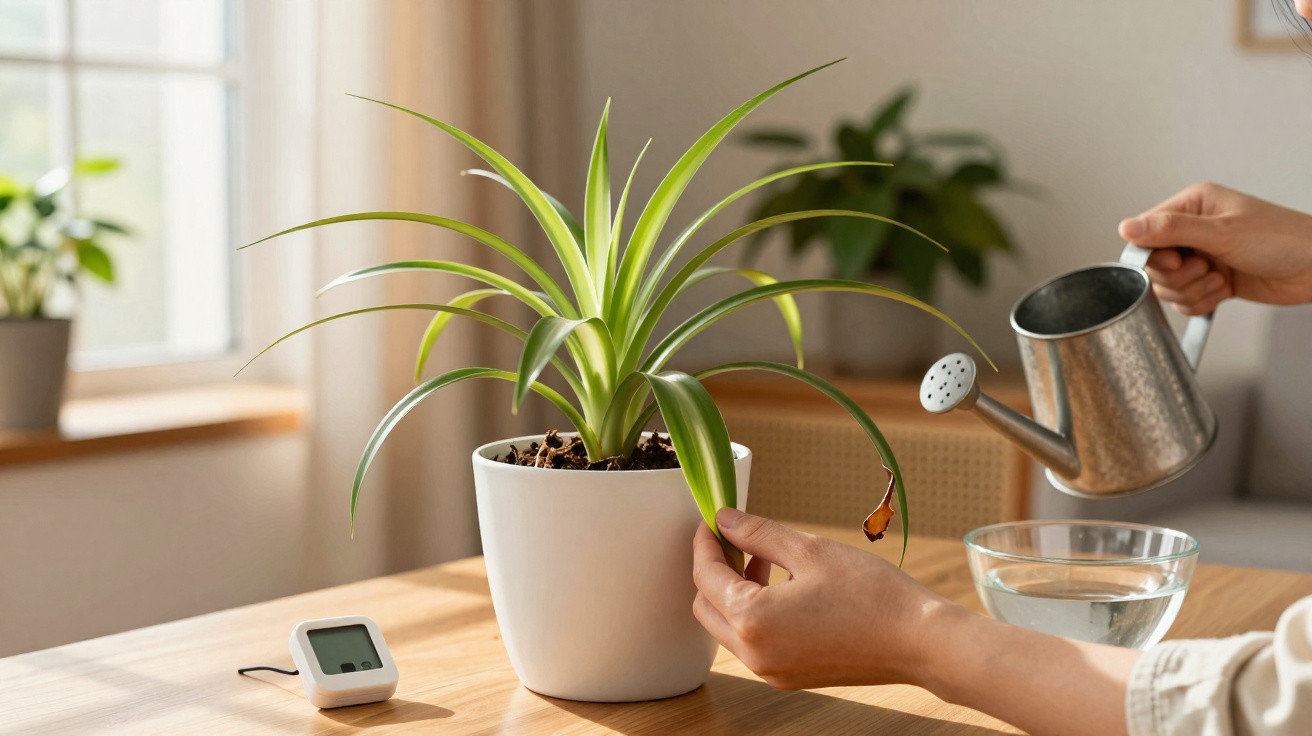
Many owners only realise how serious the issue is once several leaves have bent, faded or even snapped off. At that point, uncertainty is often high: too much water? Too little? The wrong position? Learning to read what the leaves are saying can limit the damage and help the plant recover its shape.
What a healthy spider plant really looks like
A thriving spider plant (Chlorophytum) is recognisable at a glance. Its leaves are vivid green, with white stripes depending on the variety, and are long and supple. They emerge densely from the centre before arching softly outwards, almost like water from a fountain.
They should feel flexible to the touch. If you run a finger along a leaf, it should not retain a sharp crease. The central rib should follow the same gentle curve. Even particularly long leaves look “alive”, rather than leathery or dull.
Damaged leaves look distinctly different. A genuine, concerning crease can be recognised by:
- a clear, visible angle, as though the leaf had been folded
- a noticeable ridge when you run a finger across it
- soft, mushy or yellowish areas around the bend
- or extremely dry, brittle sections that break immediately when bent
These signs indicate that the internal vascular tissue has been damaged. Water and nutrients can then move through the leaf only to a limited extent, while photosynthesis works far less effectively. The leaf is no longer functioning properly – and in most cases, it will not recover.
Mechanical damage or a care problem? How to tell the difference
Start by checking the obvious causes: pets, children and cramped window ledges. A pot that has fallen, a leaf trapped between a wall and a decorative outer pot, or a cat that regularly lands in the foliage can all bend or break individual leaves without the plant being generally unhealthy.
Typical signs of purely “accidental damage” include:
- only one or two leaves are affected
- the rest of the plant has strong, normal colouring
- the compost is neither bone-dry nor soaking like a sponge
- there is no overall limpness in the plant
However, if several leaves – especially younger ones – appear bent, limp or blotchy, a care issue is almost always responsible. Incorrect watering, weakened roots or an unsuitable location are particularly common causes.
Bent leaves are not so much the actual problem as a visible warning sign coming from inside the plant.
What the condition of the leaves reveals about your watering routine
Too much water: soft, bent leaves and wet compost
If the compost feels heavy and remains damp for a long time, while the leaves develop bends, yellow areas or soft patches, overwatering is a likely cause. The roots receive too little oxygen, start to rot and become increasingly unable to supply the plant.
Common signs of excess watering:
- leaves look limp and droop more than usual
- leaf bends are often closer to the base
- yellowish or translucent-looking patches appear
- the compost smells musty and remains wet even days after watering
The only remedy here is to ease off: increase the interval between watering and wait until the top roughly 5 cm of compost has dried before watering again. If you are unsure, use a simple moisture meter to check the compost.
Too little water: brittle bends and hard leaf tips
Persistent dryness creates a different pattern in a spider plant. The compost pulls away from the edge of the pot and looks dusty, while the leaves develop hard brown tips. Bends can then occur at the slightest knock because the tissue has dried out and become brittle.
You can identify it by:
- very dry compost that has separated from the pot edge
- hard, sharp-edged breaks in the leaf
- brown tips that cannot be pressed soft
- an overall dull, tired-looking leaf colour
A thorough but controlled watering will help: water the pot slowly until water runs out from the bottom, then remove any surplus water from the saucer. Over the following weeks, aim for a more even watering pattern instead of allowing extreme dry spells.
When the roots are suffering: recognising and treating root rot
If many leaves remain soft and continue to bend even after you have adjusted watering, it is worth looking below the compost. Carefully lift the plant out of its pot.
Warning signs include:
- roots are brown, mushy and fall apart under light pressure
- an unpleasant, rotten smell
- very dark compost that stays permanently wet
In this situation, root rot is likely. Fast action may still save the spider plant:
- Let the root ball dry out, then gently remove loose, wet compost.
- Cut away all brown, soft roots with clean scissors.
- Repot it in fresh, free-draining, fairly loose compost – ideally mixed with a little sand or expanded clay.
- Water only lightly, then water far more sparingly in future.
The plant will need patience afterwards. Some specimens produce strong new growth, while others recover only partly. The crucial point is that the new pot has drainage holes and that water is never allowed to stand permanently in the outer pot.
How light and humidity affect bent spider plant leaves
Not every damaged leaf can be blamed on the watering can. A spider plant leaning strongly towards the window is usually in a position that is too dark. Its shoots stretch towards the light, the leaves become longer and softer, and they bend more easily.
A bright location without harsh midday sun is preferable, such as an east- or west-facing window. Too much direct sunlight creates different problems: scorched marks, faded areas and locally weakened sections where a leaf may later break.
Dry air from central heating also plays a part. In very dry rooms, leaves lose moisture more quickly, the tips dry out and the tissue becomes less flexible.
Stable humidity keeps leaves supple – so they do not snap immediately after minor knocks.
Practical ways to improve the room climate:
- Place a tray of pebbles and water beneath the pot, filling it to just below the surface of the stones.
- Do not position the plant directly above a radiator.
- Group other houseplants nearby, as they collectively increase humidity.
What should you do with leaves that have already bent or broken?
A severely bent leaf will not permanently straighten again. Its internal structure has been damaged. Leaving it attached is more likely to drain the plant’s energy than allow it to achieve much.
The most sensible approach is to:
- remove the leaf as close to the base as possible using clean scissors or a sharp knife
- disinfect the tool first to keep germs away
- avoid removing every leaf at once if a large proportion is affected – cut them back in stages instead
A healthy spider plant replaces lost foliage fairly quickly with new leaves from the centre. Many owners are surprised by how rapidly a dense rosette forms again after a few weeks.
Preventing rather than cutting: keeping the “green fountain” stable
If you do not want to reach for the scissors continually, establish a few simple routines. This short checklist can help reduce future damage from bent leaves:
| Problem | Action |
|---|---|
| compost is often wet | Extend watering intervals and check pot drainage |
| very dry compost, brown tips | Water more evenly and soak the whole root ball |
| long, limp leaves | Choose a brighter spot; do not place it in excessive shade |
| mechanical damage from being knocked | Hang the plant or move the pot farther from edges |
| dry air in winter | Raise room humidity slightly and avoid heated air |
Keeping a small care diary can also be useful. By recording when you repotted, fed the plant or changed its position, you can more easily identify in retrospect which change upset the balance of the leaves.
Why spider plants react so honestly
Spider plants are considered robust, yet they are also remarkably “communicative”. They respond clearly to stress – first with dry tips, then discolouration and bends, and in extreme cases with leaves that die back completely.
Their structure explains these reactions: the long, narrow leaves carry much of their own weight. Once the tissue stores less water or the vascular channels are damaged, the leaves lose their firmness. A bend is then the natural result, much like a straw that is too thin and dried out.
Anyone who learns to read these warning signs can also assess them more accurately in other houseplants. Many foliage plants show similar patterns when watering is wrong or light is insufficient, although often less clearly than a spider plant.
With a good eye for colour, firmness and growth habit, care soon becomes routine: a quick check as you walk past is enough to spot early whether water, light and air are in balance – and whether your “green fountain” is still as stable as it looks.

Comments
No comments yet. Be the first to comment!
Leave a Comment