
Fed up with your garden?
Bare, brown patches in the lawn do not have to be permanent – a straightforward trick can get rid of them within a few weeks.
Every spring, many amateur gardeners look at their lawn in dismay: yellowed areas, bare patches and dried-out islands among the green. Rather than reseeding the same troublesome spots year after year, there is a clever alternative that is much tougher than ordinary lawn seed and improves the soil too.
Why lawns are full of gaps after winter
Before looking at the solution, it is useful to understand the causes. Bare or brown areas in a lawn are often the result of:
- frost damage and waterlogged ground during winter
- dog or cat urine
- heavy wear from playing children or garden furniture
- fungal diseases or competition from moss
- insufficient water during hot spells
- nutrient-poor, compacted soil
The usual response is to scatter new lawn seed. Although it germinates, it is often just as sensitive as the original grass. This is where another approach, increasingly used by both professional and amateur gardeners in recent years, comes in.
Microclover: a small plant with a big effect on lawns
The unobtrusive star of this method is microclover, a very small-leaved form of white clover. It stays low, branches vigorously and blends almost seamlessly into a lawn.
Microclover fills bare patches, makes the lawn tougher – and supplies the soil with nutrients at the same time.
Unlike many lawn grasses, microclover needs considerably less maintenance. It:
- usually grows to only 3 to 8 centimetres tall
- spreads across the ground and rapidly fills gaps
- copes well even with poor soil
- survives dry spells better than grass-only lawns
- withstands foot traffic, games and boisterous dogs surprisingly well
Gardeners with a “problem lawn” – an area that sees heavy use or is difficult to water – often deliberately choose a blend of lawn grass and microclover instead of repeatedly reseeding and fertilising.
How microclover fills bare patches in the lawn
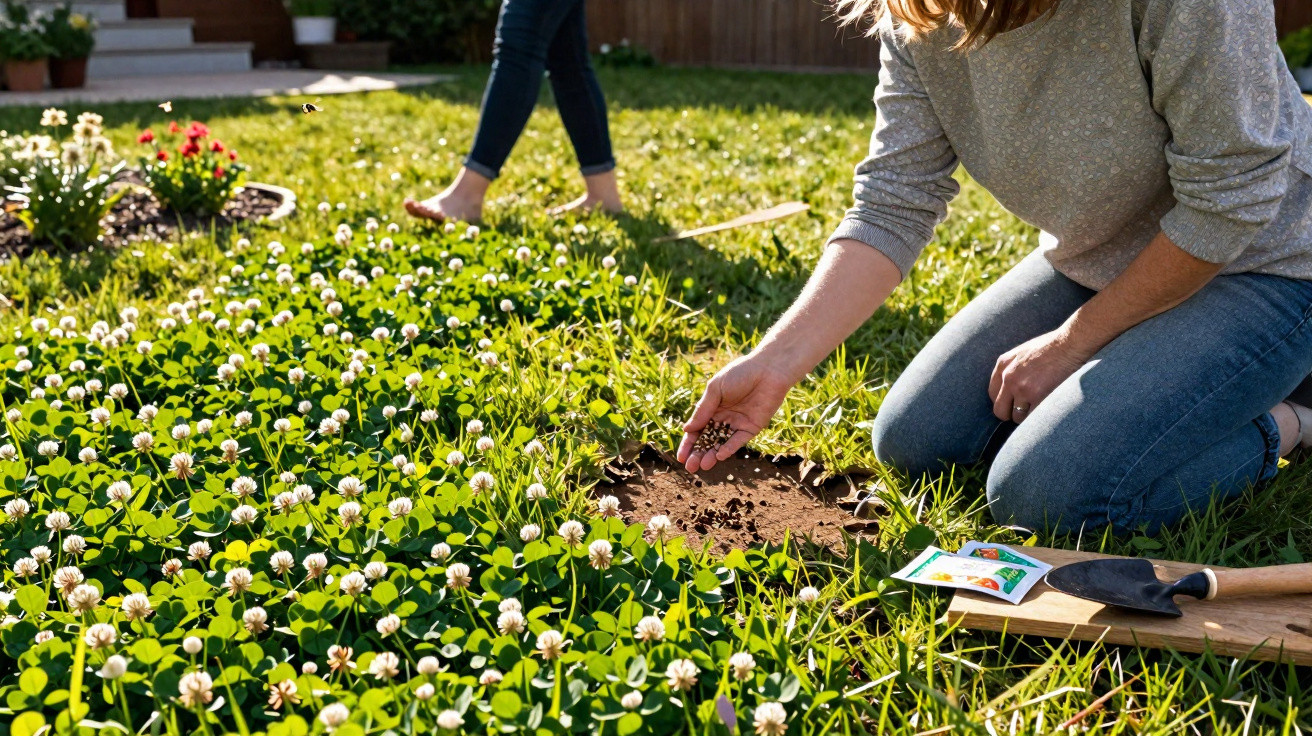
The method itself is simple: spread the seeds exactly where the lawn is sparse or has died completely. Preparing the area properly beforehand is important.
Step-by-step guide to sowing microclover
- Clear the bare patches: Thoroughly remove dried grass, moss and weeds. The cleaner the ground, the better the seeds can germinate.
- Loosen the soil: Use a rake or a small cultivator fork to break up and lightly loosen the top layer. This improves contact between the seed and soil.
- Level the surface: Roughly level the soil and break up larger clods. A reasonably fine seedbed supports germination.
- Mix the seeds: Combine the microclover seed with some fine soil or, if preferred, a small proportion of lawn seed. This helps distribute it more evenly.
- Sow: Scatter the mixture thinly over the prepared areas. Do not sow too densely, so the plants do not crowd one another later.
- Press down lightly: Gently firm the surface using your hand, a board or the soles of your shoes, ensuring the seeds make contact with the soil.
- Water in: Water the areas thoroughly but gently, so that nothing is washed away.
During the first few weeks, the soil must not dry out. A fine spray early in the morning or late in the evening is ideal. Once a thick green covering has formed, normal watering can resume.
The ideal time: starting early pays off
Anyone planning to use microclover should not wait too long. Early spring is the best time, once the soil is no longer frozen and has warmed up somewhat.
Sowing in spring gives the plants a head start before the summer heat – and saves stress at the height of summer.
Young plants need several weeks to establish a strong root system. If they are already growing well by the time the first heatwave arrives, they will withstand dry periods far better than newly sown lawn grasses planted in June or July.
Less fertiliser, less hassle: how microclover benefits the soil
Microclover is a legume, meaning that it uses root nodule bacteria to capture nitrogen from the air. Over time, this nitrogen enters the soil and becomes available to the lawn.
This brings several advantages:
- The need for mineral lawn fertiliser drops considerably.
- Nutrient supply becomes more even.
- The turf remains denser and more vigorous.
Those who currently fertilise several times a season can often reduce this with a clover-grass mix. At the same time, the clover’s root mass helps counteract soil compaction – a benefit in gardens where people often walk or play.
Where microclover works particularly well – and where it does not
Microclover is not right for every garden, but in many situations it is an extremely practical addition to a traditional lawn.
Particularly suitable for
- family gardens with children at play
- areas regularly used by dogs
- sunny to partially shaded positions
- gardeners wanting to reduce their fertiliser use
- fine-cut lawns that still need a more stable root network
Less suitable for
- formal ornamental lawns in a golf-course style, where completely pure grass is required
- deeply shaded corners beneath dense trees
- heavily waterlogged soils with no drainage
Anyone seeking a flawless carpet lawn without a single “foreign” leaf will probably not be happy with microclover. For people who enjoy lively, resilient greenery, however, the mix is often exactly what they need.
Year-round care: what changes and what stays the same
A lawn containing microclover requires slightly different care, although it remains easy to manage overall:
| Care task | Grass-only lawn | Lawn with microclover |
|---|---|---|
| Mowing | Regularly, often cut very short | Mow normally but not too low; clover regrows quickly |
| Fertilising | Usually 2–3 times a year | Can be greatly reduced, sometimes only 1 application is needed |
| Watering | Sensitive to drought | More resilient and better able to tolerate brief dry spells |
| Recovery | Gaps must be reseeded | Clover spreads and fills many gaps by itself |
When mowing, avoid cutting the lawn too short so that both clover and grass retain enough leaf growth. A cutting height of around four centimetres has proved effective.
Flowers, bees and a barefoot feel: how microclover changes the lawn’s appearance
Depending on the variety, microclover develops small, discreet leaves followed by delicate flowers. These are generally subtle in mixed lawns, although noticeably more insects will buzz around the area in summer.
Those who enjoy walking barefoot across the lawn will notice the difference: the surface becomes softer and more springy. A greater proportion of flowers in the garden may be an issue for people with pollen allergies, though this depends greatly on individual sensitivity.
There is another benefit: at the height of summer, a clover-enriched lawn often stays richly green for longer, while grass-only areas quickly become patchy. The places that were once bare are then often covered by a dense, clover-rich carpet.
Practical tips for getting started with microclover
Anyone wanting to try this method can begin on a small scale by treating only the worst problem areas first. A few practical pointers:
- Use only certified seed from a specialist retailer.
- Do not sow too thickly – the plants will branch out by themselves.
- Keep the ground consistently moist while the plants are establishing.
- Keep children and pets away from the areas for the first few days, until seedlings become visible.
Depending on the weather, it will become clear after two to four weeks whether sowing has been successful. Many gardeners then decide to enrich further areas with microclover, as the difference in everyday use soon becomes apparent.
For anyone frustrated by the same brown patches in their lawn year after year, microclover can be a genuine breakthrough: less work, less fertiliser, more rich green growth – and a lawn that does not become a source of stress with every hot summer.




Comments
No comments yet. Be the first to comment!
Leave a Comment