
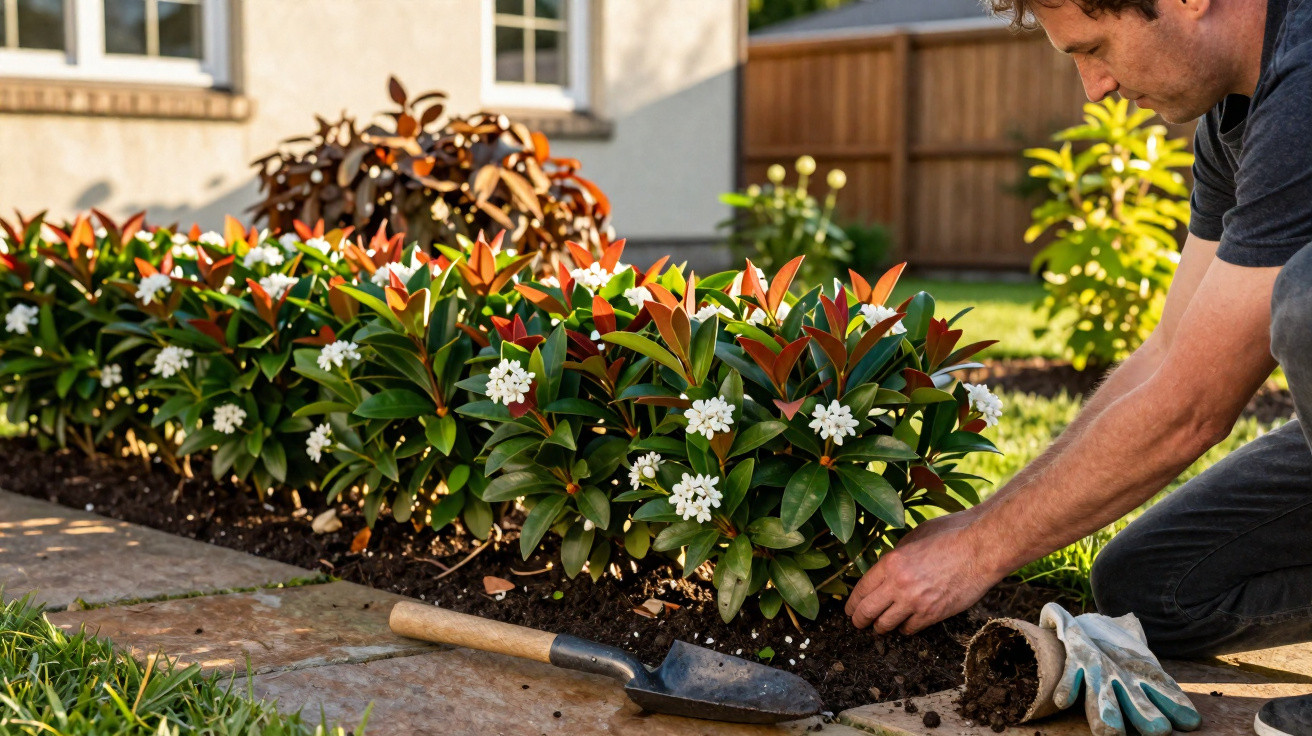
In countless new housing developments, the vivid red Photinia hedge has been the default choice along fences and property boundaries in recent years. That picture is now changing: fungal diseases are taking a heavy toll on the shrub, leaving entire rows bare. Garden designers expect another shrub with colourful, hardy foliage to take its place in many gardens by 2026 - with considerably less maintenance required.
From Thuja walls to the standard red hedge
For a long time, Thuja was the undisputed option for anyone wanting to screen off a plot quickly and cheaply. These evergreen conifers grew densely, creating tall, dark barriers that reliably kept prying eyes out. At the same time, they depleted soil nutrients, provided insects with very little food and made streetscapes look monotonous.
Problems began to emerge from the 2000s onwards. Fungi including Pestalotiopsis and Phytophthora severely affected many Thuja hedges. Entire stretches failed, turned brown or died back in patches. Many garden owners did not want to expose themselves to the same risk again.
Photinia, usually the ‘Red Robin’ variety, moved into this gap. Its principle was similar: a clipped, enclosed hedge, but with extra visual appeal. New shoots emerge in brilliant red before later turning dark green - an effect that was especially sought-after in spring.
“Photinia was regarded as the perfect all-purpose hedge: evergreen, fast-growing, readily available and with spectacular red new growth.”
Many garden centres converted almost their entire hedge section to this shrub. What few people anticipated was that the climate would change, taking the risk of disease with it.
Why Photinia hedges are now failing in large numbers
Milder winters and damp springs provide ideal conditions for one fungus in particular: Entomosporium maculatum, which causes Photinia leaf spot disease. Plant disease specialists have observed this pathogen spreading rapidly for several years.
The infection begins as small reddish spots on the leaves. They expand into brown patches, the tissue dies and the leaves can no longer photosynthesise. Soon afterwards, they turn yellowish and drop.
In densely planted hedges, just one wet season can be enough to reduce foliage by between 15 and 30 per cent. If this happens repeatedly over two or three years, little more than a framework of bare branches often remains.
- small red dots - the first signs of fungal infection
- brown, sunken spots - dead leaf tissue
- severe leaf drop - gaps in the hedge and loss of privacy
- considerable effort - continual trimming, leaf collection and spraying are needed
Garden experts now consider the decline of many Photinia hedges virtually irreversible, at least in particularly mild, damp areas. Anyone planting now is looking for alternatives.
A new favourite: why Pittosporum is succeeding Photinia
Pittosporum, often sold under its botanical name or as pittosporum, has long been familiar in mild areas. Until now, it was found mainly in coastal gardens or sheltered urban spaces. Climate change is increasingly extending where it can be used further inland.
“Pittosporum combines permanently dense foliage with markedly fewer disease problems than Photinia - making it the preferred choice for many designers.”
Its main advantages include:
- evergreen, dense foliage - ideal for privacy screening
- moderate growth of around 20–30 centimetres annually - easy to manage and not prone to rampant growth
- many varieties with variegated or glossy leaves - providing greater visual variety
- relatively undemanding requirements for water and soil - provided it is not left permanently wet
- noticeable resilience against the leaf fungi that cause such problems for Photinia
In practical terms, a Pittosporum hedge normally needs only a light annual shaping cut to stay dense enough for privacy. While Photinia owners may be battling fungicides, bags of fallen leaves and repeated remedial pruning, this hedge is more likely to need a trim with hedge shears and occasional organic fertiliser.
An example from a terraced-house garden
The experience of many homeowners follows a familiar pattern. A woman had a 20-metre Photinia hedge planted several years ago. After three mild, wet winters, large parts of the row were almost leafless, allowing neighbours an unobstructed view into the garden. Replanting the whole hedge with the same species would mean more work and substantial expense - with no guarantee of success.
The answer is to replace the old plants gradually with Pittosporum. Within only two to three years, a dense privacy screen forms again while requiring far less upkeep. For many garden owners, this is much more appealing than the ongoing stress of ailing Photinia rows.
Why single-species hedges are becoming outdated
Even where Pittosporum performs well, many specialists now advise against hedges consisting of only one species. Thuja, cherry laurel and Photinia have followed the same pattern for decades: one shrub becomes fashionable, spreads throughout entire residential areas, then a disease or new pest arrives and affects whole streets.
Landscape architects now place greater emphasis on mixed hedges. The reason is straightforward: the more diverse the species, the lower the likelihood that one fungus or insect will ruin the entire planting.
“Anyone who combines different shrubs gets a more attractive, more resilient and less stressful hedge in the long term.”
What a resilient mixed hedge can look like
Typical combinations for gardens in central Europe include:
- Pittosporum as an evergreen foundation with decorative foliage
- Elaeagnus ebbingei (Ebbing’s silverberry), with silvery leaves and high tolerance
- hazel as a classic native shrub that provides food
- Cornus sanguinea (common dogwood), for colourful stems in winter
This produces a hedge that looks different in every season: flowers in spring, fruit clusters in late summer and colourful bark in winter. It also attracts substantially more birds and insects than a uniform, tightly clipped wall.
Practical advice on moving away from Photinia
Anyone with badly damaged hedge rows should not simply plant new specimens of the same species into the gaps. Fungal spores can survive in fallen leaves, soil and woody debris.
- Remove severely infected plants completely, including the rootball.
- Do not compost diseased leaves or prunings; dispose of them with general waste or through local authority collection points.
- Leave the soil to rest for several months and avoid watering it continually where possible.
- Plan replacement planting with as many mixed species as possible - using Pittosporum as the main component, but not the only one.
Those unsure which varieties will cope with winter at their location should speak to a local tree nursery. Pittosporum tolerates light frosts well, but in severe frosts at higher elevations it needs a sheltered position or winter protection.
What garden owners can expect by 2026
Many specialist firms expect a significant change in German and Austrian terraced-house gardens over the next two or three years. Remaining old Thuja will disappear, weakened Photinia hedges will fail, and more varied hedges with new leading shrubs will replace them.
Pittosporum is likely to play a key role, particularly in warmer regions and cities. Other hardy shrubs with similarly low maintenance needs are suitable for cooler locations. The overarching trend is clearly towards mixed, climate-resilient hedges that provide both privacy and habitat.
Anyone replanning today should look beyond the next season and consider the next ten to fifteen years. A hedge that grows more slowly but remains healthier saves a great deal of work, stress and money. It also makes the garden livelier, with more birds, more flowers and more colour throughout the year.
Comments
No comments yet. Be the first to comment!
Leave a Comment