
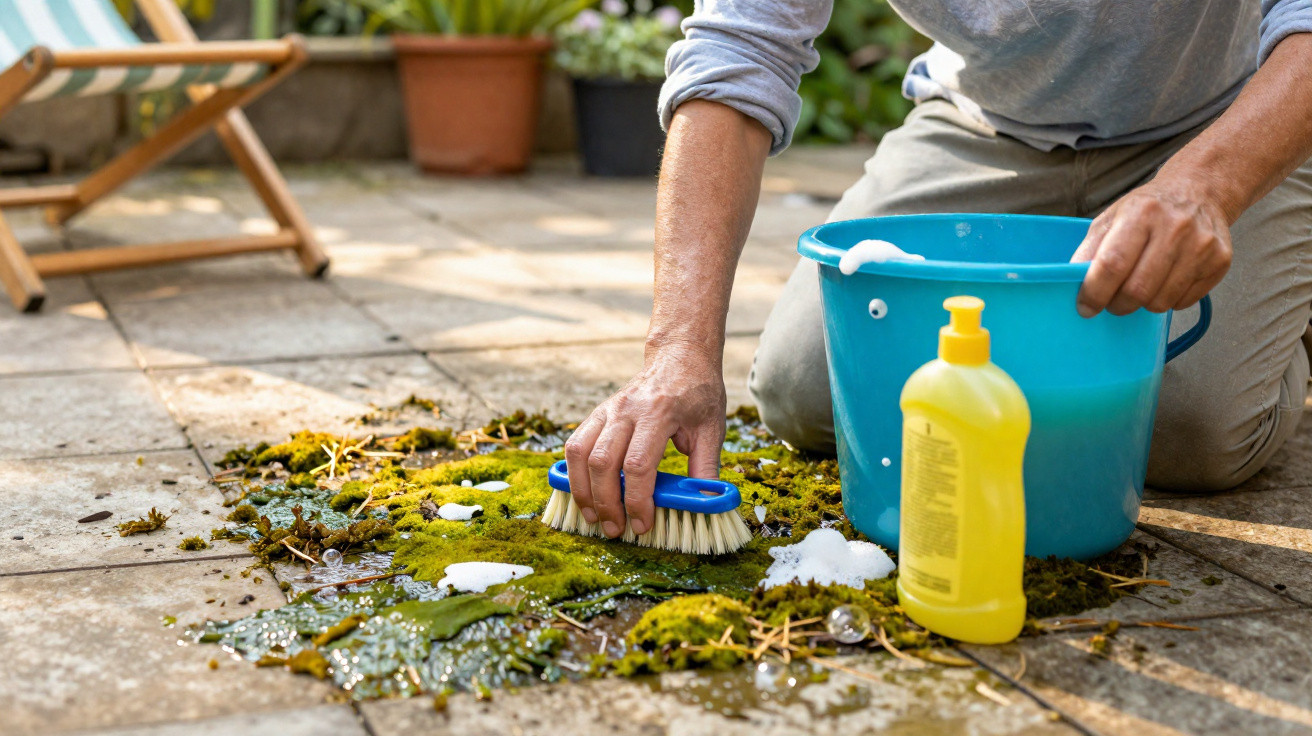
Many homeowners do not realise that removing the slippery layer does not require either a pressure washer or harsh chemicals. Gardening professionals recommend a straightforward kitchen staple that tackles moss and algae at their source – and can keep them away for months.
Why patios keep developing algae
Moss and algae thrive in shaded, cool places that remain damp. Those are precisely the conditions found on many patios: a north-facing position, paving that dries poorly, and puddles after every shower. Following an especially wet winter, the surface can quickly become a green, slippery hazard.
This is more than an appearance issue. Slipping on slick steps can result in bruising or broken bones. The surface itself may also suffer: moss holds moisture against it like a sponge. Concrete and natural stone can eventually develop fine cracks, while timber can begin to rot if it never dries out properly.
Many homeowners instinctively reach for a pressure washer, only to find another green coating appearing a few weeks later.
Why a pressure washer can do more harm than good
Garden designers have warned for years against using excessive pressure on patio paving. While the jet removes the visible growth, it also wears away the material’s top layer. Concrete pavers and soft natural stone can develop rough microscopic surfaces, allowing fresh dirt to cling even more readily.
The second issue is the joints. This is where the most resilient moss and algae spores live. A water jet usually cleans only the middle of each slab, leaving green growth along the edges – the very places where moisture lingers longest. The familiar result is pale centres with dark borders.
For this reason, many people turn to specialist moss and algae cleaners. However, these often contain biocides that may harm aquatic organisms and soil life. Label warnings advising users to wear protective gloves and avoid drains are a reminder of this. That is hardly reassuring for an area where children play and pets run around.
“A gentler approach: washing-up liquid at the right dilution loosens the growth, reaches spores in the joints, and protects both the paving and the garden.”
The washing-up liquid trick: how the method works
The principle behind this trick is the chemistry of washing-up liquid. It contains substances known as surfactants. These break down the protective waxy coating around moss and algae. The plants lose moisture, dry out and die. At the same time, the soapy mixture works its way into tiny cracks and joints where spores are concealed.
For patios, choose a mild, biodegradable washing-up liquid with no bleach, ammonia or harsh fragrance ingredients. This allows the paving to be treated without unnecessarily affecting nearby beds, lawns or soil organisms.
Many amateur gardeners also use vinegar or bicarbonate of soda. These can work in isolated spots, but they have drawbacks:
- Vinegar may etch calcareous natural stone, such as limestone, and cause permanent discolouration.
- Bicarbonate of soda and washing soda often leave white deposits and require plenty of water to rinse away.
- Washing-up liquid dissolves more easily, works across the whole surface, and can simply be swept away and rinsed off.
Step by step: tackling green growth with a bucket
Only a few items are needed, most of which are already available in a typical household.
Equipment to prepare
- A bucket containing around 4 litres of warm water
- 3 tablespoons of mild, biodegradable washing-up liquid
- A sturdy outdoor broom or scrubbing brush with synthetic or natural bristles
- Work gloves
- Optionally, a watering can or garden sprayer for larger areas
A practical method for patio owners
- Dry clean first: Sweep away leaves, soil and loose debris before starting. This is the only way for the solution to reach the paving surface.
- Mix the soapy solution: Fill the bucket with warm water and stir in the washing-up liquid until thoroughly combined.
- Wet the surface: Use a watering can or bucket to spread the solution evenly over affected areas, paying particular attention to joints and shaded corners.
- Allow time to work: Choose a period with several dry hours. During this time, the green film loosens and moss turns brown and crumbly.
- Brush thoroughly: Scrub firmly across the paving with the broom, then sweep up and dispose of the loosened material.
- Rinse lightly: Pour or spray clean water over the area so that soapy puddles do not run into beds or across the lawn.
For stubborn patches, repeat the process selectively after a few days. Even on the second treatment, firmly attached edges should lift noticeably more easily.
Keeping the patio clean for longer
Even the most effective clean has limited results if the area remains constantly wet. To slow moss and algae growth over the long term, make a few simple adjustments around the patio.
Common weak points and quick fixes
| Problem | Simple approach |
|---|---|
| Standing water after rain | Check guttering, inspect the slope and, where possible, add a drainage channel or gravel strip |
| Permanent shade | Cut back overhanging branches and thin hedges so more light and air reach the area |
| Large amounts of leaves and soil in joints | Sweep roughly at least once a month, and more often after storms or during autumn |
| First green films in spring | Apply diluted soapy solution immediately, before a thick layer can form |
“Those who carry out light cleaning regularly avoid the major scrubbing job – moss and algae then never have the chance to build up in layers.”
Considerations for pets, children and sensitive plants
Compared with many specialist cleaners, a mild soapy solution is considerably gentler. Even so, it is worth considering a few possible risks.
- Pets: Animals should not drink puddles of concentrated solution. Ideally, carry out the treatment while dogs or cats are indoors, and let them back outside only once the surface has largely dried.
- Young children: During the hours when the solution is working, children should not run barefoot across the patio. Once it has been rinsed away, there is no particular danger.
- Plants: Do not allow heavily soapy water to flow directly into plant pots or vegetable beds. Rinse the edges carefully with clean water.
When other methods may be appropriate
For extremely algae-covered or weathered surfaces, a bucket mixture may sometimes be insufficient. Patio owners can then combine methods: first clean roughly with plain water and a brush, then use the soapy solution to target the spores. With very porous paving, check the manufacturer’s data sheet before adopting a method for regular use.
Anyone planning a new patio can address the issue from the outset: create a gentle slope away from the house, use free-draining joints, choose light rather than very dark paving, and avoid dense planting immediately along the edge. The faster water drains away and the better the air circulation, the fewer opportunities moss and algae have to establish themselves.
Ultimately, a safe, well-kept patio surface does not require aggressive chemicals or hours of noisy pressure washing. A bucket of warm water, a little washing-up liquid, a sturdy broom and a few sensible habits are enough to keep paving dry, grippy and visually appealing for months.
Comments
No comments yet. Be the first to comment!
Leave a Comment