
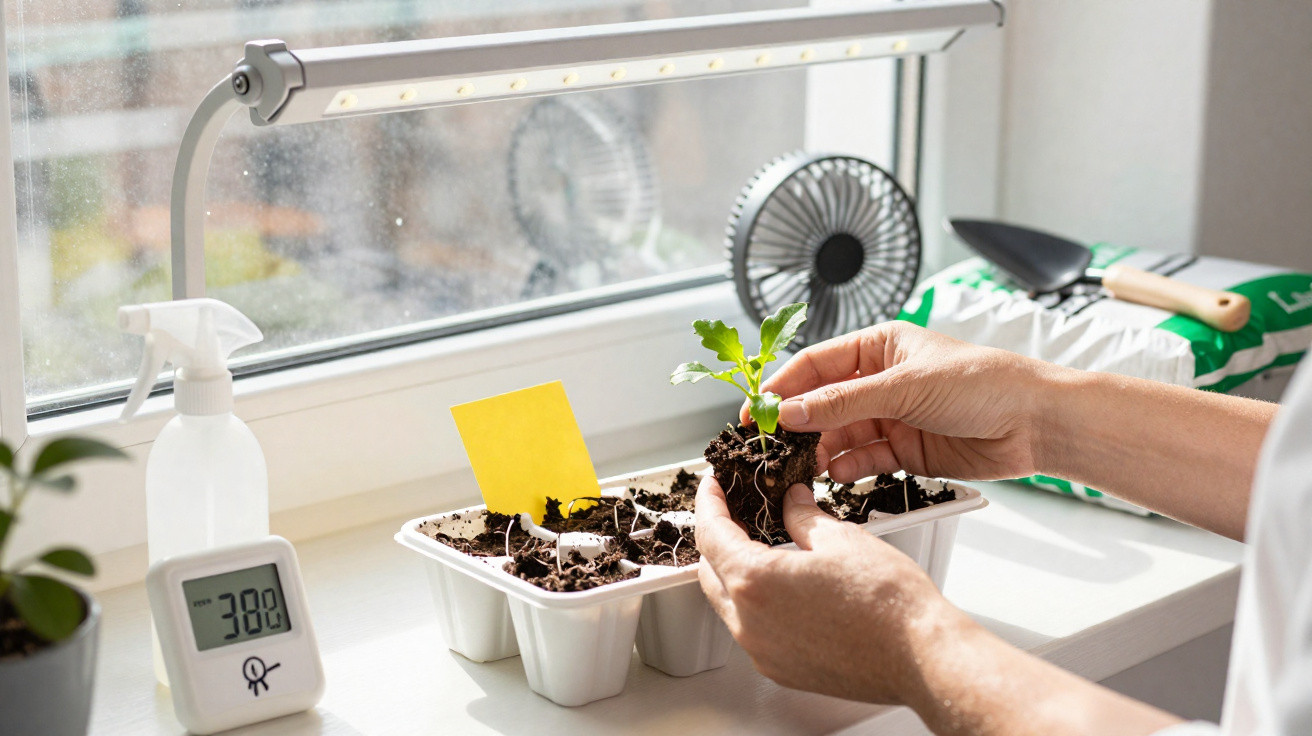
Throughout Europe and North America, gardeners begin sowing early crops well before spring officially begins. Windowsills fill with seed trays, greenhouses are brought back into use, and bags of seed compost accumulate in sheds. Fungi, aphids and gnats are equally prepared for the new growing season. February is the point at which sensible protection should begin, before issues escalate in March and April.
Why February protection makes or breaks your seedlings
Your seedlings and many fungal diseases and pests favour the same environment: warmth, moisture and soft new growth. This shared preference makes late winter particularly hazardous.
Seedlings stressed in February often stay weak for the rest of the year, even if they survive the first attack.
Conditions indoors and in greenhouses may intensify the problem. Stagnant air, overcrowded trays and excessive watering can turn seed compost into an ideal habitat for fungi and insects. Fortunately, several focused February routines can greatly reduce these dangers.
The hidden enemies waiting in seed trays
Damping-off: the classic February killer
Damping-off refers to a range of soil-borne fungal diseases that make seedlings collapse at the base before rotting, sometimes within hours.
- Stems look pinched or water-soaked at soil level
- Leaves suddenly flop, even though the compost is moist
- Whole patches in a tray die in a single day
These pathogens flourish where conditions are cold, wet and poorly ventilated – precisely the situation found on many late-winter windowsills.
Fungus gnats and other soil pests
The minute black “flies” that hover above indoor pots are fungus gnats. While the adults are largely a nuisance, their larvae feed on delicate roots and can spread disease.
Fungus gnats love constantly damp compost; their larvae can devastate young root systems before you notice a thing.
As well as gnats, aphids may gather on tender shoots, while spider mites can appear in rooms that are excessively warm and dry. Each feeds on soft fresh growth, and each multiplies rapidly.
Cold-related stress and opportunistic infections
February nights may remain severe, particularly inside unheated greenhouses. Frequent chilling damages plant cells and slows development. When plant tissue is under stress, fungal spores already present on tools or in the air can establish themselves more readily.
Building a February defence plan
Start with clean tools and healthy compost
Many issues are introduced by the gardener, through unclean pots, used compost or contaminated equipment. A straightforward hygiene routine reduces what can reach your seedlings.
- Clean trays and pots with hot, soapy water, then allow them to dry completely
- Sanitise seedling equipment using a mild bleach solution or rubbing alcohol
- Choose fresh, high-quality seed compost and avoid garden soil for fine seeds
- Keep compost indoors or in a dry shed, preventing it from becoming cold and waterlogged
Think of seed trays like a nursery ward: clean surroundings are your first pesticide.
Watering: the fine line between support and damage
Too much water provides the quickest route to disease. Young roots require air spaces just as much as they need moisture. As evaporation is limited in February, compost remains wet for longer.
Key habits:
- Where possible, water from below so the compost draws up moisture through the drainage holes
- Allow the compost surface to dry a little between waterings, particularly for herbs and Mediterranean plants
- Use water at room temperature so sensitive roots are not chilled
- Water in the morning, allowing foliage and surfaces to dry before nightfall
Light, spacing and air movement
Pale, leggy seedlings are especially vulnerable to fungal rot and attractive to pests. Light levels and spacing are as important as any product you could purchase.
Strong, stocky seedlings resist disease naturally; pale, stretched plants rarely recover from early infections.
Place trays where they receive the greatest possible amount of light: on a bright south-facing windowsill, in a greenhouse or beneath simple LED grow lights if available. Turn the trays every day to stop stems leaning in a single direction.
Once seedlings have formed true leaves, thin them or prick them out. Congested seedlings hold humidity and allow spores to travel easily between plants. Running a fan gently or airing the greenhouse or room regularly maintains airflow and helps surfaces stay dry.
Expert tactics for specific February threats
Dealing with fungus gnats without harsh chemicals
Rather than immediately using sprays, experienced growers generally combine several gentle measures. This layered method is the most effective approach.
| Method | How it helps |
|---|---|
| Drying the surface | Breaks the life cycle by denying larvae the constant moisture they need |
| Sticky yellow traps | Catches adults before they lay more eggs |
| Fine sand or grit layer | Physical barrier that makes egg-laying difficult and dries quickly |
| Biological controls (e.g. nematodes) | Microscopic helpers that hunt larvae in the compost |
In smaller home-growing arrangements, applying a surface layer of horticultural sand or fine grit, alongside more careful watering, will often resolve the issue within weeks.
Preventing damping-off in crowded seed trays
Commercial nurseries give careful attention to ventilation. Their methods can be readily adopted at home:
- Sow seeds sparsely rather than scattering them densely into a single tray
- Choose sterile seed compost instead of last year's old multipurpose compost
- Take off covers or propagator lids immediately after germination to lower humidity
- Lift trays above cold windowsills with an insulating mat or wooden board
Most cases of damping-off start with too many seeds, too much water and too little air.
Managing February temperature swings
In porches and unheated greenhouses, abrupt frosts can undo carefully planned sowing. A few simple measures help protect young plants from temperature extremes.
- Cover trays with fleece overnight to retain a slim layer of warmer air around them
- Do not stand seedlings directly on cold concrete or stone; use wooden benches instead
- Keep trays together so they benefit from a slightly warmer microclimate
When a cold spell is forecast, bring the most tender trays indoors for several nights. Avoiding stress at this stage reduces the likelihood of disease later.
Thinking like a plant pathologist at home
Professionals frequently refer to the “disease triangle”: disease requires a host, a pathogen and suitable conditions. Take away even one of these three elements and it becomes difficult for disease to spread.
Healthy plant + low humidity + clean compost means fungi must fight for every inch of ground.
If you spot leaf markings or sudden wilting, consider the disease triangle. Has your watering routine altered? Has the growing area become more crowded? Have you recently brought in fresh compost or plants? Adjusting one or two conditions usually provides more lasting control than relying on a rapid chemical treatment.
Useful terms and real-life scenarios
Terms such as “hardening off” and “systemic insecticide” are often used by gardeners without much explanation. This brief glossary is useful when you are reading advice or product labels.
- Hardening off: gradually acclimatising seedlings raised indoors to colder, windier outdoor conditions before they are planted out.
- Contact spray: a treatment that kills pests only where it physically contacts them, with minimal movement through the plant.
- Systemic product: a product taken into plant tissue and carried in the sap, affecting pests that feed at a later point.
- Biological control: the use of living organisms, including beneficial nematodes or predatory mites, in place of synthetic chemicals.
Picture two neighbours sowing tomatoes in February. One relies on old compost, waters every day “just in case” and leaves the propagator lid in place for weeks. The other sows lightly into fresh compost, removes the lid as soon as seedlings emerge and permits the surface to dry slightly between watering. By April, the first gardener is dealing with fungus gnats and drooping seedlings. The second has robust young plants prepared for pricking out, with considerably fewer pests.
Young seedlings react rapidly to good care as well as neglect. Each small February choice - the way you water, the level of light supplied and the point at which you thin - influences their resilience for months. A measured, watchful method instead of continual intervention generally produces the strongest plants and reduces the need for treatments later in the season.
Comments
No comments yet. Be the first to comment!
Leave a Comment