
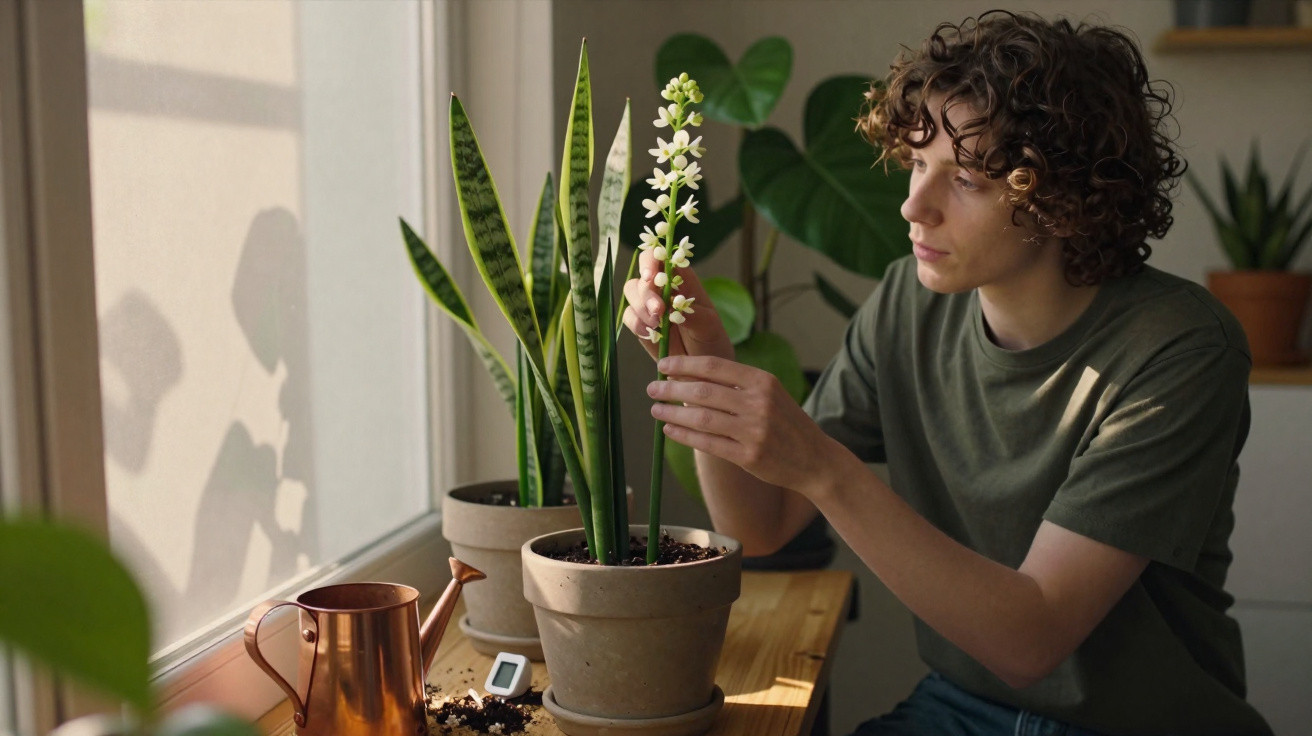
A snake plant can produce small, pale, fragrant flowers once it has matured and is grown in favourable conditions. Scientifically known as Dracaena trifasciata, it chiefly needs bright light, carefully managed watering, free-draining compost and stability in its pot, although no approach can guarantee flowering.
How much light does a snake plant need to flower?
Although it can survive in low-light settings, the plant is unlikely to flower if it spends years in a dark corner. To support its full development, place the pot where it receives plenty of bright, indirect light throughout the day and, where possible, a few hours of gentle early-morning sun.
Move it to a brighter position gradually, as leaves accustomed to shade may scorch in strong sunshine. Near a well-lit window, the snake plant can photosynthesise more effectively and store energy to develop roots, leaves and, potentially, a flowering stem.
How should you water it without hindering flower formation?
Its thick leaves retain water, so excessive moisture is more harmful than a brief dry spell. Your watering routine should follow the condition of the compost:
- wait until the compost has dried out completely before watering again;
- water the compost until water runs through the pot’s drainage holes;
- pour away any water that collects in the saucer;
- water less often in winter and in cool rooms;
- do not allow water to sit between the leaves.
Why does pot size affect flowering?
Dracaena trifasciata generally grows well when its roots are established in a container that is proportionate to the plant. An overly large pot keeps the compost damp for longer, while frequent repotting directs energy towards root growth rather than flower production.
That does not mean allowing the plant to become severely pot-bound or leaving it until the container cracks. Repot it when the rhizomes fill almost all the available space, water struggles to soak into the compost, or the roots begin to distort the pot.
What care can increase the chances of a flowering stem appearing?
Alongside light and watering, the plant requires healthy roots and a moderate supply of nutrients. The following care measures help maintain that balance:
- use compost for cacti and succulents, or another fast-draining mix;
- keep the drainage holes at the base of the pot clear;
- feed every four to six weeks during spring and summer;
- choose a balanced fertiliser and apply it at the dose stated on the label;
- avoid too much nitrogen, which encourages leaf growth instead of flowers;
- do not cut the stem while the flowers are developing.
What do snake plant flowers look like?
Flowers appear on a long stem, forming small clusters of tubular blooms in white, cream or a faint greenish shade. They may release droplets of nectar and a sweet fragrance that is more noticeable in the late afternoon and overnight.
Not every specimen flowers, even with good care, and young plants rarely produce stems. Keeping an adult snake plant in a bright place, without waterlogging or unnecessary repotting, provides better conditions for this natural cycle to occur.




Comments
No comments yet. Be the first to comment!
Leave a Comment