
The hose had been on for nearly an hour, yet the bed still seemed parched. The gardener, with their sunhat sliding sideways and T-shirt clinging to their back, pressed a finger into the soil and frowned. The upper few centimetres were wet, almost sloppy. Underneath, though, the earth crumbled dry. The flowers were surviving, but their leaves sagged by mid-afternoon in a way that revealed the strain. More water, more mulch, more “tips” from social media… but something was still not right.
They were searching in the wrong place.
Just below the surface, a thin and frequently neglected soil layer was silently determining whether each drop of water remained available or simply drained away.
The forgotten layer between roots and rock
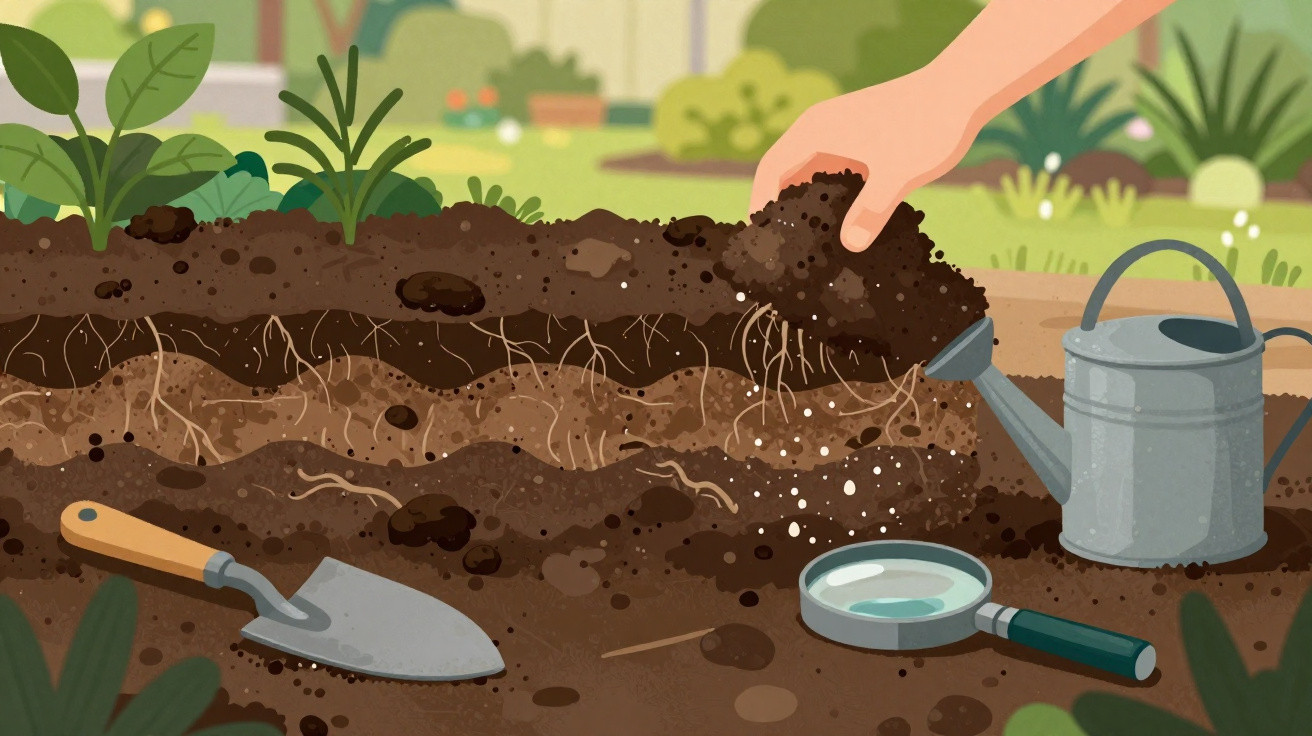
Garden guides tend to celebrate topsoil: the dark, friable layer filled with life and potential. Immediately beneath it, however, is a less conspicuous feature: the transition layer where topsoil begins to blend into subsoil. It is rarely attractive. It may be pale, dense, uneven, or flecked with gravel. Even so, this “in-between” zone is the gatekeeper for moisture.
If the layer is open and porous, water slows, moves sideways and remains around the rooting area. If it is compacted and sealed, water either rushes over the surface like a small stream or drops too deeply to be useful. You may not realise it exists until your spade strikes it.
Watch a summer downpour for a few minutes from the window and this layer is almost visible in action. On one side of the road, there may be an established garden that has been gently cultivated over many years: rain vanishes into the soil, foliage remains firm and, by evening, the whole garden looks revived. Opposite, a newer garden with compacted imported soil beneath a shallow topsoil layer behaves differently: water beads, runs, pools and, once the sun comes out, dries into a crust.
The rainfall is the same, the town is the same, but the results are dramatically different. The explanation lies precisely in the ignored transition between loose topsoil and the heavier soil underneath. It is rather like placing a sponge on a tiled floor.
Physically, this middle layer governs both the entry and storage of water. Soil particles form minute channels, allowing water to travel down while capillary tension holds it near plant roots. Heavy machinery, repeated foot traffic and years of cultivating only the surface can crush those channels. When rain arrives, it finds no straightforward route and either drains away rapidly or remains trapped in shallow pockets that evaporate quickly.
That is why you can water increasingly often while getting progressively less benefit.
How to revive the hidden sponge in your soil
Testing this layer requires remarkably little technology. Use a narrow spade or soil auger to make a straight-sided hole roughly 30–40 cm deep. Notice when the spade no longer cuts smoothly and starts to jar or bounce. That resistance, together with a shift in colour and texture, generally indicates the transition zone. Take a handful, squeeze it and then rub it apart. Hard clods that resist crumbling usually point to the bottleneck.
After identifying it, the aim is not to pulverise the layer but to carefully reconnect it with the soil above. In smaller beds, this may involve deep forking; in larger areas, broadforking may be appropriate. You can also introduce organic matter slightly deeper than normal, giving soil life a reason to travel downwards.
A frequent error is to lavish compost and mulch solely on the upper 5–10 cm and hope for dramatic results. At first, plants respond well: roots feed near the surface and the soil appears active. Then a heatwave arrives, and that thriving upper layer can dry out during one breezy afternoon. At that point, it becomes clear that your plants have been living on a balcony rather than in a house.
A better-balanced method is to create a gradient of life: rich soil at the surface, a middle layer that remains active, and soil beneath that is not lifeless. This may involve using a fork annually to make gentle cracks in the transition layer rather than turning it over. It can also mean watering more gradually, so moisture can enter small openings rather than striking a hard pan at force.
“People often tell me they have ‘bad soil’,” says Marta, a soil scientist who now advises small-scale growers. “What they actually have is a perfectly decent top layer sitting on a compacted lid. Once we break open that lid and feed life a bit deeper, water behaves totally differently.”
- Observe your soil profile - A single 40 cm test hole can tell you more about watering problems than a month of speculation.
- Loosen, do not turn - Deep turning blends distinct layers and may damage structure; gentle vertical cracks are normally sufficient.
- Feed below the surface
- Water more slowly
- Protect against compaction - Permanent paths, less heavy machinery and avoiding walking on saturated soil all help to keep this vital layer open.
A quiet soil layer with noisy consequences
Once you recognise this neglected layer, it is difficult to ignore. It clarifies why two neighbours receiving identical rainfall and growing the same plants may need to water so differently. It also helps explain why raised beds often seem more manageable: often by chance, they provide a looser, deeper active layer without a buried “cement lid” preventing water movement.
This middle layer is also where much of tomorrow’s resilience will be determined. As summers alternate between heavy rainfall and extended dry periods, a soil profile that slows, stores and gradually releases water is becoming less of a gardening indulgence and more of a survival practice. Honestly, nobody adjusts their watering routine every day. We depend on the soil to do its work when we are not paying attention.
The quiet invitation here is to dig once, think twice and work with this concealed layer rather than against it. Share the one-spade test with a neighbour and compare your findings. Beneath two gardens that appear almost identical from the pavement, entirely different stories may be developing only 20 cm below ground.
| Key point | Detail | Value for the reader |
|---|---|---|
| Hidden transition layer | The zone between topsoil and subsoil that regulates water movement | Helps explain why certain soils retain moisture for longer |
| Gentle deep loosening | Use forks or broadforks to crack compacted areas rather than turn them | Enhances retention without ruining soil structure |
| Deeper organic matter | Put compost and roots a little below the surface | Creates a living sponge that cushions drought and heat |
FAQ:
- Question 1 What precisely is this “overlooked” soil layer?
- Question 2 How far down should I dig to find out whether my soil has a compacted layer?
- Question 3 Can plants genuinely access water held in that transition zone?
- Question 4 Do I require specialist tools to improve this layer?
- Question 5 How quickly will moisture retention improve after I begin working on it?


Comments
No comments yet. Be the first to comment!
Leave a Comment