
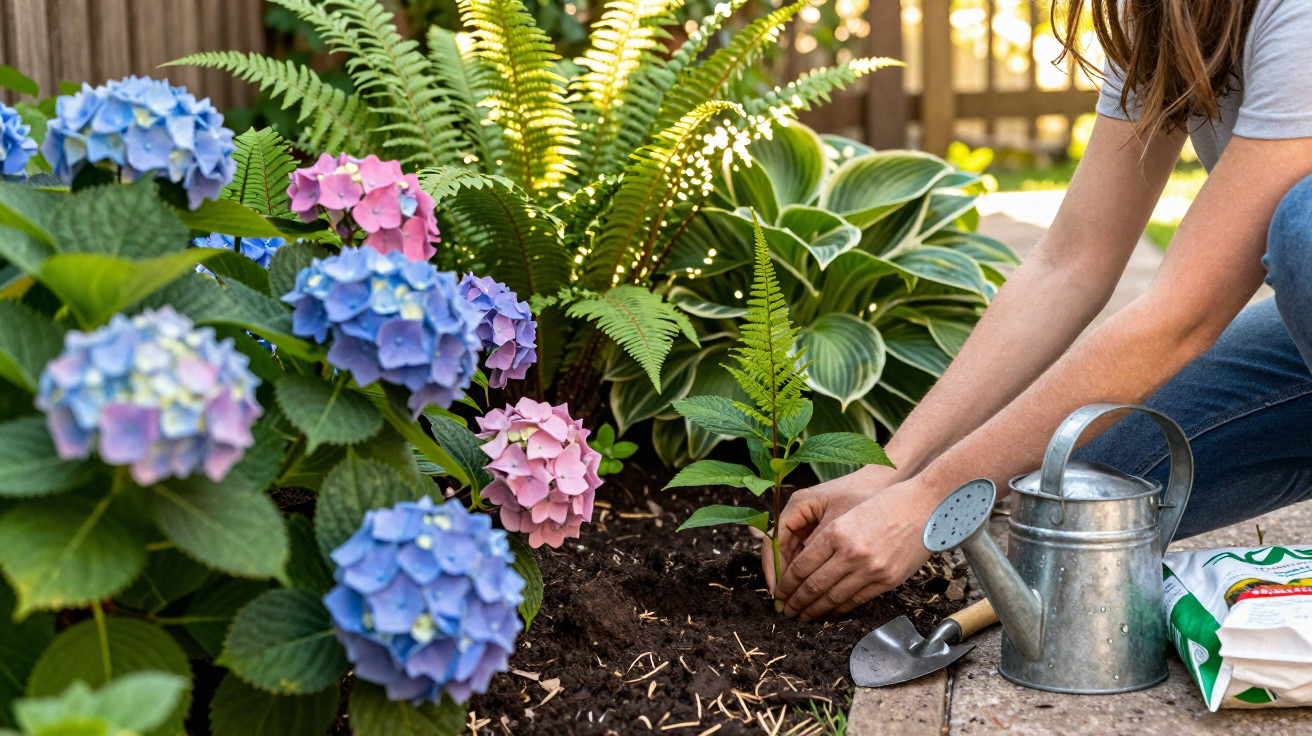
Anyone who loves hydrangeas will know the frustration: catalogues show enormous flower heads, yet at home the panicles droop, the foliage looks tired and every hot day leaves its mark. So you water more often, add extra fertiliser and dig over the soil – but the wow factor still fails to appear. The frequently overlooked solution is growing right beside them: the plants that share the bed with the hydrangeas.
Why hydrangeas need strong planting companions
Hydrangeas are not uncomplicated shrubs that can simply be planted anywhere and left alone. They need humus-rich, slightly acidic soil that stays evenly moist without becoming waterlogged. Bright shade or partial shade is ideal, such as on the north or east side of the house, or beneath a light tree canopy.
At the same time, hydrangeas are among the heavy feeders in a border. They require plenty of water and nutrients, yet react sensitively to competition from invasive weeds and intense heat. This is precisely where suitable companion plants make a difference: they help create a stable microclimate that eases the long-term strain on the shrubs.
Plant the right neighbours and hydrangeas experience less stress, less heat damage and noticeably better flower formation.
Three widely available perennials do an especially effective job while remaining easy to grow themselves: ferns, astilbes and hostas. Each is ideally suited to a typical hydrangea position and supports the shrub in its own way.
Ferns: living shade providers that retain moisture
Ferns are among the most rewarding companions for a hydrangea border. They thrive in partially shaded to shady places and tolerate the same soil conditions as the shrubs. Their dense foliage, usually with relatively shallow roots, acts like a natural mulch layer.
This offers several benefits at once:
- Soil dries out more slowly, so moisture remains around the hydrangeas’ roots for longer.
- Soil temperatures fluctuate less, helping to soften periods of extreme heat.
- Weeds have less room and light, so their growth is considerably weaker.
Even in small gardens, combining ferns with hydrangeas quickly creates an almost tropical feel, without the need to grow exotic plants that are not frost-hardy. The effect is particularly attractive when taller hydrangeas are placed at the back, with lower fern varieties arranged loosely in front.
Which ferns work particularly well?
Suitable choices include:
- Lady fern – delicate, airy foliage with a very elegant look
- Male fern – robust and well suited to more informal garden areas
- Japanese painted fern – introduces silvery-green to reddish foliage
Most importantly, do not plant ferns right up against the hydrangea stems. Leave some space for air to circulate, so the shrubs do not become “smothered”.
Astilbes: extending the hydrangea flowering season with colour
Astilbes, often sold as false goat’s beard, favour nutrient-rich, moist soil and partial shade just as hydrangeas do. Their feathery leaves provide a finer texture alongside the coarser hydrangea foliage, making borders appear more lively.
Their greatest advantage is that astilbes flower alongside hydrangeas in many regions, while their colourful, candle-like flower plumes tend to last longer. As a result, the border retains colour when the large hydrangea blooms are already beginning to fade.
Astilbes bridge the gap between peak hydrangea flowering and the later autumn colour – keeping the border attractive for far longer.
Position and care for astilbes
When planting astilbes around hydrangeas, a few basic rules should be observed:
- The soil must never dry out completely; otherwise, they shed leaves or flower much less freely.
- An annual addition of compost in spring encourages strong flower stems.
- Pale varieties in white and light pink create an airy feel, while stronger shades such as red or purple provide bold accents.
Astilbes combine well with ferns and can be placed slightly in front of them or between them. This creates a tiered arrangement: low ferns at the front, medium-height astilbes behind, and hydrangea flower heads above them.
Hostas: a leafy canopy and heat shield for sensitive roots
Hostas form the third pillar of the ideal hydrangea border. These perennials produce large, often heart-shaped leaves that spread over the ground like an umbrella. They block afternoon and evening sun, keeping the hydrangeas’ root zone cool.
They also draw the eye downwards: while hydrangea flowers cluster above, hosta leaves create a calm, even surface below. Varieties with white or yellow leaf margins also add brightness to shady corners of the garden.
One effect should not be underestimated: hostas attract slugs more strongly than hydrangea leaves do. In many gardens, feeding damage therefore ends up on the hosta rather than on the hydrangea shoots.
A straightforward planting plan for every garden
When creating a new border or redesigning an existing one, use this simple basic layout as a guide:
| Position in the border | Plant | Function for the hydrangea |
|---|---|---|
| Centre of the border | Hydrangeas | Main feature, focal point for flowers |
| Immediately around the hydrangeas | Hostas | Sun protection, cool soil, visual frame |
| Behind them / at the edges | Ferns | Retain soil moisture, suppress weeds, add structure |
| Between ferns and hostas | Astilbes | Colourful accents, a longer flowering season |
This arrangement quickly produces a cohesive, low-maintenance area that remains attractive from June well into late summer.
Care mistakes that can limit success despite good neighbours
Even with ideal companion plants, hydrangeas can suffer if a few basic principles are ignored. Common issues include:
- Waterlogging: Although their companions enjoy moisture, the bed must not sit in water, as roots will rot.
- Too much direct sun: Many positions become too hot, especially in the afternoon, even if hostas provide some shade.
- Incorrect fertiliser: Cheap general-purpose fertiliser with a high nitrogen content encourages lots of foliage but few flowers.
For new planting, loosen the soil deeply, remove thick roots and work in plenty of compost or composted bark. In areas with very lime-rich soil, specialised hydrangea compost in the root zone can help lower the pH value.
Practical examples for different garden types
In a terraced-house garden with a narrow strip along the north side, plant two or three hydrangeas in a row. Alternate hostas and astilbes in front of them, then add a few low-growing ferns at the outer edge. This makes the narrow space look like a deliberately designed shade-garden border.
In larger gardens, create a semicircular hydrangea grove with a seating area at its centre. Edge the circle of shrubs with a band of hostas, followed by loose strips of ferns behind them. Group astilbes at the transitions to lawn or path.
What many overlook: microclimate and long-term impact
Once ferns, hostas and astilbes have become established, they noticeably alter the microclimate. Soil stays cool for longer, humidity within the planting rises slightly, and wind hits the hydrangeas less severely. The contrast is especially clear in hot summers: while isolated hydrangeas often look limp, shrubs in a well-balanced perennial planting remain visibly fresh for longer.
At the same time, maintenance requirements fall. Once the bed has filled out, there is no need for constant weeding or daily watering. Many amateur gardeners report that, after making this change, they are more likely to thin out their hydrangeas than support them, because the shrubs grow more vigorously and produce more shoots capable of flowering.
Those who follow the basic principle of “hydrangeas in the centre, perennial helpers all around” can also add to these three groups, for example with shade-tolerant grasses or spring bulbs. The core idea remains unchanged: the right neighbours reduce stress for the shrubs and visibly bring more flowers from every hydrangea.
Comments
No comments yet. Be the first to comment!
Leave a Comment